
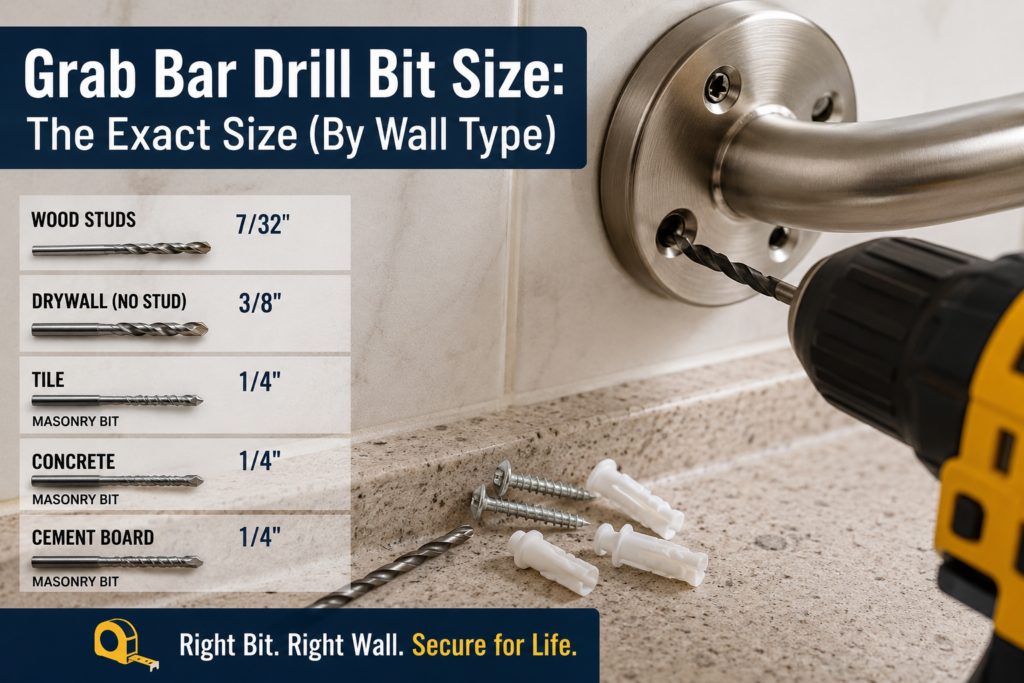
Introduction
Grab Bar Drill Bit Size You’ve got the grab bar out of the box, the drill charged, and one question standing between you and a finished job: what size bit actually goes in the chuck? Get this wrong and you’re either stripping the screw hole or cracking a $40 ceramic tile. Here’s the number, by wall type, so you drill once and get it right.
Table of Contents
Quick Answer: For grab bar screws driven into a wood stud, use a 1/8-inch bit for the pilot hole—the size The official guide for installing grab bars from Home Depot specifies this procedure. For drywall anchors or toggle bolts, match the bit to the anchor packaging (commonly 3/16″ to 1/2″). For tile or masonry, use a carbide or masonry bit sized to the anchor, not the screw.
What You Need to Know
- Wood stud with the included screws: 1/8-inch bit, per The Home Depot’s official grab bar installation guide.
- No stud available: the bit size is set by the wall anchor or toggle bolt you buy — check the anchor’s own packaging, not the grab bar’s screws.
- Tile or fibreglass over a stud: drill the tile with a tile-rated bit first, then finish into the stud with the same 1/8-inch bit.
- Solid masonry or concrete block: use a masonry bit matched to your concrete anchor, never a wood bit.
- Studs sit 16 or 24 inches on centre, and grab bars near a toilet typically mount 33 to 36 inches off the floor — both affect where you’re drilling in the first place.
Drill Bit Size by Wall Type
| Wall / Fixing Type | Screw or Anchor Used | Drill Bit Size | Why |
|---|---|---|---|
| Wood stud | Included wood screws | 1/8″ | Home Depot’s install guide specifies drilling pilot holes with a 1/8-inch bit before driving screws into the stud. |
| Drywall (no stud) | Toggle bolt or heavy-duty anchor | 3/16″–1/2″ (check packaging) | Toggle bolts and plastic anchors are sized to their own hole spec — using the wrong diameter means the anchor either won’t seat or won’t grip. |
| Tile over stud. | Wood screw through tile | Tile/glass bit for the surface, then 1/8″ into the stud | The tile needs a slow-start ceramic bit to avoid cracking; the stud underneath still only needs 1/8″. |
| Solid masonry / concrete block | Concrete screw or expansion anchor | Sized to anchor (commonly 1/4″–3/8″) | Masonry anchors rely on a snug fit — oversized holes won’t develop full holding strength. |
Save or screenshot this drill bit size chart — it covers the four wall situations you’ll actually run into behind a bathroom wall.
Does Screw Size Change the Bit Size You Need?
Yes — the pilot hole should always match the screw’s core, not its outer thread diameter. Most grab bars ship with #10 or #12 stainless screws sized for a 1/8-inch pilot in wood; if you’re buying separately, this is the number to check first.
If your grab bar came from a UK or European brand, the hardware is sized in metric (M5, M6) and paired with a 6 mm bit rather than a fractional inch one—worth noting if you’re comparing installation guides online, since that math doesn’t translate directly to US hardware store bits.
What Happens If the Pilot Hole Is the Wrong Size?
A hole that’s too small can split the stud or snap the screw head off mid-drive; a hole that’s too large means the screw spins without ever gripping the wood. Neither failure shows up until someone’s full body weight is pulling on the bar.
This is the quiet failure mode nobody warns you about: an oversized pilot hole looks perfectly installed—flush screw, tight-looking bar—right up until it’s loaded.
Do You Always Need a Pilot Hole?
Almost always, yes. Skipping it lets the screw wander off your marked point, especially on tile, and increases the odds of cracking the surface or missing the stud entirely. The one exception is self-tapping masonry screws designed to cut their own thread — check the anchor’s packaging before skipping this step.
Removing or Repositioning a Grab Bar
Drilled in the wrong spot, or do you need to move a bar that’s already up? Grabbarsguide.com‘s guide on removing a grab bar without cracking tile walks through backing screws out and patching the old holes without damaging the surrounding tile.
Common Mistakes to Avoid
- Using the grab bar’s screw size to pick a bit for anchor installs. The anchor, not the screw, sets the bit size when there’s no stud.
- Drilling tile at full speed. Start slow with a centre punch or masking tape over the mark to keep the bit from skating.
- Assuming any bathroom wall is solid behind the tile. Fibreglass tub surrounds and some tile-over-drywall setups have almost no holding strength without hitting a stud or using load-rated anchors.
- Overtightening into tile. Home Depot’s guide specifically warns that overtightening screws in tile will crack it — snug is enough.
FAQs
Should a shower grab bar be straight or angled?
The right style depends on how the grab bar will be used. A horizontal bar is a practical choice for steadying yourself while standing or moving along the shower wall. An angled bar can provide a more natural hand position when the user needs to pull up, turn, or step over a bathtub edge. Consider the user’s movement and support needs before choosing the bar orientation.
What is the code for grab bars in a bathroom?
For public and commercial facilities covered by ADA requirements, bathroom grab bars must be designed to withstand at least 250 pounds of force and generally require 1½ inches of space between the bar and the wall. The U.S. Access Board’s toilet room requirements guide explains the applicable accessibility standards. These federal ADA requirements generally do not apply to private residential bathrooms, although homeowners may use them as a useful safety guideline.
Are shower grab bars easy to install yourself?
A shower grab bar can be a relatively simple DIY installation when the mounting holes can be positioned over solid wall studs. Basic tools such as a drill, level, and stud finder are usually sufficient. Installation requires more care when the desired mounting location does not have a stud or when the wall is covered with tile. In those situations, selecting the correct anchors and drill bit is especially important for a secure installation.
Do you need a pilot hole for a grab bar in drywall?
Yes, most drywall-anchor installations require a hole before the anchor is inserted. The correct hole size is determined by the particular anchor rather than the grab bar screw itself. Always follow the anchor manufacturer’s recommended drill-bit diameter. Making the hole too small can damage the anchor, while an oversized hole may prevent it from gripping the wall properly.
Can you use the same drill bit for stud and tile installations?
No. Tile and wood require different types of drill bits. When a grab bar is mounted over a wood stud behind tile, the tile should first be drilled with a bit designed for the tile material. Once the bit reaches the wood, use a suitable wood or general-purpose bit to create the pilot hole. Using the wrong bit on the tile can cause chips, cracks, or other surface damage.
What to Do Next
If a grab bar was drilled in the wrong location, you may need to remove it carefully before installing it somewhere else. See our guide on removing a grab bar without cracking tile for safer removal tips. Before drilling a new mounting hole, make sure you have accurately located the wall studs or selected an appropriate rated anchor for the wall type.