
Select 80 more words to run Humanizer.
Introduction
Grab Bar for Fibreglass Shower You just checked your shower wall and realised it’s fibreglass, not tile — and now you wonder if a grab bar will actually hold. That’s a fair thing to worry about, and the honest answer isn’t a flat yes or no.
Table of Contents
Quick Answer: Yes, you can install a grab bar in a fibreglass shower, but it can’t rely on the fibreglass alone. Anchor it into the wall stud behind the wall, or use hardware rated to transfer weight through fibreglass to the frame. The residential code requires grab bars to withstand 250 pounds of force, and fibreglass alone isn’t allowed to carry that load.
What You Need to Know
- Fibreglass shower panels are not structural — building code prohibits grab bars from being supported by fibreglass alone.
- You need to find a stud, use a stud-transfer mounting system, or use hollow-wall anchors specifically rated for grab bars — not generic drywall anchors.
- Grab bars must withstand 250 pounds of applied force to meet the residential accessibility code.
- Suction cups and most “no-drill” bars aren’t a substitute for anchored hardware — they’re a temporary aid at best.
- Sealing every screw hole with silicone matters as much as the anchor itself, since water behind fibreglass rots framing you can’t see.
Can You Install a Grab Bar in a Fibreglass Shower?
Yes — as long as the load goes into the framing, not just the fibreglass panel. Fibreglass shower and tub units flex under pressure, which is exactly the wrong quality for something you’re going to pull your full body weight against.
Residential building codes based on the ICC A117.1 accessibility standard require a grab bar, its fasteners, and its mounting device to withstand 250 pounds of force applied at any single point. Several state codes go further and explicitly state that grab bars cannot be supported directly by a residential-grade fibreglass bathing unit. That’s not a suggestion — it’s the same logic that makes towel bars a bad substitute for grab bars in the first place, a distinction worth understanding before you buy anything.
The fix isn’t complicated once you know it: get the load onto the stud or onto hardware engineered to bridge the gap between the fibreglass and the stud behind it.
Why Fibreglass Showers Are Different (and Riskier) to Drill Into
A fibreglass shower wall is a thin moulded shell, usually sitting a half-inch to over two inches away from the actual wall framing—and that air gap is exactly what trips people up.
In a tiled shower, you’re drilling through the backer board that sits close against the studs. In a fibreglass unit, you’re drilling through a curved, sometimes brittle shell with open space behind it. Drill without support and one of two things happens: the fibreglass cracks around the hole, or your anchor sits in open air and spins uselessly the first time someone pulls on the bar.
Fibreglass also ages differently than tile. UV exposure, years of hot water, and prior repairs can make an older panel more brittle than it looks, which is part of why professional installers routinely recommend a test hole before committing to a final mounting position.
Step 1: Find the Studs Behind the Fibreglass
Every fibreglass grab bar installation starts the same way: locating the framing, not guessing at it. A magnetic or electronic stud finder often struggles through fibreglass, so plan on a slightly different approach than you’d use on drywall.
How to Locate Studs Through Fibreglass
Tap along the wall with a knuckle and listen for the pitch to change from hollow to solid—studs are typically spaced 16 inches on centre, so once you find one, measure out to check for the pattern. A stud finder with deep-scan mode (rated for at least 1.5 inches of material) will often work where a basic model won’t.
If you’re not confident in the reading, drill one small test hole — about 1/8 inch — at your planned screw location before committing. You can seal a wrong guess; you can’t un-crack a panel from an oversized hole in the wrong spot.
What If There’s No Stud Where You Need the Bar?
This is the most common real-world problem, since ADA and residential placement guidelines dictate where the bar needs to go — not where your studs happen to be. If you’re facing this exact situation, the fixes for anchoring without a stud are worth reading in detail before you buy hardware.
Which Mounting Hardware Should You Use?
The right hardware depends on two things: how far the stud is from your ideal bar position and how big the gap is between the fibreglass and the wall framing. Here’s how to match your situation to the right approach.
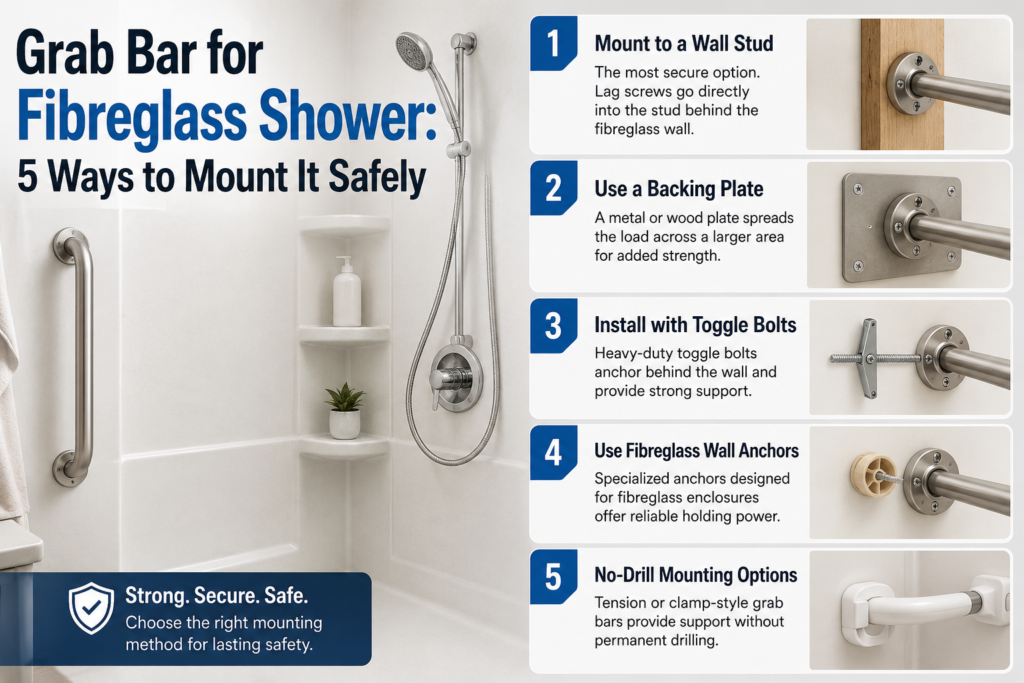
| Your Situation | Recommended Hardware | Typical Weight Rating | Drilling Required | Difficulty |
|---|---|---|---|---|
| The stud sits directly behind the bar location. | Stainless steel lag screws driven straight into the stud | Meets or exceeds the 250-lb code minimum | Yes | Easy |
| The stud is a few inches off, with a gap under ~1 inch. | Longer screws angled into the stud, or a stud-extender bracket | Meets 250 lb minimum when properly seated | Yes | Moderate |
| No accessible stud, gap over 1 inch (open cavity behind fibreglass) | A stud-transfer mounting plate system built for fibreglass, bridging the gap to the nearest stud | Rated to 250 lbs when installed to spec | Yes | Moderate–Advanced |
| No stud within reach at all | Heavy-duty toggle bolts or hollow-wall anchors specifically rated for grab bars — never standard drywall anchors | Varies by product; confirm the manufacturer’s load rating | Yes | Moderate |
| Renting or want zero permanent holes | A no-drill clamp or tension-pole bar rated for your wall thickness | Manufacturer-specified, generally lower than a stud-mounted bar | No | Easy |
Save or screenshot this hardware table — it covers the decision most people get wrong on the first try: assuming any wall anchor will do because “it’s just a shower.”
If you’d rather have this as a printable checklist for your next hardware-store trip, that’s exactly the kind of reference we send out — worth grabbing before you’re standing in the aisle guessing.
Step-by-Step: How to Install a Grab Bar in a Fibreglass Shower
- Mark your bar height and length. ADA placement guidance calls for horizontal bars roughly 33 to 36 inches above the floor—check your specific model’s flange spacing before marking anything.
- Confirm your stud or mounting hardware plan from the table above. Don’t drill until you know which of the five scenarios applies to your wall.
- Apply masking tape over each drill point. This single step prevents most of the surface chipping that happens when a bit first bites into fibreglass.
- Drill a pilot hole with a carbide- or diamond-tipped bit, sized to match your screw or anchor — going slow at first contact matters more than the bit itself.
- Set your anchor or mounting hardware per the manufacturer’s instructions, torquing screws snug but not overtightened, since fibreglass can crack under excess torque even with the tape removed.
- Attach the grab bar flange and hand-tighten the mounting screws, checking that the bar sits flush against the wall with no visible gap.
- Test the bar before anyone relies on it—apply firm downward and outward pressure with your full body weight in the same direction someone would pull in a real fall.
- Seal every screw hole and the flange edge with 100% silicone caulk, letting it cure fully (usually 24 hours) before the shower sees water again.
Do No-Drill or Suction-Cup Grab Bars Actually Work?
No — suction-cup bars are not a reliable safety solution in a fibreglass shower. They can lose their seal with heat, soap film, or simple time, and none of that is obvious until someone’s already pulling on the bar mid-fall.
“No-drill” doesn’t automatically mean unsafe, though — tension-pole bars and heavy-duty clamp systems can work if they’re rated for your specific wall thickness and used within their stated weight limit. The distinction that matters is whether the product publishes a real load rating, the same way a stud-mounted bar does, or whether it’s marketed on convenience alone with no rating in sight.
Sealing and Waterproofing the Holes
Every hole you drill into fibreglass is a potential path for water into the wall cavity, and that’s a slower, quieter problem than a bar pulling loose.
Run a bead of 100% silicone caulk (not standard latex caulk, which won’t hold up to constant moisture) around the base of the flange and over each screw head before you reattach the bar. Recheck the seal every year or two — caulk in a shower environment degrades faster than caulk almost anywhere else in the house.
DIY or Call a Professional?
Most fiberglass grab bar installations are doable as a weekend DIY project if you can confidently locate the stud—the risk isn’t the drilling; it’s guessing wrong on the anchor point.
Call a professional if your shower is older and you’re not sure how brittle the fiberglass has become, if you can’t get a confident stud reading after a couple of attempts, or if the bar needs to go somewhere code requires but no stud exists nearby. A 2022 study published in Frontiers in Public Health found that bathtubs and showers rank among the leading products associated with non-fatal home injuries in the U.S., at a national cost approaching $20 billion a year—which is the actual stake behind a “good enough” installation.
Common Mistakes to AvoidThe single most common failure isn’t bad hardware—it’s skipping the test hole and drilling straight into a guess. A few other mistakes show up again and again:
Overtightening screws into fibreglass. Snug is the goal—cranking hardware down after it’s already seated is how panels crack weeks after a clean install.
Using a standard drywall anchor behind the fibreglass. It’s rated for drywall load, not the pull-and-twist force of someone catching themselves mid-fall.
Trusting a towel bar to double as a grab bar. This is common enough that Health Canada and the U.S. CPSC jointly recalled a towel-style grab bar in 2021 after it broke under bodily support—the products are simply not engineered for the same load, a distinction covered in more depth in our towel bar vs. grab bar comparison.
Skipping the silicone seal. A structurally sound bar with unsealed screw holes just relocates the failure point from the wall to hidden water damage.
FAQs
Do suction-cup grab bars work on fibreglass showers?
Suction grab bars should not be treated as a dependable safety solution. Their grip can weaken because of moisture, soap buildup, temperature changes, or gradual loss of suction. The problem is that you may not know the connection has weakened until the bar moves. They can be useful for short-term or travel situations, but a properly secured grab bar is a safer choice for permanent bathroom use.
Can you install a grab bar on a fibreglass shower?
Yes, grab bars can be installed in fibreglass showers. However, the fibreglass surround itself is generally not strong enough to carry the forces created when someone uses a grab bar for support. The installation needs to transfer the load to a wall stud or use mounting hardware specifically designed and rated for the particular fibreglass shower system.
Are there no-drill grab bars for fibreglass showers?
Some products are designed to avoid drilling, including certain tension-mounted and clamp-style support bars. However, you should not assume that every no-drill product provides the same level of protection. Before purchasing one, check the manufacturer’s weight rating, installation requirements, and whether the product is suitable for your fibreglass wall construction.
What are the disadvantages of fibreglass showers?
Fibreglass is lightweight and convenient, but it is not normally intended to function as a structural support surface for heavy loads. This means the fibreglass panel alone should not be relied on to support a grab bar. Older fibreglass surrounds can also become scratched, stained, cracked, or brittle over time, which can make drilling and mounting more complicated.
How much force should a grab bar support?
Grab bars and their mounting systems are commonly designed around a 250-pound applied force requirement under standards based on ICC A117.1. The actual capacity can vary depending on the bar, fasteners, wall construction, and installation method. Always review the manufacturer’s specifications rather than assuming that every grab bar installation has the same load capacity.
Do you need a professional to install a grab bar in a fibreglass shower?
A professional installer isn’t always necessary. A capable DIYer may be able to complete the installation when the wall framing can be accurately located and the correct mounting method is used. Professional installation becomes a better option when the fibreglass is old or damaged, the wall construction is unclear, or you cannot confidently determine where a suitable structural attachment point is located.
What to Check Before Installing a Fibreglass Shower Grab Bar
Before buying a grab bar, determine where it will be installed and how the load will be transferred through the fibreglass surround. Correct placement is just as important as choosing the right hardware.
For guidance on bathroom grab bar height and placement, see our ADA bathroom grab bar requirements guide.
If your planned installation does not line up with a wall stud, review our guide to grab bars for drywall without studs for additional mounting considerations.
Also, don’t assume that an existing towel bar can provide the same support as a grab bar. Learn the difference in our guide on whether a towel bar can be used as a grab bar.