
Introduction
Horizontal vs vertical grab bars: horizontal vs vertical bathroom grab bars. You’re standing in the grab bar aisle or scrolling through a placement guide, and every source seems to say something slightly different. Some install pages show horizontal bars. Others show vertical ones near the same fixture. Here’s the answer without the runaround.
Table of Contents
Quick Answer: Horizontal and vertical grab bars support two different movements, so most bathrooms need both, not one or the other. Horizontal bars help you push up and stay balanced sideways. When standing, vertical bars assist you in pulling yourself up and stabilising your body. ADA rules require horizontal bars; ANSI (American National Standards Institute) and most local codes also require vertical ones near toilets.
What You Need to Know
- Horizontal bars support pushing up from a seated position and balancing while standing or moving sideways.
- Vertical bars support pulling up a standing position and steadying you during entry and exit—like stepping into a shower.
- The ADA only mandates horizontal bars in commercial/public restrooms; ANSI A117.1 and most residential building codes also call for vertical bars near toilets.
- Diagonal or angled bars exist as a hybrid option, mostly used beside toilets.
- A bar in the wrong orientation for its location can be worse than no bar at all — it invites a grip that doesn’t match the motion you’re actually making.
What’s the Difference Between Horizontal and Vertical Grab Bars?
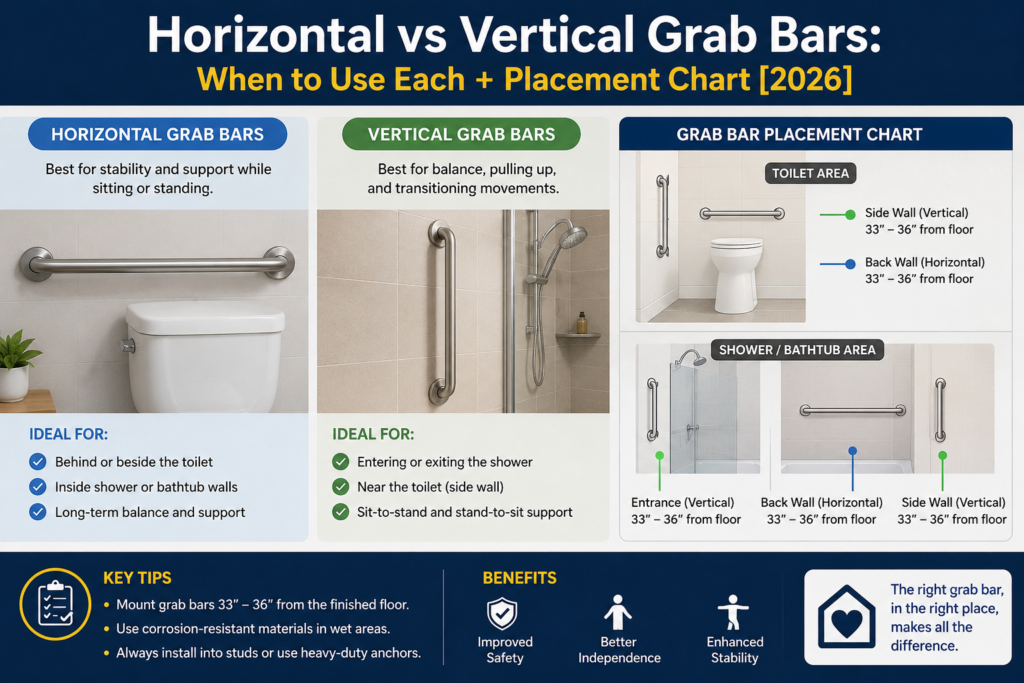
The difference lies in the direction of force that each bar is designed to withstand. A horizontal bar runs parallel to the floor, and you grip it while pushing down and forward—the motion of rising from a toilet, bath seat, or shower bench. A vertical bar runs perpendicular to the floor, and you grip it while pulling upward—the motion of stepping over a tub wall or steadying yourself as you stand from a crouch.
Neither bar substitutes for the other. A horizontal bar mounted where you need a vertical pull will sit at the wrong height and the wrong angle for your hand to close around it mid-motion. That mismatch is one of the more common reasons people report installed bars that “don’t feel secure” even though the bar itself is solid.
Does ADA Require Horizontal or Vertical Grab Bars?
The ADA specifically requires horizontal grab bars in public and commercial restrooms — it does not mandate vertical bars. The 2010 ADA Standards for Accessible Design call for a horizontal bar behind the toilet and one on the side wall, both mounted 33 to 36 inches above the floor.
Vertical bars enter the picture through a separate standard: ICC/ANSI A117.1, which most state and local residential building codes reference. ANSI recommends a vertical bar near the toilet, typically mounted so its bottom edge sits around 39 to 41 inches above the floor. If you’re building or renovating a private home, ANSI (not ADA) is usually the governing reference, and it’s the standard that pushes vertical bars from “nice to have” to “expected”.
Grab Bar Orientation by Location
Where a bar goes determines its orientation more than any single rule of thumb does. The table below breaks down what most placement guidance recommends for each fixture, so you’re not guessing room by room.
| Location | Orientation | Typical Height | Movement Supported |
|---|---|---|---|
| Beside the toilet | Horizontal | 33–36 in. from floor | Push up from seated |
| Beside the toilet | Vertical | 39–41 in. from floor | Pull up to stand |
| Shower entry/exit | Vertical | 42–48 in. from shower floor | Steady balance during step-through |
| Inside shower (side wall) | Horizontal | 33–36 in. from shower floor | Lateral balance while standing |
| Tub side (long wall) | Horizontal | 33–36 in. from tub floor | Support while lowering/rising |
| Tub entry wall | Vertical | 33–48 in. from tub floor | Grip while stepping over the tub wall |
Save or screenshot this orientation chart — it covers the placement and height for every major fixture in one bathroom.
What About Diagonal or Angled Grab Bars?
A diagonal bar is a hybrid designed to combine the push of a horizontal bar with the pull of a vertical one, usually mounted beside a toilet. Because it runs at roughly a 45-degree angle, your hand can find a comfortable grip at multiple points along the bar as you move from sitting to standing, rather than needing to reposition your hand mid-transfer.
Diagonal bars aren’t a full substitute for a separate horizontal and vertical bar in a shower or tub, where the movements are more distinct. They work best in the single, continuous sit-to-stand motion beside a toilet—that’s the one place where blending both supports actually helps rather than compromises.
Can You Use Both Types Together?
Yes, and for most bathrooms it’s the standard recommendation rather than an upgrade. A horizontal bar and a vertical bar mounted near the same fixture cover both the push and the pull phases of a single movement, like standing up from the toilet or stepping out of the tub.
There’s no code conflict in running both—ADA’s horizontal requirement and ANSI’s vertical recommendation aren’t mutually exclusive, and installers commonly place both at the same fixture without either one interfering with the other’s grip zone.
Common Mistakes People Make With Grab Bar Orientation
The most common mistake is mounting a bar based on where it looks tidy rather than the motion it needs to support. A horizontal bar centred at “average” height might look balanced on the wall, but if you need to pull yourself up rather than push off, it’s the wrong tool at the wrong angle.
A close second: mounting any grab bar into drywall alone. Grab bars need to anchor into a wall stud, blocking, or a mounting plate rated for the load—drywall anchors can pull loose under the sudden weight of a real fall, which defeats the purpose of installing the bar in the first place.
When to Call a Professional Installer
Finding solid backing behind your bathroom wall — a stud, blocking, or existing reinforcement — isn’t always visible from the surface, especially in older homes or around tiled showers. If you’re not confident locating structural backing or confirming a wall can hold fall-force weight, have a licensed installer or contractor check it before you drill. A correctly orientated bar mounted into the wrong wall material is still a fall risk.
If you’re planning a full bathroom safety update rather than a single bar, it’s worth working through a broader safety checklist while you’re already thinking about it — that’s the kind of thing worth having on hand before the next project, not after an incident prompts it.
FAQs
Should grab bars be installed vertically or horizontally?
Both types can be useful in a bathroom because they provide support for different movements. Horizontal grab bars are helpful when standing up, sitting down, or maintaining stability while moving sideways. Vertical bars can make it easier to pull yourself up and maintain balance when entering or exiting a shower or bathtub. The right orientation depends on where the bar is installed and how the person will use it.
What is the best location for a bathtub grab rail?
A horizontal grab bar can provide useful support along the long side of a bathtub, particularly when lowering into the tub or getting back up. A vertical bar positioned close to the tub entrance can offer a stable handhold while stepping over the tub wall. The ideal installation height should account for the user’s height, reach, and the design and rim height of the bathtub.
Should a shower grab bar be straight or angled?
Straight grab bars are suitable for many shower applications when they are installed in locations that match the user’s needs. A horizontal bar can help with balance and movement along the shower wall, while a vertical bar can provide support near the entrance. Angled bars may also be useful in certain situations, although they are more frequently used around toilets than in standard shower setups.
What is the recommended height for a vertical grab rail in a shower?
A vertical grab bar near a shower entrance is often positioned approximately 42 to 48 inches above the shower floor. It should be placed where the user can comfortably reach and grip it before stepping across the threshold. Because users have different heights and mobility needs, the final position should be adjusted for safe and comfortable access.
Can a grab bar be installed too high to be useful?
Yes. Installing a grab bar beyond a person’s comfortable reach can make it harder to grip and may reduce the amount of support it provides. The bar should be positioned so the user can grab it naturally without excessive stretching or raising the shoulder. Personal height, reach, mobility, and the intended use of the bar should all be considered when determining placement.
Do vertical grab bars meet ADA requirements on their own?
Not necessarily. ADA accessibility standards for public and commercial bathrooms specify required grab-bar configurations and locations, which generally include horizontal components. A vertical grab bar should not automatically be considered a substitute for those requirements. In residential bathrooms, additional vertical bars may provide useful support, but installation should also follow applicable building codes and accessibility standards.
What to Do Next
If you’re mapping out a full bathroom, start with our guide to bathroom grab bars for elderly users for a broader look at who needs them and why. For the exact code language behind the numbers in this article, see our breakdown of ADA bathroom grab bar requirements. And for a deeper, fixture-by-fixture placement walkthrough, our guide to grab bar placement for the toilet and shower picks up exactly where this article leaves off.