
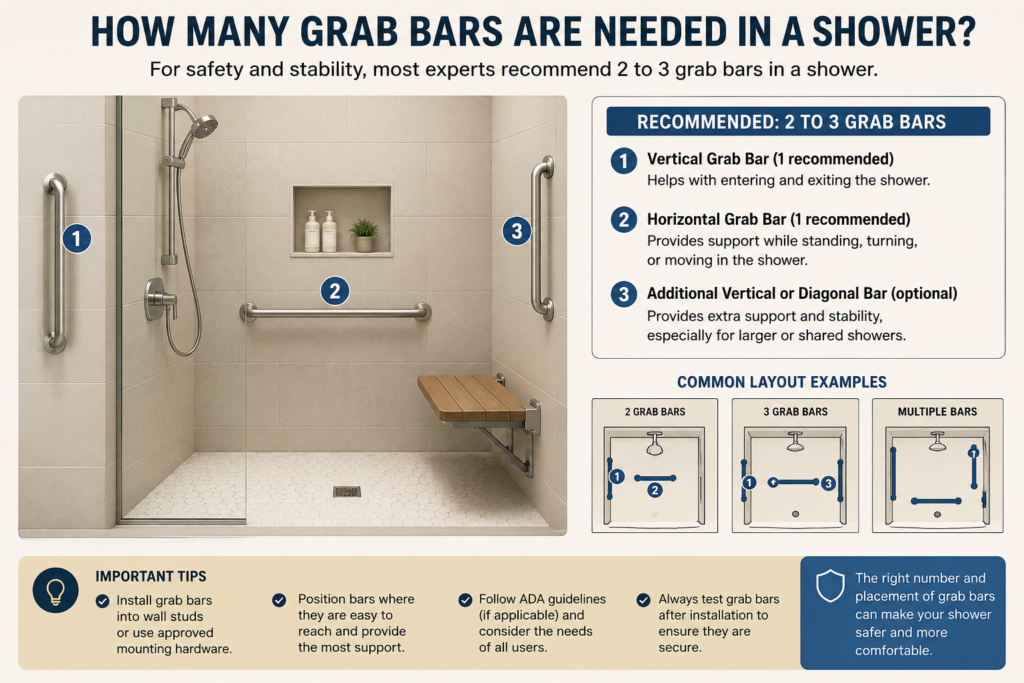
If you’re wondering how many grab bars are needed in a shower, the short answer is: it depends on your shower’s size, layout, and who’s using it — but most bathrooms need at least three to be truly safe. Whether you’re renovating for aging parents, recovering from surgery, or simply making your bathroom safer for everyday use, getting the number and placement right can mean the difference between a quick shower and a dangerous fall.
Many homeowners assume one bar near the entrance is enough — but that’s rarely the case. In this guide, we’ll break down the exact number of grab bars you need based on ADA guidelines, shower type, and personal mobility needs, plus where to install them for maximum safety and support.
ADA Guidelines vs. Real-World Recommendations
The Americans with Disabilities Act (ADA) sets the baseline for how many grab bars are needed in a shower in commercial and public spaces. According to ADA standards, a standard shower stall requires a minimum of three grab bars: one on the back wall and one on each side wall (or the control wall and the wall opposite it, depending on shower configuration).
However, it’s important to understand that ADA guidelines are written for public and commercial buildings, not private homes. For residential bathrooms, these guidelines serve as a strong starting point, but real-world needs often call for adjustments based on the specific user, shower type, and layout.
Key takeaway: Three grab bars is the widely accepted minimum, but your home may need more depending on the factors below.
Image suggestion: A simple diagram showing ADA-compliant grab bar placement in a standard shower stall (back wall + two side walls).
Standard Recommendation: 3 Grab Bars
For most walk-in showers, three grab bars cover the essential safety zones:
- Entry/exit bar — installed near the shower entrance to assist with stepping in and out safely.
- Vertical bar — mounted on the side wall, helping users pull themselves up or steady themselves while standing.
- Horizontal bar — placed along the back wall at a height that supports balance while showering or sitting.
This three-bar setup addresses the most common fall risks: losing balance while entering, standing up, and moving around inside the shower. For many households, this is sufficient — but showers with unique layouts or users with greater mobility needs may require additional bars.
Image suggestion: A labeled photo or illustration showing the three grab bar positions (entry, vertical, horizontal) inside a walk-in shower.
Grab Bar Placement by Shower Type
Not all showers are built the same, and the number of grab bars needed often depends on the type of shower you have.
Walk-in showers: These typically need the standard three bars — entry, vertical, and horizontal — since there’s no tub barrier to navigate.
Tub/shower combos: These require additional consideration since users must step over the tub wall. Typically, this means adding a fourth bar near the tub edge to assist with the step-over motion, on top of the standard three.
Curbless/roll-in showers: Designed for wheelchair users or those with severe mobility limitations, these often need four or more bars, including a lower horizontal bar for seated users and additional support near any fold-down shower seats.
Image suggestion: Side-by-side comparison images of a walk-in shower, tub/shower combo, and curbless shower, each with grab bars marked.
Shower Size & Layout Considerations
Shower size directly impacts how many grab bars are needed. A small, standard-sized shower stall (roughly 32″ x 32″) may only need the standard three bars, since users are never far from a wall.
Larger showers, however — especially those over 5 feet wide or with unconventional shapes like L-shaped or corner showers — often need additional bars. This is because users may find themselves in the center of the shower without a nearby bar to reach in an emergency.
As a general rule: if any point inside the shower is more than an arm’s length (about 2-3 feet) from a grab bar, it’s time to add another one.
Image suggestion: A top-down floor plan illustration showing grab bar coverage zones in a small vs. large shower.
Table of Contents
Grab Bars for Specific Needs
The number of grab bars needed in a shower isn’t just about the space — it’s also about who’s using it.
Elderly users: Often benefit from four or more bars, including a seated-height horizontal bar if a shower bench or chair is used.
Wheelchair users: Typically require a minimum of four bars, positioned to support transfers from a wheelchair to a shower seat, plus a lower horizontal bar for stability while seated.
Post-surgery recovery: Temporary but critical — an extra bar near the entrance and one at a lower height (for those unable to stand for long periods) can significantly reduce fall risk during recovery.
Balance or vertigo issues: May require bars at multiple heights and angles to provide support during sudden dizziness or instability.
Image suggestion: A photo of a shower setup designed for a wheelchair user, showing multiple grab bars at different heights.
Vertical vs. Horizontal vs. Angled Bars
Beyond simply counting bars, the type of bar matters just as much:
- Vertical bars are best for pulling up from a seated position or steadying yourself while standing up.
- Horizontal bars provide side-to-side support, ideal for maintaining balance while washing or standing still.
- Angled bars (usually 45 degrees) combine the benefits of both, offering support whether a user is standing, crouching, or transitioning between positions.
A well-designed shower often uses a mix of all three types rather than relying on just one orientation.
Image suggestion: A simple graphic showing the three bar orientations (vertical, horizontal, angled) with arrows indicating the type of support each provides.
Bathtub-Specific Considerations
If your shower is combined with a bathtub, the step-over motion introduces additional fall risk — meaning extra grab bars are often necessary.
For tub/shower combos, consider:
- A vertical bar near the faucet end to assist with standing up from a seated bathing position.
- A horizontal bar along the tub wall to support stepping over the edge.
- An angled bar near the entry point for combined support during the step-over motion.
In total, tub/shower combos often require 4 to 5 grab bars to be fully safe, compared to the standard 3 for walk-in showers.
Image suggestion: A photo of a tub/shower combo with grab bars installed at the entry point and along the tub wall.
Weight Capacity & Mounting Requirements
How many grab bars are needed in a shower isn’t only about position — it’s also about ensuring each bar is properly rated and installed. A grab bar is only as good as its mounting.
- Grab bars should be rated to hold at least 250-300 lbs of force, per ADA and safety standards.
- Bars must be anchored into wall studs or backed with proper blocking — mounting into drywall alone is not sufficient and can lead to bar failure under weight.
- If your bathroom walls weren’t built with reinforcement, professional installation with added blocking is strongly recommended.
Skipping this step can render even a well-placed grab bar useless — or dangerous — in an emergency.
Image suggestion: A cutaway diagram showing a grab bar properly anchored into a wall stud versus one loosely mounted into drywall.
Common Mistakes: Too Few or Poorly Placed Bars
Even homeowners who install grab bars often make mistakes that reduce their effectiveness:
- Installing only one bar near the entrance and assuming it’s enough.
- Placing bars too high or too low, making them hard to reach in a fall.
- Ignoring the center of larger showers, leaving a gap in coverage.
- Using towel bars instead of grab bars, which aren’t rated to support body weight.
- Skipping stud mounting, resulting in bars that pull away from the wall under stress.
Avoiding these mistakes is just as important as getting the grab bar count right.
Image suggestion: A “do’s and don’ts” style graphic showing correct vs. incorrect grab bar placement.
Cost & Installation Considerations
Budget is often a factor when deciding how many grab bars to install. On average:
- A single grab bar (mid-range quality) costs $20-$60, with premium or designer options running higher.
- Professional installation typically costs $100-$250 per bar, depending on whether wall reinforcement is needed.
- DIY installation is possible for those comfortable locating wall studs and using a level, but professional installation is recommended when stud placement doesn’t align with ideal bar positioning.
For a standard 3-bar walk-in shower, total cost (including installation) often ranges from $350 to $700.
Image suggestion: A simple cost breakdown table or infographic comparing DIY vs. professional installation costs.
Building Code Requirements by Region
While ADA guidelines provide a national baseline, local building codes can add additional requirements — especially for homes being renovated for accessibility or aging-in-place purposes. Some states and municipalities have specific codes for grab bar height, spacing, and mounting that go beyond ADA minimums.
Before installing grab bars, it’s worth checking with your local building department or a licensed contractor to confirm any regional requirements that may apply to your renovation.
Grab Bars for Aging in Place / Universal Design
For homeowners planning ahead — rather than reacting to an immediate need — grab bars are a key part of “universal design,” a philosophy focused on making homes usable for people of all ages and abilities.
Installing 4-5 grab bars during a bathroom renovation, even before they’re strictly necessary, can save significant cost and hassle later. This proactive approach is especially popular among homeowners planning to age in place, as it avoids the need for disruptive retrofits down the road.
Image suggestion: Before/after photos of a bathroom renovated with universal design principles, including grab bars, a curbless shower, and a fold-down seat.
Frequently Asked Questions
Do I need grab bars if I’m not disabled or elderly? Yes — grab bars benefit anyone, as slippery shower surfaces pose a fall risk regardless of age or ability. Many safety experts recommend at least one bar in every shower.
Can I install more than 3 grab bars? Absolutely. Three is the minimum recommendation, but there’s no maximum — adding more bars only increases safety, especially in larger showers or for users with specific mobility needs.
What height should grab bars be installed at? ADA guidelines recommend horizontal bars be installed between 33-36 inches from the shower floor, though this can be adjusted based on the primary user’s height.
Do grab bars need to match my bathroom decor? Not necessarily for function, but many modern grab bars now come in finishes (brushed nickel, matte black, chrome) that blend seamlessly with bathroom fixtures.
Conclusion
So, how many grab bars are needed in a shower? While three bars is the standard, ADA-backed minimum for most walk-in showers, the right number for your bathroom depends on shower type, size, and who’s using it. Tub/shower combos, larger showers, and homes accommodating elderly or mobility-impaired users often benefit from four or more strategically placed bars.
The most important takeaway is this: proper placement and secure mounting matter just as much as the number of bars you install. A single, well-anchored grab bar in the right spot is far more valuable than several poorly placed or loosely mounted ones.
If you’re renovating your bathroom for safety, accessibility, or aging-in-place purposes, take the time to assess your shower’s layout and consult a professional for installation — it’s a small investment that can prevent serious injuries down the road.