
Introduction
Are Grab Bars Required in Bathrooms? A parent just got home from hip surgery, or a contractor asked whether the new bathroom needs code-compliant blocking, and now you’re trying to figure out if grab bars are actually mandatory or just a good idea. Here’s the direct answer, then the details that matter for your specific situation.
Table of Contents
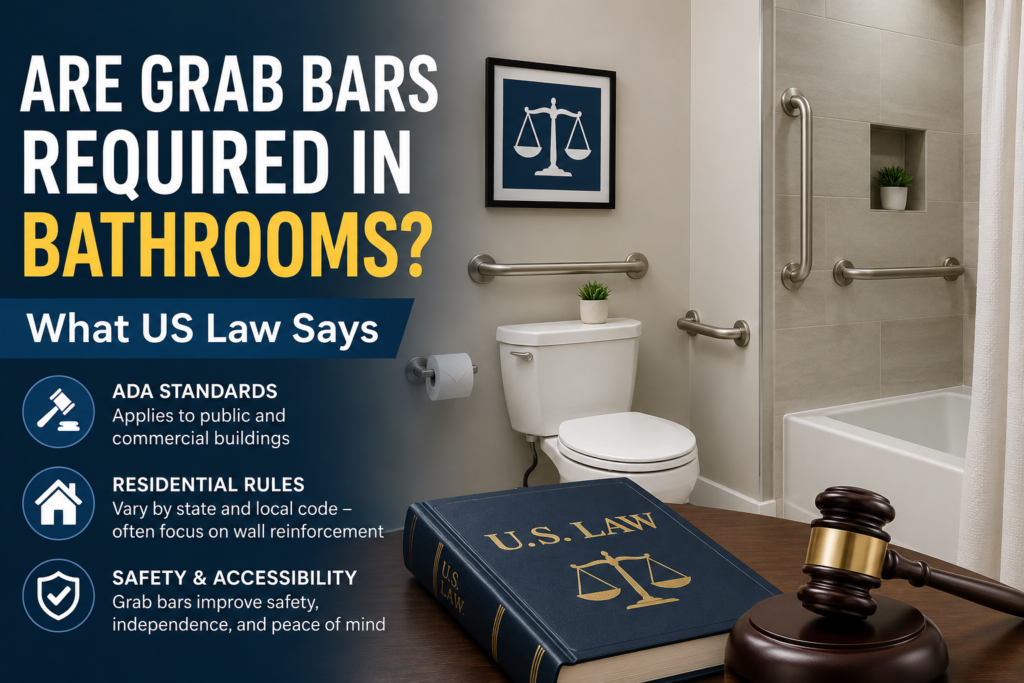
Quick Answer: Grab bars are not legally required in most private US bathrooms. The Americans with Disabilities Act (ADA) governs public and commercial spaces—restaurants, hotels, offices—not private homes. Many local residential codes do require wall reinforcement (“blocking”) for future grab bar installation, even when the bar itself isn’t mandatory today.
What You Need to Know
- Private homes: No federal law requires grab bars, but some local building codes require reinforced walls near toilets and tubs.
- Commercial and public restrooms: ADA-compliant grab bars are legally required in most cases.
- Rental apartments: Landlords may be required to allow or install grab bars as a “reasonable accommodation” under the Fair Housing Act.
- New construction: Building codes increasingly require blocking even where the bar itself is optional.
- Falls are the real reason to install one anyway — not the law.
When Grab Bars ARE Legally Required
The ADA requires grab bars in public and commercial restrooms, not private residences. This includes restaurants, retail stores, hotels, government buildings, and workplaces open to the public. The ADA’s own accessibility standards spell out exact height, length, and placement rules for these spaces—a business owner who skips them risks complaints and litigation, not just an inspection failure.
The US Access Board publishes the technical specifications businesses and architects use to stay compliant. If you’re building or renovating a commercial bathroom, this is the source to work from directly rather than a secondhand summary.
Are Grab Bars Required in Your Home?
The ADA requires grab bars in public and commercial restrooms, not private residences. This includes restaurants, retail stores, hotels, government buildings, and workplaces open to the public. The ADA’s own accessibility standards spell out exact height, length, and placement rules for these spaces—a business owner who skips them risks complaints and litigation, not just an inspection failure.
The US Access Board publishes the technical specifications businesses and architects use to stay compliant. If you’re building or renovating a commercial bathroom, this is the source to work from directly rather than a secondhand summary.
| Setting | Is an ADA grab bar required? | Local code reinforcement required? | Recommended anyway? |
|---|---|---|---|
| Private single-family home | No | Sometimes (new builds/remodels) | Yes, especially for older adults. |
| Rental apartment | No | Depends on local code. | Yes, and tenants can often request it. |
| Assisted living facility | Usually yes (state licensing rules). | Yes. | Yes. |
| Restaurant or store restroom | Yes. | Yes. | N/A — it’s mandatory. |
| New home construction | No | Often yes. | Yes. |
Save or screenshot this table — it covers the most common situations people search this question for in one place.
Rental Apartments and Landlord Rules
A landlord isn’t automatically required to install grab bars, but the Fair Housing Act changes that if a tenant has a disability. Under the Fair Housing Act’s reasonable accommodation guidance from HUD, a tenant with a documented disability can request modifications like grab bars, and in many cases the landlord must allow the tenant to install them at the tenant’s own expense. Some jurisdictions go further and require the landlord to cover the cost.
If you’re a tenant in this situation, the request usually needs to go through your landlord in writing, and documentation from a doctor or occupational therapist strengthens it considerably.
Required vs. Recommended — Why Install Anyway
The law rarely forces the issue, but the safety case is hard to ignore. According to the CDC, falls are the leading cause of injury for adults 65 and older, and bathrooms are one of the most common rooms where they happen — wet, hard surfaces plus a change in body position (sitting to standing) is a bad combination. You can find more on fall risk and prevention through the CDC’s older adult fall prevention resources.
One counterintuitive point: a towel bar is not a substitute for a grab bar, even though people reach for them the same way. Towel bars are rated for a fraction of the weight and are anchored differently — they’re built to hold a towel, not a falling adult.
Where Should They Go If You Install Them?
Placement matters as much as the decision to install one at all — a bar mounted at the wrong height or angle can be nearly useless in an actual fall. We break down horizontal versus vertical placement and which one supports which movement in our full guide to horizontal vs. vertical grab bar placement.
Want the Exact ADA Measurements?
If you’re working on a commercial space—or you just want to build to the ADA standard even in a home for consistency—the exact height, length, and spacing numbers are laid out in our detailed ADA bathroom grab bar requirements guide.
Choosing the Right Grab Bar
Not every grab bar suits every wall or every user. Weight rating, mounting type, and grip diameter all change the decision. Our guide to choosing bathroom grab bars walks through how to match the bar to the bathroom and the person using it.
Common Mistakes People Make
Assuming a suction-cup bar is code-compliant or fall-rated. Suction bars are fine for light, temporary support on a smooth surface, but they aren’t a substitute for a wall-anchored bar rated for a real fall load.
Skipping the reinforcement even when not required. Even in homes with no code obligation, adding blocking during a renovation costs very little compared to retrofitting it later, and it means a bar can go in immediately if needs change.
Assuming “not required” means “not worth it.” The law and the safety case are two separate questions—this article covers the law, but the CDC data above answers the second one clearly.
FAQs
What are the bathroom code requirements for grab bars?
There is no universal grab bar requirement that applies to every private home in the United States. The ADA establishes accessibility standards for many public and commercial facilities, including requirements for grab bar placement, dimensions, and mounting. Residential rules can vary by location and may focus on providing wall reinforcement so grab bars can be installed later. Always check your local building codes before starting an installation.
Where should grab bars be installed in a bathroom?
Common locations include the walls beside and behind the toilet, as well as key areas inside a bathtub or shower. In a shower, bars may be useful along the back wall, near the controls, or at the entrance. The ideal position depends on the person’s needs and whether the bar is being used for balance, standing, sitting, or transferring.
How many grab bars are recommended in a bathroom?
There is no fixed number for every residential bathroom. A practical setup often includes one grab bar near the toilet and additional bars in the shower or bathtub area. Commercial bathrooms designed to meet ADA accessibility standards may require multiple bars around accessible fixtures, depending on the layout and type of facility.
What is the best location for a bathroom grab bar?
The right location is determined by the movement the user needs help with. A horizontal bar can provide leverage when standing or lowering onto a toilet, while a vertical bar can offer stability when entering or exiting a shower or tub. Placement should be based on the user’s reach, height, mobility, and the bathroom layout rather than using one position for every situation.
Is a permit required to install a grab bar at home?
A basic grab bar installation in an existing bathroom often does not require a separate permit, but requirements vary between jurisdictions. If the project involves opening walls, adding structural blocking, or making broader bathroom modifications, permits may be required. Contact the local building department to confirm the rules that apply to your project.
Can a landlord prevent a tenant from installing a grab bar?
In many situations, federal fair-housing protections may allow a tenant with a qualifying disability to request a reasonable modification, which can include installing a grab bar. However, specific responsibilities for installation, payment, restoration, and approval can depend on the circumstances and applicable local laws. Tenants should discuss the request with the landlord and review the rules that apply to their property.
What to Do Next
If you’re planning where the bars should actually go, start with horizontal vs. vertical grab bar placement. If you need exact measurements for a commercial project, go to ADA grab bar requirements. And when you’re ready to pick a bar, our buying guide covers weight ratings and mounting types.