
Introduction
How to Choose Bathroom Grab Bars. You’re standing in a hardware store aisle or scrolling a product page at 11 p.m., looking at a dozen grab bars that all look roughly the same—and you have no idea which one is actually safe to put your weight on. Here’s what actually separates a grab bar that holds someone up from one that pulls out of the wall at the worst possible moment.
Table of Contents
Quick Answer: “A grab bar needs to hold at least 250 pounds of applied force” anchored into a wall stud or reinforced blocking (never drywall alone); between 1.25 and 1.5 inches in diameter for a secure grip; and positioned based on the specific task—horizontal near the toilet for pushing up and vertical at shower entries for pulling up.
What You Need to Know
- Weight capacity matters more than material or finish — a stainless steel bar mounted wrong is more dangerous than a plastic bar mounted right.
- Wall anchoring, not the bar itself, is where most installations fail. Drywall alone cannot hold a person’s full body weight during a fall.
- Orientation follows function. Horizontal bars support pushing up from sitting; vertical bars support pulling up while standing or stepping.
- You don’t need full ADA compliance in a private home, but ADA numbers (diameter, height, and load rating) are the most reliable reference point available.
- Professional installation is worth it unless you’re certain your bathroom walls have accessible studs or blocking where you need the bar.
How to Choose the Right Grab Bar (Quick Overview)
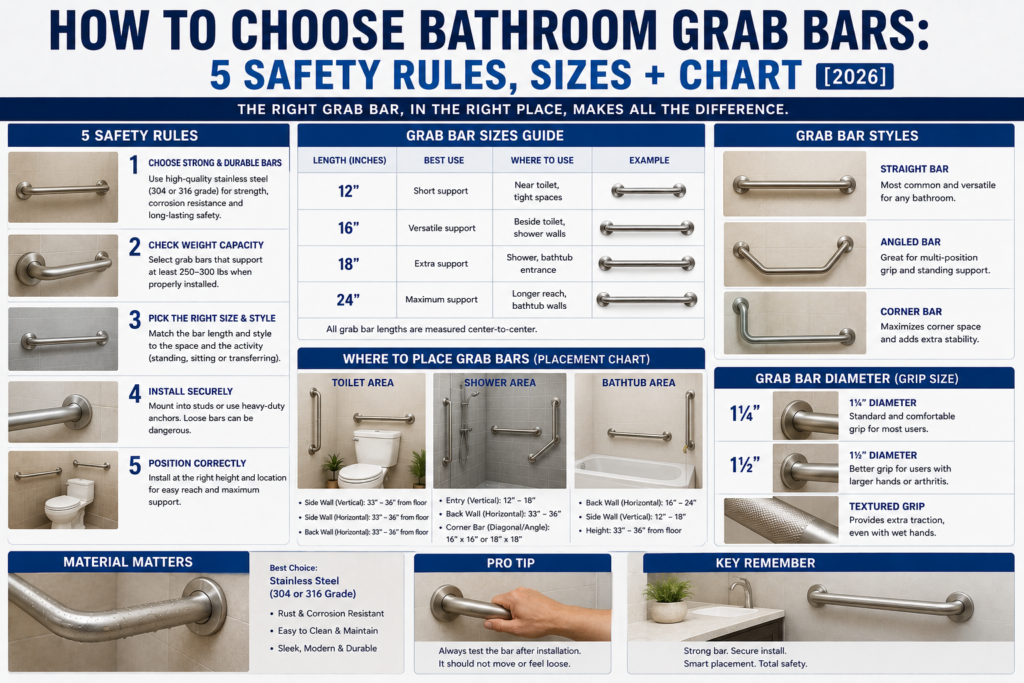
Start with weight capacity, then work outward from there. A grab bar’s ability to support a real fall depends first on how much force it’s rated for, second on whether the wall behind it can actually take that force, and only third on length, diameter, and orientation. Get the first two right, and the rest is largely preference. Get them wrong and the bar becomes a hazard instead of a safeguard — something that gives way exactly when someone leans on it hardest.
Five factors decide whether a grab bar works: weight rating, wall anchoring, length and diameter, placement height, and orientation. Each one below explains what to look for and why it’s non-negotiable.
Weight Capacity Comes First
A grab bar needs to hold at least 250 pounds of applied force, not just the user’s static body weight. That 250-pound figure comes from the 2010 ADA Standards for Accessible Design, and it’s not arbitrary—it accounts for the sudden, dynamic force of someone grabbing the bar mid-fall, which is far higher than their standing weight alone.
Manufacturers list a “weight capacity” on the packaging, but that number only means something if the bar is anchored correctly. A 500-pound-rated bar screwed into hollow drywall will still fail well below its rating because the wall—not the bar—becomes the weak point.
Look for bars explicitly tested to the 250-pound ADA structural strength standard, even for a home that has no legal obligation to meet ADA code.
Wall Type and Anchoring
The single most common installation failure is mounting a grab bar into drywall or tile without hitting a stud or added blocking. Drywall alone has almost no pull-out resistance under sudden lateral force—it’s designed to hold light picture frames, not a falling adult.
The reliable fix is anchoring directly into wall studs, which are typically spaced 16 inches apart in U.S. homes, or into blocking—a piece of solid wood or plywood installed inside the wall specifically to give a grab bar something solid to bite into.
If a stud isn’t where you need the bar, don’t rely on standard drywall anchors. Heavy-duty toggle bolts rated for the bar’s full load, or professionally installed blocking, are the only reliable alternatives.
What length grab bar do I need? Most bathroom grab bars run 12, 18, 24, or 32 inches, and the right length depends on the task: 12–18 inches works for a single-point toilet-side grip, while 24–32 inches suits a shower wall where a hand needs to travel with the body during entry or exit.
Length and Diameter
The grab bar diameter should sit between 1.25 and 1.5 inches—narrow enough for most adult hands to close fully around it and wide enough to distribute grip pressure without digging into the palm. This range comes directly from Section 609 of the ADA Standards and applies just as well to a private bathroom as a commercial one.
Anything thinner tends to feel unstable under a full grip; anything thicker can be hard for someone with arthritis or reduced hand strength to close around securely.
Beyond diameter, check for a textured or knurled surface. A smooth polished-chrome bar looks clean in photos but becomes noticeably harder to grip the moment a hand is wet or soapy.
Placement and Height by Bathroom Zone
Mount grab bars between 33 and 36 inches above the finished floor—the ADA-referenced height range (Section 609.4) that matches how most adults naturally reach while standing or transferring from a seated position. This isn’t a hard rule for every household; a shorter or taller primary user may need the height adjusted.
Placement changes by zone. Near the toilet, a bar supports the push-up motion of standing from a seated position. At the shower entry, a bar supports balance while stepping over a threshold. Inside the shower or tub, a bar supports weight-bearing during the wash itself.
For exact positioning by fixture—toilet, shower stall, or tub—see our full breakdown of grab bar placement for toilets and showers, which covers distance from walls and corners in detail.
Straight, Angled, or Vertical?
Horizontal bars support pushing up from a seated position; vertical bars support pulling up while standing or stepping. These aren’t interchangeable—a horizontal bar mounted where someone needs to pull themselves upright offers the wrong angle of leverage entirely.
Should grab bars be angled or straight? A 45-degree angled (diagonal) bar is often the best single choice beside a toilet because it lets one hand transition smoothly through the push-pull motion of sitting down and standing up, rather than needing two separate bars.
For a full comparison of when each orientation makes sense, see our guide on whether grab bars should be horizontal or vertical.
Grab Bar Selection Chart
| Bathroom Zone | Recommended Orientation | Typical Length | Minimum Load Rating | Mounting Requirement |
|---|---|---|---|---|
| Beside toilet | Horizontal or 45° angled | 18–24 in | 250 lbs | Stud or blocking |
| Shower entry/threshold | Vertical | 18–24 in | 250 lbs | Stud or blocking |
| Inside shower wall | Horizontal | 24–32 in | 250 lbs | Stud or blocking |
| Tub side wall | Horizontal, two bars | 24 in each | 250 lbs | Stud or blocking |
| Tub control-end wall | Horizontal | 24 in | 250 lbs | Stud or blocking |
Save or screenshot this Grab Bar Selection Chart — it covers the four factors (zone, orientation, length, load rating) you need before you buy or install anything.
Do You Need ADA-Compliant Bars?
A private home is almost never legally required to meet ADA standards, but the ADA specifications are still the best benchmark available for choosing a safe bar. ADA rules apply to public and commercial buildings, not individual residences — so nobody is going to inspect your bathroom for compliance.
That said, the numbers behind ADA grab bar rules (1.25–1.5 inch diameter, 1.5 inches of wall clearance, 33–36 inch mounting height, and 250-pound load rating) exist because they were tested against real biomechanics, not because a regulator picked round numbers. Using them as your default is a reasonable, evidence-based shortcut even when compliance isn’t required.
For the full technical detail on where ADA rules do and don’t apply to residential bathrooms, see our ADA bathroom grab bar requirements guide.
DIY Install or Hire a Pro?
Installing a grab bar yourself is reasonable if you can locate studs or blocking exactly where the bar needs to go; if not, hire a licensed contractor or handyman. A stud finder and a confirmed anchor point are the deciding factors, not general handiness.
The risk with DIY installation isn’t the screwdriver work—it’s the temptation to mount the bar a few inches from the ideal spot because that’s where the stud happens to be, rather than moving the bar’s function to match. A professional installer can add blocking behind the wall to put the bar exactly where it needs to be, which a DIY installer usually can’t do without opening the wall.
No product placement—purely informational. If your bathroom walls are tile over cement board, or you’re unsure what’s behind the surface, that uncertainty alone is a good reason to bring in a professional rather than guess.
Common Mistakes People Make Choosing Grab Bars
The most frequent mistake is buying based on appearance instead of load rating and anchor location. A polished, decorative bar that matches the towel rack is worthless if it’s mounted into drywall alone.
- Assuming any wall mount is secure enough. Drywall anchors are not rated for fall-force impact, regardless of how many screws are used.
- Choosing suction-cup bars for permanent, full-weight support. Suction bars are useful for light balance assistance or travel, but they are not a substitute for a stud-anchored bar for anyone who needs to bear real weight.
- Mounting at a fixed “standard” height without checking the primary user’s actual reach. The 33–36 inch ADA range is a strong starting point, not a rule that overrides a specific person’s needs.
- Installing only one bar. A bathroom with a toilet, shower, and tub often needs three or more bars at different zones—a single bar rarely covers every transfer point.
- Skipping the stud finder. Guessing at stud location and hoping for the best is the single most avoidable error in this entire process.
According to the CDC’s Morbidity and Mortality Weekly Report on nonfatal bathroom injuries, an estimated 234,000 nonfatal bathroom injuries among people 15 and older are treated in U.S. emergency rooms every year, and roughly 80% of those injuries come from falls. A grab bar that’s correctly anchored and positioned is one of the few home modifications directly tied to reducing that risk.
Best Grab Bars for Elderly or Limited-Mobility Users
Choosing a grab bar for an ageing parent or a household member with limited mobility usually means prioritising lower reach heights, angled bars near the toilet, and multiple bars along the full bathing path rather than a single fixture. For a full breakdown of what changes when the primary user has reduced strength or balance, see our guide to bathroom grab bars for elderly users.
FAQs
Should Grab Bars Be Angled or Straight?
Angled, or diagonal, grab bars can be especially useful beside a toilet because they provide support during both lowering and rising movements. Horizontal grab bars are often a better fit for situations where the user needs to push or pull sideways, such as getting up from a shower seat. Vertical bars can provide steady support when entering or exiting a shower or when maintaining balance while stepping.
What Are the Rules for Grab Bars in Showers?
Private residential bathrooms generally do not have a federal requirement to include grab bars. However, commonly referenced accessibility standards provide guidance on safe placement and installation. A typical shower setup may include a vertical grab bar near the entrance and a horizontal bar along the main wall. Grab bars should be securely attached to structural framing or suitable blocking and should be capable of supporting substantial loads. Exact dimensions can vary depending on the bathroom layout and applicable accessibility requirements.
Should Toilet Grab Bars Be Horizontal or Vertical?
Horizontal or diagonal grab bars are usually more practical beside a toilet than a purely vertical bar. When a person rises from a seated position, they often need support that allows them to push upward while maintaining control. A horizontal or angled bar can provide a more natural hand position for this movement. The ideal configuration ultimately depends on the user’s height, strength, mobility, and the bathroom layout.
What Are the Best Bathroom Grab Bars for Elderly People?
The right grab bar depends on the user’s individual mobility and support needs. In general, a securely anchored grab bar is preferable to decorative bars or suction-only models when the user needs to put significant weight on the bar. Bars should be installed at a comfortable height and positioned where the person naturally reaches for support. Near a toilet, an angled bar can be helpful for users who need assistance when sitting down or standing up.
Can Grab Bars Be Installed on Tile Without Drilling Into a Stud?
Grab bars can be installed through tiled walls, but the tile itself should not be treated as structural support. The mounting hardware needs to connect securely to a wall stud or properly installed blocking behind the tile. During installation, the installer must drill through the tile carefully to avoid cracking it while reaching the structural support behind the wall. If suitable framing is unavailable, additional blocking may need to be installed before the grab bar is mounted.
Do Grab Bars Need to Be Installed by a Professional?
Professional installation is not always necessary. A skilled DIYer can install a grab bar when the mounting location, wall construction, and structural anchor points have been properly confirmed. However, professional help is a smart choice when there is no suitable stud or blocking where the bar needs to go. A qualified installer can reinforce the wall and position the grab bar correctly so it provides dependable support.
What to Do Next
Start by confirming where your bathroom actually needs support — toilet, shower entry, or tub — using the exact height and distance specs in our grab bar placement guide for toilets and showers. From there, decide on horizontal versus vertical orientation for each spot, and if you’re shopping specifically for an ageing parent or a household member with reduced mobility, our guide to bathroom grab bars for elderly users narrows the choice further.