
Introduction
Can You Use Drywall Anchors for a Grab Bar? Your stud finder beeped in the wrong spot, and the grab bar you bought will not line up with any wood. Drywall anchors can work here, but only if you use the right type for your wall, and this article gives the load ratings to help you decide.
Table of Contents
Quick Answer: Yes, if the anchors are heavy-duty strap-toggle types rated for hollow walls. In half-inch drywall, one 1/4-inch SnapToggle has a 265-pound ultimate pull-out value, and Toggler recommends using one quarter of that, about 66 pounds per anchor. Standard plastic drywall anchors are not safe for grab bars.
What You Need to Know
- Heavy-duty strap-toggle anchors can hold a grab bar in hollow drywall. Standard plastic anchors cannot.
- Toggler’s published pull-out value for a 1/4-inch SnapToggle in 1/2-inch drywall is 265 lb, and its safe working load is one quarter of that.
- That rating assumes the load sits close to the wall. A grab bar stands 1½ inches off the wall, so treat 265 lb as a ceiling.
- Before drilling, confirm the drywall thickness, at least 1-7/8 inches of space behind the wall, and no wires or pipes.
- If a stud or blocking is within reach, use it instead of anchors.
Can You Use Drywall Anchors for a Grab Bar?
Yes, but only with heavy-duty hollow-wall anchors, such as strap-toggle anchors rated for grab bars, never standard plastic anchors. A stud is still stronger. Anchor strength depends on drywall thickness, so check the manufacturer’s load rating before you drill.
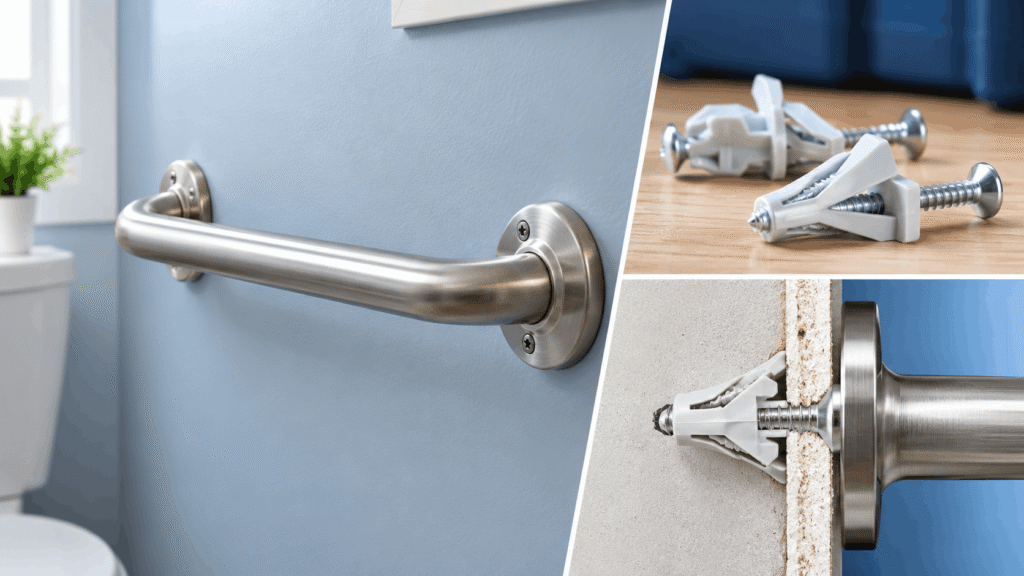
A strap-toggle anchor is a hollow-wall fastener with a metal channel that flips flat behind the drywall, used to spread a load across the back of the wall instead of onto one screw thread. That spreading is what a grab bar needs. Drywall itself is soft gypsum, typically 1/2 or 5/8 inch thick.
Are Drywall Anchors Strong Enough for Grab Bars?
Sometimes. Whether an anchor is strong enough depends on its size, the drywall thickness, and how far the bar sits from the wall.
The 2010 ADA Standards, Section 609.8, require that grab bars, fasteners, mounting devices, and supporting structures withstand 250 pounds of force applied at any point. That rule binds covered public buildings, not most homes. Still, it is the yardstick most people use, so the numbers below are compared against it.
| Bolt size | Drywall thickness | Ultimate pull-out | Working load per anchor (÷4) | Four anchors, equal share |
|---|---|---|---|---|
| 1/4″-20 | 1/2″ | 265 lb | ~66 lb | ~265 lb |
| 1/4″-20 | 5/8″ | 356 lb | 89 lb | 356 lb |
| 3/16″-24 | 1/2″ | 238 lb | ~60 lb | ~238 lb |
| 3/16″-24 | 5/8″ | 356 lb | 89 lb | 356 lb |
Ultimate load versus working load
Ultimate pull-out value is the force at which an anchor fails in a laboratory test. Working load is the much lower force you should plan on, which Toggler sets at one quarter of the ultimate value.
Here is the counterintuitive part. Four anchors, each used at one quarter of its ultimate value, add up to roughly one anchor’s failure point. In 1/2-inch drywall with 1/4-inch bolts that is about 265 lb, right at the ADA’s 250 lb. With 3/16-inch bolts, the same math gives about 238 lb under it.
This is a sanity check, not an engineering calculation. The ADA figure is a stress test on the whole assembly, not a working load, so the two numbers do not compare exactly.
Why does distance from the wall cut the rating
Toggler states that its holding values apply to objects held close to the wall. Moving the load away from the wall raises the effective force on the anchor and greatly reduces the allowable load.
A grab bar sits 1½ inches from the wall, and a person’s pull acts as a lever on the anchors. Treat every number in the table as a ceiling, not a guarantee.
Which Drywall Anchors Work for Grab Bars, and Which Never Should?
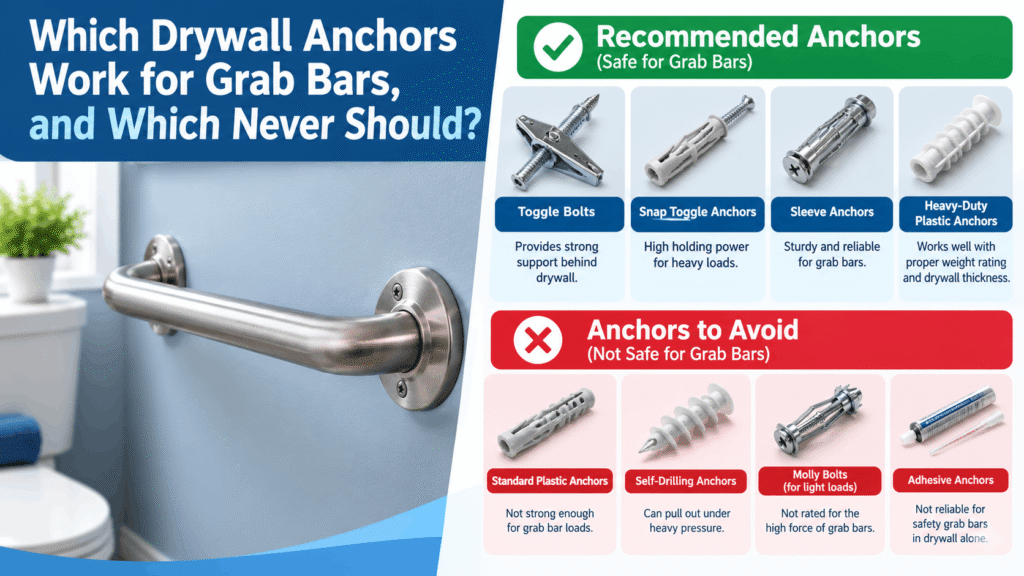
Only anchors with a published load rating for hollow walls belong behind a grab bar. Anchors sold for towel racks and shelves are built for light, steady loads, not sudden body weight. Towel bars and grab bars are built differently for the same reason.
| Anchor type | Fit for a grab bar? | Why |
|---|---|---|
| Plastic expansion anchors | No | Designed for light fixtures, with no grab-bar-level rating |
| Wing-style toggle bolts | Only if rated | Toggler says its SnapToggle holds up to twice as much as wing toggles of the same bolt diameter, and a 1/4″ wing toggle needs a 3/4″ hole |
| Strap-toggle anchors (SnapToggle type) | Yes, within the numbers above | Published ratings, works in walls 3/8″ to 3-5/8″ thick, uses a 1/2″ hole for the 1/4″ size |
| Grab-bar-specific mounting kits | Yes, if rated | Follow the kit’s own weight rating and instructions. |
How Do You Check Your Wall Before Drilling?
Confirm three things before the first hole: drywall thickness and empty space behind instructions. and nothing hidden in it. Skipping any of them makes the table above meaningless.
- Thickness: Measure at any exposed edge, such as a cut-out or door frame. If you cannot see one, assume 1/2 inch and use that row of the table.
- Clearance: The anchor channel needs at least 1-7/8 inches of empty space behind the wall, according to GrabBars.com’s install guidance for Toggler anchors.
- Hidden lines: Check for wiring and plumbing behind the wall. GrabBars.com warns that older homes may not follow current layouts.
- Wall type: Tile over drywall, plaster, or a fibreglass shower surround changes the hole prep and the rating. [CONTENT GAP: how to install a grab bar on tile/in a fiberglass shower]
- Stud: Scan again a few inches either side of your planned spot, because sliding the bar to catch a stud beats any anchor. Most stud walls are built 16 inches on centre, so measure from the nearest corner in 16-inch steps and confirm with a knock or a tapped finishing nail, as Family Handyman’s stud-finding guide shows. In old plaster walls, verify each stud by hand, because electronic finders can mistake wood lath for a stud.
Stud, Anchor, or Blocking: Which Should You Use?
When a stud reaches a mounting point, use the stud. When it does not, the wall’s condition decides the rest.
- Does a wood stud line up with a mounting point? Yes: screw the bar into the stud.
- No stud, but the wall is open or being remodelled? Add horizontal blocking (lumber fitted between studs), then screw into it.
- Wall closed, drywall at least 1/2 inch, at least 1-7/8 inches of clearance, no wires or pipes? Use four strap-toggle anchors.
- Any “no” or “not sure”, or is the wall plaster, tile, or fiberglass? Stop and call a professional.
Height matters as much as mounting. The ADA sets it at 33 to 36 inches to the top of the gripping surface (Section 609.4). That binds public buildings, not most homes, so treat it as the reference and adjust to the user’s height.
For the wider set of options, see our guide to installing a grab bar in drywall without studs.
If you’d like this decision tree, the load table, and the six steps below on one printable page, the newsletter’s Grab Bar Anchor Checklist covers all three. [EMAIL CAPTURE: Grab Bar Anchor Checklist]
How to Install a Grab Bar With Drywall Anchors
Installing a grab bar with heavy-duty drywall anchors requires careful measuring, drilling, and fastening. For a typical two-point mounting setup, you’ll make four anchor holes—two at each mounting flange—and use a 1/2-inch drill bit if that matches the anchor manufacturer’s specifications.
1. Mark the Hole Locations
Start by placing painter’s tape over the areas where the grab bar will be mounted. Position the bar at the desired height and use a level to make sure it is straight.
Mark the centre of each mounting hole through the grab bar’s flanges. Take your time at this stage because accurate hole placement makes the rest of the installation much easier.
2. Check for Pipes and Electrical Wiring
Before drilling, make sure there are no plumbing lines or electrical wires behind the marked locations.
If you cannot confidently determine what is behind the wall, stop and investigate further before making any holes. Drilling into a hidden pipe or electrical cable can create a serious safety and repair problem.
3. Drill the Anchor Holes
Once the locations are confirmed, drill the four mounting holes using a 1/2-inch drill bit, provided that size is specified for your particular anchors.
Keep the holes as close to the required diameter as possible. A hole that is too large can prevent the anchor from gripping the wall properly, while an undersized hole may make installation difficult or damage the anchor.
4. Insert the Toggle Anchors
Prepare each toggle anchor according to its instructions. Fold the metal channel against the plastic straps and push the channel through the drilled hole.
After the channel passes through the wall, pull the straps toward you so the metal portion sits flat against the back of the wall. Slide the locking cap down the straps until it rests firmly against the wall surface.
Secure the cap and remove the excess plastic straps according to the anchor manufacturer’s instructions.
5. Secure and Seal the Grab Bar
Use fasteners designed for the specific toggle anchors you installed. Do not automatically use wood screws simply because they came with the grab bar; screws are intended for wood.
What Mistakes Make an Anchored Grab Bar Fail?
The most costly mistake is reading an ultimate pull-out rating as a safe load. A 265 lb figure means the anchor fails at 265 lb, not that it is safe at 265 lb.
- Reusing plastic anchors that came with a towel bar or shelf.
- Drilling an oversized hole “for easy fit”, which reduces holding strength.
- Skipping the thickness check and using 5/8-inch numbers in a 1/2-inch wall.
- Leaving out sealant in a shower, which lets water get behind the flange and can rust the hardware.
- Never re-checking the bar. Press on it now and then, and tighten or reset anything that moves.
When Should You Call a Professional Instead?
Call a professional when you cannot confirm the wall type, the clearance, or what runs behind it. That includes plaster walls, tile over unknown backing, fiberglass surrounds, and any bar that will take full body weight during transfers.
Grab bars matter for a reason. According to the CDC, falls are the leading cause of injury for adults 65 and older, and over 14 million, or 1 in 4, report falling every year. The CDC also reports that the age-adjusted fall death rate rose 21% between 2018 and 2024, from 64.7 to 78.4 per 100,000 older adults.
FAQs
Can Grab Rails Be Fixed to Plasterboard?
Yes, but use heavy-duty hollow-wall anchors rated for the load, or fasten the rail into timber studs or blocking behind the plasterboard. Standard plastic plugs or screws alone are not suitable for a grab rail.
How Do You Install a Grab Bar Without Screws?
Suction and adhesive grab bars are available, but their holding strength varies by product and surface. For a bar that may support body weight, use studs, blocking, or properly rated anchors whenever possible.
How Much Weight Can You Hang on Drywall?
Drywall capacity depends on the anchor, wall thickness, and how the load is applied. Grab bars require extra caution because body weight can create sudden and uneven forces, so use the anchor’s rated working load rather than the drywall’s general capacity.
Do Grab Bars Need to Be in Studs?
No, but studs or solid blocking provide a strong mounting surface. If no stud is available, use a heavy-duty anchor specifically rated for grab-bar applications and the wall type.
Are Drywall Anchors Strong Enough for Grab Bars?
Some heavy-duty toggle anchors can support a grab bar when correctly installed and used within their rated limits. Standard plastic drywall anchors should not be used for this purpose.
Can You Use These Anchors Through Tile?
Some anchors can be installed through tile and drywall, but the anchor must accommodate the complete wall thickness. Use the correct tile drill bit and verify what is behind the tile before drilling.
How Many Anchors Does a Grab Bar Need?
The number depends on the grab bar’s design and mounting instructions. Follow the manufacturer’s specified number, anchor type, and fastener size rather than using the same setup for every bar.
What to Do Next
Once you’ve chosen the right mounting method, the next step is selecting a grab bar that provides reliable support and suits your bathroom environment. Compare stainless steel vs. brass grab bars and explore the differences between textured and smooth grab bar grips.
For guidance on proper bathroom placement and accessibility, refer to the AARP HomeFit bathroom guide.