
Introduction
Grab Bar vs. Towel Bar You reached for the bar on your bathroom wall to steady yourself, and it wobbled. Now you wonder if it was ever meant to hold your weight in the first place. Here’s the straight answer, no guessing involved.
Table of Contents
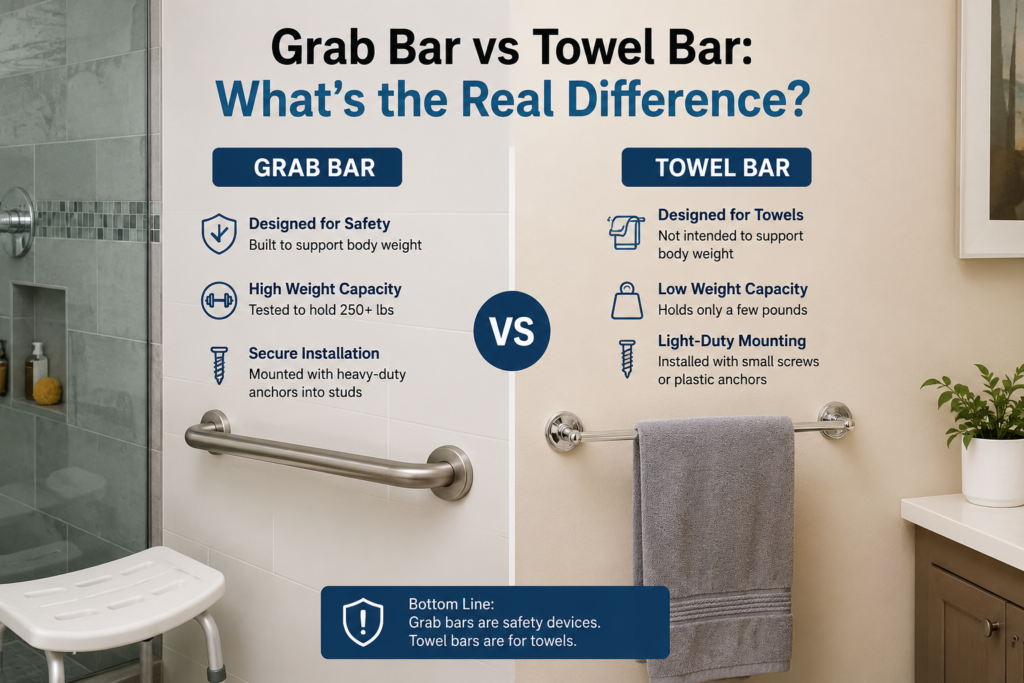
Quick Answer: A grab bar is a load-rated safety fixture, tested to hold at least 250 lbs under ADA/ANSI A117.1 standards, and mounted into wall studs or heavy-duty anchors. A towel bar is a light fixture rated for a few pounds of damp fabric, mounted with small screws, and never tested or built to bear body weight.
What You Need to Know
- Grab bars must meet a 250-lb minimum pull-force standard under ANSI A117.1; most sold today are rated to 500 lbs.
- Towel bars are attached with light-duty screws or anchors that aren’t designed for sudden, off-centre force.
- The two can look almost identical on a store shelf — the difference is in the mounting hardware and internal reinforcement, not the visible bar.
- If you’ve been using a towel bar for balance, that’s a sign a real grab bar belongs in that exact spot.
- Falls are the leading cause of injury among older adults in the U.S., and home modifications like grab bars are one of the interventions the CDC’s STEADI fall-prevention programme recommends.
What Is a Grab Bar?
A grab bar is a bathroom fixture engineered specifically to bear body weight during a fall or loss of balance. It’s made from stainless steel or another reinforced metal, textured or knurled for grip when wet, and anchored into wall studs or specialty anchors rated for load-bearing use.
The 250-lb figure isn’t marketing—it’s the minimum pull force a grab bar has to survive under ANSI A117.1, the accessibility standard most manufacturers build to. Many bars on the market today, including common models sold at major home improvement retailers, are rated up to 500 lbs.
That rating only holds if the bar is installed correctly. A grab bar screwed into drywall alone, without hitting a stud or using a rated anchor, doesn’t meet that standard regardless of what the packaging says. The bar itself might be perfectly rated, but the wall behind it becomes the weak point.
Grab bars also come in more shapes than most people expect — straight, angled, L-shaped, and even fold-away versions for tight spaces. The shape changes how someone uses it (pushing up from a toilet vs. steadying while stepping over a tub wall), but the weight rating and stud-mounted installation stay the same requirement across every style.
What Is a Towel Bar?
A towel bar is designed to hold a few pounds of wet fabric — nothing more. It’s typically thin chrome, brushed nickel, or even plastic, mounted with small screws into drywall or light anchors.
Nobody engineers a towel bar for sudden lateral force. The bracket, the screws, and the wall anchor are all sized for a static, gentle load — a towel hanging still, not a hand grabbing firmly mid-slip.
That’s the core problem: a towel bar can feel steady when you lightly test it with your hand, because “steady under a soft pull” and “load-rated for a fall” are two completely different engineering standards. One measures whether a towel stays put. The other measures whether a person stays upright.
Manufacturers don’t publish a weight rating for towel bars the way they do for grab bars, because towel bars were never designed against that kind of test in the first place. There’s no ANSI standard a towel bar is trying to meet.
The Real Difference (Side-by-Side)
| Grab Bar | Towel Bar | |
|---|---|---|
| Weight rating | 250 lb minimum (ANSI A117.1), often up to 500 lb | Typically 5-15 lb, untested for sudden force |
| Material | Stainless steel, reinforced metal | Thin chrome, brushed nickel, or plastic |
| Mounting | Wall studs or heavy-duty load-rated anchors | Small screws or light drywall anchors |
| Surface | Textured/knurled grip, wet-safe | Smooth, can be slippery when wet |
| Typical price | $15–$60 | $10–$30 |
| Can it be mistaken for the other? | Yes — some styles look nearly identical to a towel bar | Yes — same risk |
The weight rating and the mounting method are the two things that actually separate a grab bar from a towel bar—everything else is styling. Save or screenshot this table; it covers the exact specs to check before you buy or before you decide a bar in your bathroom is safe to lean on.
Price alone won’t tell you which one you’re looking at either. A well-finished towel bar can cost more than a basic grab bar, which is exactly why checking the packaging and hardware matters more than checking the price tag.
Can I Use a Towel Bar as a Grab Bar?
A towel bar’s screws and wall anchors aren’t built to survive the sudden, uneven force of a real slip, even if it holds steady when you lightly pull on it by hand.
The failure mode is the part people underestimate. A towel bar doesn’t usually snap cleanly — it tears the anchor out of the drywall, which means the person reaching for support gets nothing to hold onto at the exact moment they need it most. That sudden loss of the thing you grabbed can turn a minor stumble into a full fall. Bathroom falls carry real weight in the data: falls in the bathroom are more than twice as likely to cause injury as falls elsewhere in the home, according to research funded through the CDC’s STEADI initiative. That’s exactly why the bar within reach near your shower, tub, or toilet needs to be rated for it.
How to Tell Them Apart When Buying
At the store, grab bars and towel bars can look almost identical, so check the packaging and the mounting hardware, not the shape of the bar. This is the part most guides skip, and it’s exactly where people get confused while shopping.
- Look for “ADA compliant” or “ANSI A117.1” printed on the packaging—towel bars never carry this label.
- Check the included hardware: grab bars ship with lag screws or stud-mounting hardware; towel bars ship with small drywall screws.
- Check the listed weight rating directly—if it’s not printed anywhere, it’s not a grab bar.
- Feel the surface—most grab bars have a textured or peened grip; towel bars are usually smooth.
- Check the bar’s diameter—grab bars are typically 1¼ to 1½ inches thick for a secure handgrip; towel bars are often thinner or oval-shaped for a decorative look.
Online, the same rule applies. Read the product description for a weight rating and an ADA or ANSI mention before you trust a photo. Retail listings that skip both of those details are almost always towel bars, even when the product name uses the word “bar” in a way that sounds safety-related.
If You’re Already Using a Towel Bar for Support
Replace it before you rely on it again, not after the next slip. Swapping a towel bar for a properly rated grab bar in the same spot is one of the simpler bathroom safety upgrades, but it does mean locating a stud or using anchors rated for the load, not just repeating the towel bar’s screw holes.
Reusing the exact same holes is a common shortcut that undermines the whole point of the swap — a grab bar mounted into towel-bar-sized anchors is still only as strong as those anchors, regardless of what the bar itself is rated for.
If you’re not sure which bar fits your bathroom layout or how many you actually need, this guide on how to choose bathroom grab bars walks through sizing and placement for showers, tubs, and toilets. For the mounting details specifically—stud-finding, anchor types, and when to call a pro—see bathroom grab bar mounting options.
Common Mistakes
The single most common mistake is trusting a hand test over a weight rating. A bar that feels rigid when you push on it gently tells you nothing about how it holds up under a sudden 150+ lb lateral pull.
- Mounting a “grab bar” into drywall alone without hitting a stud or using a rated anchor—this voids the weight rating even on a real grab bar.
- Assuming a decorative towel bar with a thicker, “sturdier-looking” design is automatically safe—thickness isn’t the same as load rating.
- Placing the grab bar where it looks good instead of where the hand naturally reaches during a slip near the shower entry or toilet
- Buying based on finish or price alone instead of checking for the ADA/ANSI label and hardware included in the box
- Assuming one grab bar covers every risk spot in the bathroom, when most bathrooms actually need bars at both the shower and the toilet
FAQs
Can You Use a Towel Bar as a Grab Bar?
No. A standard towel bar should never be relied on for body support. Towel bars are generally designed to hold towels rather than support a person’s weight, and their mounting hardware is not intended to handle the sudden force that can occur during a slip or loss of balance. A properly installed grab bar is specifically designed for stability and support.
How Are Grab Bars Different From Towel Bars?
The main difference is their purpose, construction, and mounting strength. Bathroom grab bars are designed as safety supports and are installed using appropriate structural anchoring. Towel bars, on the other hand, are designed for hanging towels and typically use lighter-duty mounting hardware. A towel bar should therefore not be treated as a substitute for a properly installed grab bar.
What Grab Bar Is a Good Choice for Seniors?
For many older adults, a straight or angled stainless-steel grab bar can provide dependable support when it is correctly selected and installed. Common sizes include bars around 18 to 24 inches long, but the ideal size depends on the location and the user’s needs. Placement is equally important, particularly around the shower entrance, shower area, and toilet. For more detailed guidance, see our complete guide on how to choose bathroom grab bars.
Is a Grab Bar Necessary in a Walk-In Shower?
A grab bar can be an important safety feature in a walk-in shower, particularly for someone who has difficulty with balance, limited mobility, or is recovering from an injury or procedure. Although a walk-in shower eliminates the need to step over a bathtub wall, it can also remove a convenient surface that someone might instinctively use for balance. A properly positioned grab bar provides a purpose-built support point.
How Much Weight Can a Towel Bar Support?
There is no universal weight capacity for towel bars because their construction and mounting systems vary. They are generally intended for relatively light loads, such as towels, rather than supporting a person’s body weight. More importantly, the force created when someone suddenly grabs or pulls on a fixture during a fall can be very different from simply hanging a towel on it.
Is It Safe to Lean on a Towel Bar?
No. Using a towel bar to steady yourself can be dangerous because its brackets, screws, or wall anchors may not be designed for body weight. If the fixture pulls away from the wall when someone depends on it for support, the person could lose balance and fall. Use a properly installed grab bar instead whenever a bathroom requires reliable hand support.
When Should You Hire a Professional?
Professional installation can be a smart choice when you cannot identify suitable wall studs or when the installation area includes tile, fibreglass, or a prefabricated shower surround. An experienced installer can determine the appropriate anchoring method and position the grab bar correctly for the intended user.
Proper installation matters just as much as choosing a quality grab bar. A bar can only provide the expected level of support when it is attached to a suitable structure using an appropriate mounting method.
What Should You Do Next?
Before buying or installing a grab bar, consider where support is actually needed in your bathroom and what type of bar will work best for the space. Our guide on how to choose bathroom grab bars can help you compare the important factors, including size, style, and placement.
If you already know where you want to install a bar, review our guide to bathroom grab bar mounting options to understand the different ways grab bars can be securely attached to bathroom walls.