
Introduction
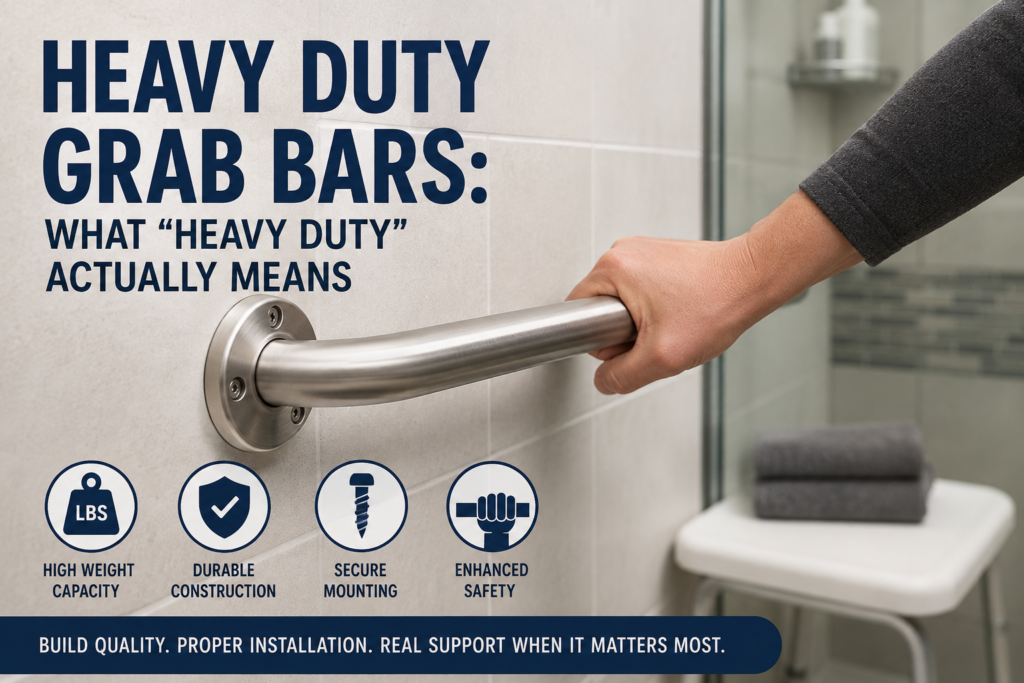
Heavy-Duty Grab Bars A slick tub, an unsteady grip, and a bathroom fixture rated for a hundred pounds less than the person leaning on it — that’s how most people end up searching this exact phrase. Not every grab bar labelled to hold you is actually installed to hold you. This breaks down what “heavy duty” means in real numbers, so you can buy — and mount — the right one the first time.
Table of Contents
Quick Answer: A grab bar qualifies as “heavy duty” when it’s rated well above the 250-pound ADA minimum — typically 400 to 1,000+ pounds — and built from stainless steel or a reinforced core. But the rating only holds up if the bar is installed into a wall stud or a rated anchor system; the bar alone doesn’t determine real-world strength.
What You Need to Know
The 2010 ADA Standards require grab bars and their supporting components to withstand a 250-pound force. Heavy-duty models are typically designed and rated beyond this structural requirement. A grab bar’s strength depends heavily on its installation system. Proper attachment to wall studs, blocking, or an appropriately rated anchor system is essential for achieving the manufacturer’s stated capacity. Stainless steel is commonly preferred for high-capacity grab bars because of its strength and resistance to corrosion, although the overall design and mounting system also affect performance. Bar diameter, surface texture, and grip design primarily influence comfort and usability rather than determining the grab bar’s maximum load capacity. “Heavy duty” is not a standardised U.S. certification category. Manufacturers generally use the term to describe products with higher stated load capacities or reinforced construction.
What Makes a Grab Bar “Heavy Duty”?
“Heavy duty” isn’t a government-defined category. No code specifies what separates a heavy-duty bar from a standard one—manufacturers apply the label to bars rated well past the required minimum.
The Americans with Disabilities Act sets 250 pounds as the baseline every compliant grab bar and its mounting must withstand, per the U.S. Access Board’s accessibility standards, which require the bar, fastener, and supporting structure to resist that force without failing. That’s the floor, not the ceiling. A bar marketed as “heavy duty” typically carries a stated capacity of 400, 500, or 1,000+ pounds.
The distinction matters most for three groups: anyone above an average body weight, anyone using the bar for full-weight support during a transfer rather than just balance, and anyone installing into a wall that can’t support a full stud-mounted setup.
Diameter and clearance are separately regulated—the U.S. Access Board’s toilet room guide sets a 1¼” to 2″ bar diameter and 1½” wall clearance—but “heavy duty” as a marketing term sits entirely outside those code requirements.
Weight Capacity Chart: Standard vs. Heavy Duty
| Tier | Typical Rated Capacity | Common Material | Mounting Requirement | Typical Price (single bar) |
|---|---|---|---|---|
| ADA Minimum (code baseline) | 250 lb | Stainless steel or reinforced plastic | Stud or rated anchor | $20–$40 |
| Standard Residential | 250–350 lb | Stainless steel, powder-coated | Stud or heavy-duty anchor | $25–$50 |
| Heavy Duty | 400–500 lb | Stainless steel, reinforced aluminum core | Stud-mounted strongly preferred | $35–$90 |
| Bariatric / Extra Heavy Duty | 500–1,000+ lb | Solid stainless steel, thicker wall gauge | Stud-mounted required | $60–$150+ |
Save or screenshot this weight capacity chart — it covers the four tiers you’ll run into on product listings and what mounting each one actually requires.
Materials That Support the Highest Weight Loads
Solid stainless steel consistently carries the highest published weight ratings, followed by aluminum-core-reinforced bars, with unreinforced plastic or PVC bars sitting at the bottom of the heavy-duty range.
Here’s the counterintuitive part: a thicker-looking bar isn’t automatically stronger. Wall gauge—the actual thickness of the metal—and core construction matter more than outside diameter. Two bars that look identical on a shelf can carry very different real weight ratings depending on gauge alone.
Stainless steel also holds up better long-term in a wet environment. Corrosion weakens metal over years of shower exposure, which quietly lowers a bar’s real capacity even if the printed rating never changes.
Mounting Matters as Much as the Bar
A grab bar’s weight rating assumes it’s anchored into a stud or rated blocking—mount that same bar into drywall alone, and its real-world capacity drops far below the printed number.
The Access Board’s structural strength standard tests the bar, the fastener, and the mounting device together—not the bar in isolation. That’s the detail most buyers miss: a $90 bariatric-rated bar screwed into bare drywall performs closer to a $15 towel bar under real load.
For walls without stud access at the right height, look for anchors specifically rated for grab bar installation, not general-purpose drywall anchors. For the full walkthrough on finding studs, spacing bolts, and choosing anchors for tile or fiberglass surrounds, see bathroom grab bar mounting options.
Straight vs. Angled: Does Shape Affect Load Rating?
Bar shape and orientation don’t change a bar’s rated weight capacity — that’s set by material and mounting — but they do change how effectively that capacity gets used during an actual fall or transfer.
A vertical bar is built for pulling straight up out of a tub or off a toilet. A horizontal bar is built for lateral stability while standing or shifting weight sideways. An angled bar is meant to support both movements in one fixture, which is why it’s common in tight shower stalls.
None of these change the number stamped on the box. They change whether the person using it can actually apply force in the direction they need. For a full breakdown of when each orientation makes sense, see Should grab bars be horizontal or vertical?
Who Actually Needs a Heavy Duty Rating?
Anyone using a grab bar for full-weight support during a transfer—not just balance—should look at heavy-duty (400 lb+) ratings regardless of body weight, since transfer forces regularly exceed static body weight.
That includes bariatric users, anyone recovering from surgery who leans hard on a fixture while standing, and older adults with limited upper-body strength who rely on the bar to do more of the work than a healthy grip would. A physical or occupational therapist’s recommendation is often the trigger point—if one has suggested grab bars as part of a mobility plan, the heavy-duty tier is usually worth the extra cost over the ADA-minimum tier.
This isn’t a small population. The CDC’s fall prevention programme notes that more than one in four older adults falls each year, and bathroom fixtures like grab bars are one of the few environmental changes shown to reduce that risk.
If you’re working through a full bathroom safety retrofit one decision at a time, the Grab Bars Guide’s newsletter breaks down one fixture at a time—sign up, and the next instalment lands before you need to Google it again.
Common Mistakes
- Buying a heavy-duty bar, then mounting it into drywall alone. The rating on the box assumes stud or rated-anchor installation — skip that step and the number is meaningless.
- Assuming a bigger diameter means a stronger bar. Diameter affects grip comfort, not load capacity. Gauge and core material do.
- Confusing static body weight with transfer force. A 180-pound person pulling hard during a stand-up transfer can apply well over 180 pounds of force to a bar.
- Skipping the stud finder. Eyeballing wall studs is the single most common reason a “heavy duty” installation fails under real use.
FAQ
What type of bathroom grab bar is best for older adults?
The right grab bar depends on the user’s needs, the location, and the way the bar will be used. A well-constructed stainless-steel grab bar with a clearly stated high weight capacity can be a good option when properly installed. For someone with serious mobility challenges, professional advice from a qualified physical or occupational therapist can help determine the most appropriate bar and placement.
What can be used instead of a shower grab bar?
Items such as nonslip flooring, shower benches, and handheld showerheads can improve bathroom safety, but they do not provide the same physical support as a properly installed grab bar. These features are generally best viewed as additional safety measures rather than direct replacements for grab bars.
Are straight or angled grab bars better?
Neither style is universally better because the ideal design depends on the user’s movement and the installation location. Straight bars can provide dependable support for movements in one primary direction, while angled bars can accommodate pulling and repositioning movements. Consider the user’s needs and bathroom layout before choosing the orientation. For more information, see our guide on Should Grab Bars Be Horizontal or Vertical?.
How much weight can a heavy-duty grab bar support?
The stated capacity varies considerably between products. Many heavy-duty models advertise capacities in the 400- to 500-pound range, while some bariatric products claim considerably higher capacities. Always check the manufacturer’s specifications and installation requirements because the advertised capacity depends on the complete mounting system, not just the bar itself.
Does a heavy-duty grab bar have to be installed into a wall stud?
Not necessarily in every situation, but the installation method must be capable of supporting the manufacturer’s specified load. Some products can be installed with specially designed grab-bar anchors or other approved mounting systems when a stud is unavailable. Never assume that a standard drywall anchor is suitable; follow the manufacturer’s approved installation method.
Is “heavy duty” an official grab bar rating?
No. “Heavy duty” is generally a marketing or product-description term rather than a standardized government certification category. Instead of relying on the label alone, check the product’s stated load capacity, construction, mounting requirements, and any applicable testing or compliance information before purchasing.
What to Do Next
If you’re planning to add grab bars to a bathroom, first understand whether any accessibility requirements apply to your particular situation. Our guide on Are Grab Bars Required in Bathrooms? explains the basics. You can then review Bathroom Grab Bar Mounting Options to understand different installation approaches. For compact bathrooms, Grab Bars for Small Bathrooms can help you think through placement when wall space is limited.