
Introduction
Grab Bars for Small Bathrooms. You measured the wall next to your shower and realised the standard 36-inch grab bar everyone recommends simply won’t fit. Good news: it doesn’t have to. Small bathrooms need different sizing and placement rules than the ones most grab bar guides assume.
Table of Contents
Quick Answer: For small bathrooms, use grab bars in the 12–24 inch range instead of the standard 24–36 inch bars. Mount horizontal bars 33–36 inches above the floor, and leave at least 1.5 inches of clearance between the bar and any adjacent wall or fixture. Corner or angled bars often solve tight shower stalls better than a single long bar.
What You Need to Know
- Shorter bars (12–18″) fit shower stalls and toilet-only zones without crowding the space.
- Horizontal bars belong 33–36 inches from the floor; vertical bars mount along the entry point of the shower or tub.
- A 1.5-inch clearance from the wall is the minimum for a hand to grip properly.
- Corner-angled bars can replace two straight bars in stalls that are under 32 inches wide.
- A grab bar rated for less than 250 lbs of force is not appropriate for weight-bearing support.
What Size Grab Bar Fits a Small Bathroom?
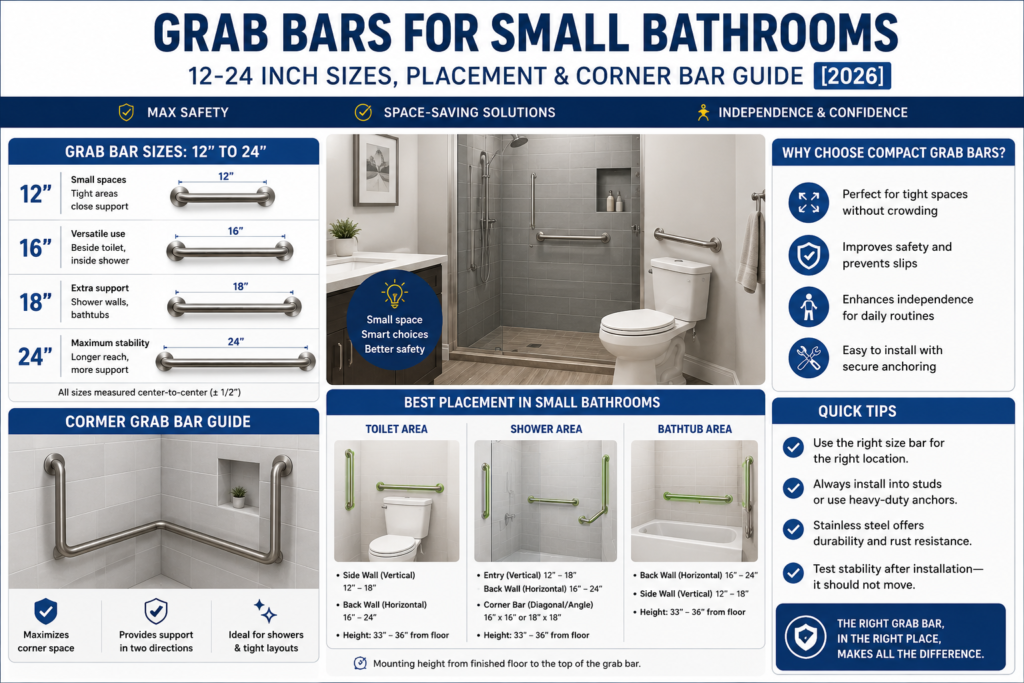
Grab bars in the 12–24 inch range fit most small bathroom layouts, compared to the 24–36 inch bars typical in standard installations. A 12-inch bar works well beside a toilet or in a narrow stall corner. An 18-inch bar covers most tub-entry points. Reserve 24-inch bars for the one wall in the room that actually has the run to support them.
Manufacturers sell bars in fixed increments—usually 12″, 16″, 18″, 24″, 32″, 36″, and 42″. In a small bathroom, you’re almost always choosing between the first three.
The Small-Bathroom Sizing & Clearance Chart
| Zone | Recommended length | Minimum wall run needed | Mounting height | Minimum clearance from fixture |
|---|---|---|---|---|
| Shower stall (single wall) | 12–18″ | 18–24″ | 33–36″ from floor | 1.5″ |
| Shower stall (corner) | Two 12″ bars or one angled bar | 18″ per wall | 33–36″ from floor | 1.5″ |
| Tub/shower combo | 24″ vertical + 18–24″ horizontal | 24–30″ | Vertical: aligned with tub rim to shoulder height; horizontal: 33–36″ | 1.5″ |
| Toilet zone | 12–24″ (residential support, not full ADA side-bar length) | 18–30″ | 33–36″ from floor | 1.5″ |
Save or screenshot this sizing chart — it covers the four spots small bathrooms most commonly need a grab bar.
Where to Place Grab Bars in a Small Shower or Tub
Placement in a small shower comes down to two zones: the entry point and the wash wall. Get these two right and you’ve covered nearly every fall risk in the space.
Shower stall placement
- Mount a vertical bar at the entry. Position it at the leading edge of the shower opening, roughly shoulder height, so a hand can locate it while stepping over the threshold.
- Add a horizontal bar on the wash wall. Set it 33–36 inches from the floor, centred on the wall the person will face while showering.
- Use a corner-angled bar if both walls are under 24 inches. A single 16–18 inch angled bar spanning the corner often does the job of two straight bars without eating extra wall space.
Tub/shower combo placement
- Put a vertical bar at the tub’s entry edge, aligned with where a hand naturally reaches while stepping over the tub wall.
- Add a horizontal bar along the back wall, 33–36 inches up, positioned within easy reach from a seated or standing position in the tub.
- Skip the diagonal bar unless the wall run allows at least 24 inches — anything shorter and a diagonal bar’s ends will land too close to the tub spout or shower valve to grip safely.
Horizontal vs. Vertical: Which Fits Tighter Spaces?
Vertical bars generally fit small bathrooms better because they use less horizontal wall run. A vertical bar only needs the depth of one stud bay, while a horizontal bar needs enough uninterrupted wall length to sit clear of the tub spout, soap dish, or corner seam.
That said, horizontal bars are still the better choice for the wash wall itself, since they support the sideways motion of standing up or steadying while washing. For the full breakdown of when each orientation makes sense, see our guide on whether grab bars should be horizontal or vertical.
Corner and Angled Grab Bars: A Space-Saving Option
A single angled grab bar can replace two straight bars in a shower stall narrower than 32 inches. Angled bars span a corner at roughly 45 degrees, giving a hand something to grip whether someone is entering the shower or already standing inside it.
The trade-off: angled bars cost more per unit than a standard straight bar, and installation requires anchoring into two different stud lines instead of one. In a stall too tight for two separate bars, that trade-off is usually worth it.
Do Small-Bathroom Grab Bars Still Need to Meet ADA Specs?
Only if the bathroom is legally required to be ADA-compliant—most residential bathrooms aren’t, which gives homeowners more flexibility on bar length than a commercial or rental-unit installation would allow. According to ADA.gov‘s Standards for Accessible Design, compliant installations require specific minimum lengths (for example, a 42-inch sidebar near the toilet) and a fixed 1.5-inch clearance from the wall—specs that don’t always fit a genuinely small bathroom footprint.
If full compliance isn’t the goal, shorter bars sized to the actual wall space still provide real support. If it is the goal—a rental property or an accessible remodel requirement—read our full ADA bathroom grab bar requirements guide before you buy anything, since it’s easy to install a bar that misses code by a few inches.
Common Mistakes in Small Bathrooms Grab Bar Installs
The most common mistake is centring a bar on the wall instead of centring it on the motion it needs to support. A bar centred on an 18-inch wall might land six inches from where a hand actually reaches during a step or a stand-up motion, which defeats the purpose even though the bar looks correctly placed.
Other frequent mistakes:
- Mounting into drywall alone. A grab bar has to hit at least one stud or use rated toggle anchors built for 250+ lbs of pull-out force—drywall anchors from a hardware store multipack won’t hold under real weight.
- Choosing a bar length before measuring the wall run. Buying a 24-inch bar for an 18-inch wall means either an awkward diagonal mount or a return trip to the store.
- Skipping the clearance check. Less than 1.5 inches between the bar and the wall makes it hard to get fingers fully around the grip, especially for anyone with reduced hand strength.
No Wall Space? Alternatives to Consider
If there’s genuinely no wall run available for a permanent bar, a few alternatives exist — though each comes with real limitations. Suction-mounted bars, tub-clamp rails, and freestanding floor-to-ceiling poles don’t require drilling, but suction bars in particular should never be trusted with full body weight; they’re best treated as a light steadying aid, not a fall-prevention device.
Want a printable version of the sizing chart above to bring to the hardware store? Our newsletter sends a downloadable placement checklist along with new guides like this one as they publish.
FAQs
What are some alternatives to grab bars in the shower?
Suction-mounted bars, tub-clamp rails, and floor-to-ceiling tension poles are the main no-drill alternatives. Suction bars can lose grip over time, especially on textured tile, so they work best as a light steadying aid rather than a substitute for a stud-mounted bar. A tension pole is a stronger option where wall space genuinely doesn’t exist.
What is the best bathroom grab bar for elderly people?
A stud-mounted stainless steel bar rated for at least 250 lbs of force is generally the safest option for elderly users, since it needs to support full body weight during a fall or a stand-up motion. Textured or knurled grip surfaces help with reduced hand strength. See our full elderly grab bar guide for model-specific comparisons.
What is the strongest suction grab bar for a shower?
Suction grab bars vary widely in hold strength, and none are rated as a primary weight-bearing support—most manufacturers explicitly recommend them only as a light-duty aid. If full weight support is needed, a stud-mounted or toggle-anchored bar is the safer choice regardless of the suction bar’s advertised rating.
What are the safest grab bars for seniors?
The safest grab bars for seniors are stud-mounted, rated for at least 250 lbs of force, with a 1.25–1.5 inch diameter that’s easy to grip and a textured surface for wet-hand traction. Placement matters as much as the bar itself—a bar mounted where it doesn’t align with actual movement patterns won’t get used consistently.
Do grab bars need to hit a wall stud?
Ideally yes, since studs give the most reliable holding strength. Where a stud isn’t available in the right spot, rated toggle-bolt anchors built for at least 250 lbs of pull-out force are an acceptable substitute—standard drywall anchors from a general hardware multipack are not.
How much wall space do I need for a grab bar in a small bathroom?
At minimum, 18 inches of uninterrupted wall run for a 12-inch bar once you account for end caps and mounting flanges. For corner installations, each wall needs roughly 18 inches as well, unless using a single angled bar designed to span
What to Do Next
Once you know the right size and placement for your space, the next decision is usually orientation and code compliance:
- Compare horizontal vs. vertical grab bar placement in more depth
- Check whether your bathroom needs to meet ADA grab bar requirements
- If you’re shopping for someone specific, see our picks for bathroom grab bars for elderly users
- For general selection guidance beyond sizing, our How to Choose Bathroom Grab Bars guide covers material, finish, and weight ratings