
Introduction
Can You Use a Towel Bar as a Grab Bar? Are you considering using a towel bar for support? Learn why towel bars, weight limits, and ADA rules are important, and 3 safer alternatives that look like towel bars
Table of Contents
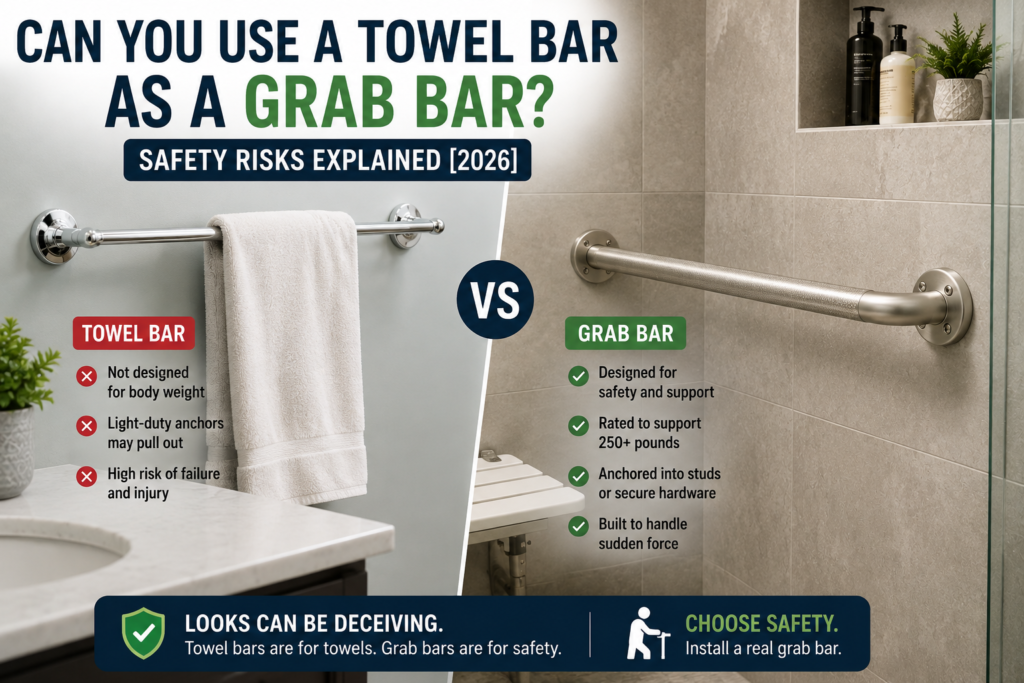
Quick Answer: No, a towel bar cannot safely be used as a grab bar. Towel bars are built to hold a few pounds and are usually mounted with light drywall anchors, not into wall studs. A grab bar is rated to a minimum design load of 250 pounds under ADA and ICC A117.1 standards and is anchored into structural framing, so it stays put under sudden, uneven force—a towel bar can pull straight out of the wall.
What You Need to Know
- A towel bar typically holds only a few pounds; a code-compliant grab bar is rated for at least 250 pounds of pull force.
- The failure point isn’t steady weight; rather, it is the sudden, sideways yank that occurs during a real slip, which towel bar anchors are not designed to withstand.
- You can check what’s on your wall right now in under a minute without any tools.
- Grab bars exist that install without hitting a stud, so a lack of blocking behind the drywall isn’t a reason to keep using a towel bar.
- Replacing a towel bar with a real grab bar is one of the cheapest, fastest bathroom safety upgrades available.
Why Towel Bars Aren’t Built to Hold Body Weight
A towel bar is engineered for a static load of a few pounds—a wet towel—not the dynamic force of a person catching their balance. The tubing is usually thin, hollow metal or plastic, and the brackets go into drywall anchors or, at best, a single stud.
A grab bar is a different category of product: solid stainless steel, installed with lag screws into wall studs or heavy-duty engineered anchors. Building codes adopting the ICC/ANSI A117.1 standard require grab bars to have a structural strength of 250 pounds applied at any point on the bar, fastener, or mounting device — a figure also confirmed on listings for code-compliant bars from major retailers.
That 250-pound figure isn’t about body weight standing still — it’s the sudden, off-angle force of someone actually slipping. The anchors are usually the really weak point, not the visible bar: they’re rated for straight-line pull, not the sideways shear force of a hand grabbing during a fall.
Towel Bar vs. Grab Bar: Side-by-Side
| Feature | Towel Bar | Grab Bar |
|---|---|---|
| Rated load capacity | A few pounds (not load-tested) | 250 lbs minimum (ADA / ICC A117.1) |
| Mounting hardware | Small screws, light anchors | Lag screws into studs or rated heavy-duty anchors |
| Wall requirement | Any wall surface | Stud or engineered anchor system |
| Typical material | Thin hollow metal, plastic | Solid stainless steel, thicker diameter |
| Surface grip | Smooth, decorative finish | Textured or knurled for wet-hand grip |
| Approximate cost | $10–$30 | $20–$50 |
| Safe to lean on for support? | No | Yes, when installed correctly |
Save or screenshot this comparison table — it covers everything you need to check before deciding what’s actually safe to grab in your bathroom. For a deeper look at how these two fixtures are built differently, see the full breakdown of grab bar vs. towel bar construction.
What Happens When a Towel Bar Fails
A towel bar rarely fails during normal use — that’s exactly what makes it dangerous. It holds a towel fine for years, which creates a false sense of confidence.
The failure happens under sudden load: a foot slips, a hand shoots out, and the full sideways force of a falling body lands on hardware built for a couple of pounds. The anchor shears out, or the bar twists loose—and the towel bar becomes a second hazard on the way down.
A peer-reviewed study on PMC (PubMed Central) found that falls occurring in the bathroom were more than twice as likely to result in an injury compared to falls in the living room. An unsecured or under-rated fixture that gives way under grip is exactly the kind of environmental risk factor that turns a slip into an injury.
How to Check What’s on Your Wall Right Now
You don’t need tools to find out what you’re actually dealing with. This takes about 60 seconds.
- Look at the diameter and shape. Grab bars are typically 1.25 to 1.5 inches thick with a straight, uninterrupted grip surface. Towel bars are often thinner or have a decorative profile.
- Check the finish. A textured or knurled surface signals a grab bar built for wet-hand grip. A smooth, glossy chrome finish usually means a towel bar.
- Inspect the mounting plates. Grab bars have substantial end brackets with multiple visible screws. Towel bars often have small, single-screw or clip-style mounts.
- Give it a firm, sideways tug — not a straight pull. Simulate the sideways force of a slip. Any flex or give at the wall means it isn’t rated for support.
- Look for a manufacturer weight rating. Code-compliant grab bars are typically labelled with a pound rating; towel bars almost never list one.
What to Use Instead — and How to Install It
grab bars that look like towel bars The fix is a proper grab bar in the same spot, not a workaround. It doesn’t require a stud to be perfectly positioned; several systems use engineered anchors rated to hold code-rated loads in open drywall. If your stud layout doesn’t line up, this guide to mounting grab bars without hitting a stud covers anchors that still meet the 250-pound standard.
Next come length, placement, and orientation. This walkthrough on choosing the right bathroom grab bar covers sizing for showers, tubs, and toilets. For accessibility code, the ADA bathroom grab bar requirements spell out placement rules, and for tight spaces, this guide to grab bars for small bathrooms covers compact options.
A bar mounted into solid framing typically takes 30 to 45 minutes to install. If the wall cavity is unusual—tile over cement board or plumbing running where the bar needs to go—bring in a licensed contractor rather than guess.
Common Mistakes
Assuming “it hasn’t failed yet” means it’s safe. A towel bar can hold up under years of gentle towel weight and still fail instantly under the sideways force of one real slip.
Testing with a straight downward pull instead of sideways. A real fall applies force sideways and diagonally, exactly the direction towel bar hardware isn’t built for.
Assuming a heavier-looking towel bar is automatically safer. Weight and thickness of the visible tube say nothing about what’s holding it to the wall.
Installing a grab bar but skipping the stud or anchor check. A grab bar mounted with the wrong hardware can fail almost the same way a towel bar does, even though the bar itself is rated correctly.
FAQs
What is the difference between a towel bar and a grab bar?
A towel bar is made for hanging towels and is not intended to support a person’s body weight. A grab bar, on the other hand, is specifically manufactured as a bathroom safety aid. It is designed to withstand significant pulling and downward force when properly installed with suitable structural support or approved heavy-duty mounting hardware.
What can I use instead of a grab bar in the shower?
There is no safe substitute for a properly installed grab bar when you need reliable support in a shower. Items such as towel racks, shower doors, shelves, and soap holders are not designed to catch a person’s weight. If there is no wall stud in the desired location, choose a grab bar and an appropriate mounting system that is specifically rated for the wall construction.
What size grab bar is suitable for a shower?
Grab bars are available in several lengths, with common options ranging from about 16 to 36 inches. Shorter bars may work well for vertical or angled support, while longer bars are often useful for horizontal installation. The best size depends on the available wall space, the user’s reach, and the position where support is needed.
What type of bathroom grab bar is best for an older adult?
A good bathroom grab bar should provide a secure, comfortable grip and have an appropriate weight rating for its intended use. Stainless-steel models with a slip-resistant or textured surface are popular choices. More importantly, the bar needs to be installed in a location where the user can naturally reach it when entering the shower, standing up, sitting down, or moving around the bathroom.
Can a towel bar be modified so it functions as a grab bar?
No. Changing the anchors or adding stronger screws does not turn a towel bar into a safety grab bar. The bar itself may not be engineered to handle the sudden forces created during a slip or fall. For dependable support, remove the towel bar and install a properly rated grab bar designed for that purpose.
Is it safe to briefly use a towel bar for balance?
A towel bar should not be used as a balance aid, even for a moment. If someone begins to slip, they may instinctively put much more force on the fixture than expected. Because towel bars are not designed for this type of load, they can pull away from the wall or fail unexpectedly. Use a properly installed grab bar whenever body support is needed.
Bottom Line
towel bar vs grab bar Although towel bars and grab bars may look similar, they serve completely different purposes. A towel bar is intended to hold towels, while a grab bar is engineered to provide physical support when properly installed. If you currently depend on a towel bar for stability, replacing it with a suitable grab bar is a much safer solution than trying to reinforce or modify the existing fixture.
For bathrooms used by someone with mobility concerns, the bar should also be positioned where it can be reached comfortably and securely. When wall construction or placement is uncertain, consider getting advice from a qualified contractor or another appropriate professional before installation.
What to Do Next
- Want to understand the difference in more detail? Read the complete guide to grab bars vs. towel bars to compare their purpose, construction, and safety features.
- Don’t have a wall stud in the right location? Learn more about installing grab bars in drywall without studs and the mounting options available.
- Not sure which grab bar to choose? Follow this bathroom grab bar selection guide to choose a suitable length, style, and placement.