
Introduction
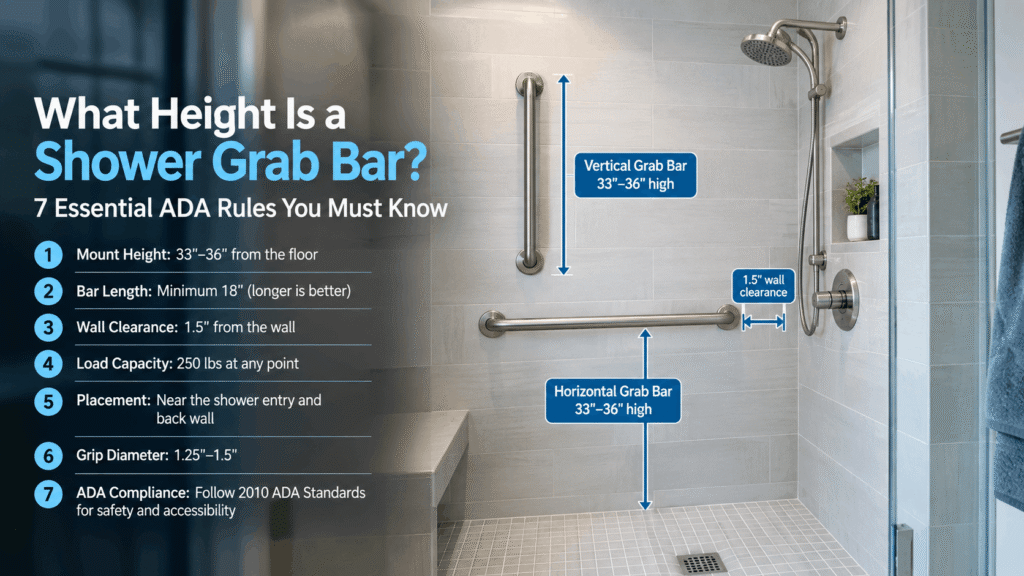
What Height Is a Shower Grab Bar? The standard ADA height is 33–36 inches above the finished floor. But the exact placement also depends on the bar’s location, wall layout, and stud position. Here’s how to get it right the first time.
Table of Contents
Quick Answer: A shower grab bar should be mounted 33 to 36 inches above the shower floor, measured to the top of the bar. This is set by ADA Standards Section 609.4. Diameter, wall clearance, and weight rating matter just as much as height—all seven rules below determine whether the bar actually holds someone’s weight.
What You Need to Know
- Mount horizontal bars 33–36 inches above the shower floor—the exact height the ADA specifies in Section 609.4.
- Bar diameter should be 1.25–2 inches; wall clearance should be 1.5 inches, both measured to fit an average adult grip.
- The bar needs to hold 250 pounds minimum—anchored into a stud or solid blocking, never drywall alone.
- Private homes aren’t legally bound by ADA, but professionals recommend the same range because it fits the widest range of body sizes.
- Transfer-type showers (no seat) also need an 18-inch vertical bar—height alone doesn’t cover that motion.
Rule 1: Mount the Bar 33–36 Inches Above the Floor
Every horizontal grab bar in the shower—back wall, control wall, seat wall—follows this same 33–36 inch range, measured from the shower floor to the top of the bar’s gripping surface.
When a shower has more than one horizontal bar, they should all sit at the exact same height. A user’s hand shouldn’t have to hunt for a different level moving from the back-wall bar to the control-wall bar—that inconsistency is one of the more common install mistakes inspectors flag.
For children’s bathrooms, the accessible range drops to 18–27 inches instead.
Rule 2: Keep the Bar Diameter Between 1.25 and 2 Inches
A grab bar’s diameter has to fall between 1¼ and 2 inches. An average adult hand can firmly grip a grab bar with a diameter between 1¼ and 2 inches. firmly by an average adult hand.
Go thinner and a weak or arthritic hand can’t close around it well; go thicker and the same problem happens in reverse. Oval-profile bars have an equivalent gripping-surface rule rather than a strict diameter, but the “wraps securely in one hand” principle is the same.
Rule 3: Leave 1.5 Inches of Clearance From the Wall
The gap between the bar and the wall behind it should be 1.5 inches.
Less than that, and fingers can’t get a full grip around the bar. More than about 2.5 inches, and an arm can slip through during a fall instead of catching on the bar — which defeats the entire point of installing one. The one carve-out: clearance next to shower controls or another bar above can narrow to 1.5 inches as a minimum, since that’s a hard space constraint.
Rule 4: Rate the Bar for at Least 250 Pounds
A grab bar and its mounting hardware need to support 250 pounds minimum of dynamic force, not just static weight.
This isn’t in the ADA measurement rules—it’s an engineering standard the industry follows because someone catching a fall generates far more force on the bar than their body weight alone. A bar rated below this on the packaging isn’t safe for a bathroom install, full stop.
Rule 5: Add a Vertical Bar in Transfer-Type Showers
Transfer-type showers—the kind without a built-in seat—require a vertical grab bar at least 18 inches long, mounted 3 to 6 inches from the seat wall.
The bottom of this vertical bar should extend at least 4 inches above the horizontal bar beneath it. It gives a pulling point for standing up and a steadying point while stepping over the threshold—motions the horizontal bar alone doesn’t support.
Rule 6: Skip the Bar Directly Above a Fixed Seat
Code prohibits mounting a grab bar directly above a built-in shower seat — it turns into an obstruction rather than support.
The bar instead runs along the wall beside the seat, still at the standard 33–36 inch height as every other bar in the shower.
Rule 7: Anchor Into Studs or Solid Blocking, Not Drywall Alone
None of the height, diameter, or weight specs matter if the bar isn’t anchored into something that can hold 250+ pounds.
Drywall anchors alone pull out under real load — a common failure reported in home-inspection notes when a bar is installed based on looks rather than what’s behind the tile. Studs or added blocking are the only reliable anchor points. If you haven’t confirmed what’s behind your shower wall yet, our stud-finding guide for shower walls walks through testing for it before you drill.
How to Find the Right Mounting Height for One Specific Person
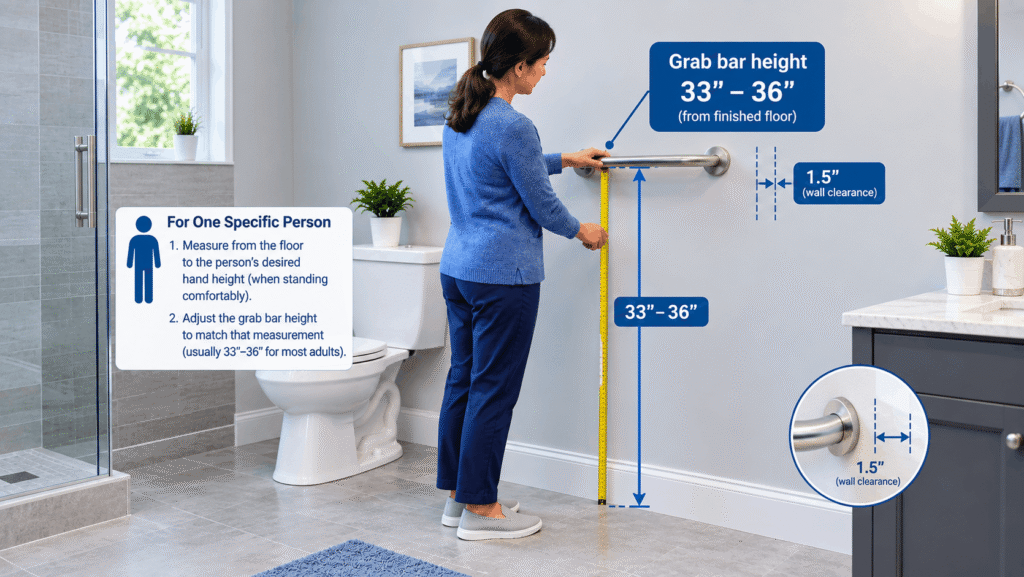
The 33–36 inch range is built for the broadest range of adults. If you’re installing for one person, three quick steps get you closer to their ideal height.
- Have them stand in the shower where the bar will go. Relaxed posture, arms at their sides—not stretched or hunched.
- Measure from the shower floor to their wrist. With the arm hanging naturally, wrist height is usually close to the ideal grip point for a horizontal bar.
- Adjust down for seated use. If they use a shower bench or wheelchair, measure from the seated position instead—this often lands below 33 inches, which is a legitimate deviation from ADA height for a single-user residential install.
Reference Table: Grab Bar Height by Wall Type
| Location in Shower | Height Above Floor | Notes |
|---|---|---|
| Back wall (horizontal) | 33–36 in | Standard mounting height |
| Control wall (horizontal) | 33–36 in | Same height as the back wall bar |
| Seat wall (horizontal, no seat present) | 33–36 in | Omit if a fixed seat sits at this wall. |
| Vertical bar (transfer shower) | Bottom edge 4 in above horizontal bar; min. 18 in long | Mounted 3–6 in from the seat wall |
| Children’s bathroom (horizontal) | 18–27 in | Accessible design for child use |
Is ADA Height Legally Required in a Private Home?
No—ADA Standards legally apply to public and commercial facilities, not private residences.
A homeowner installing a bar in their own bathroom isn’t required to hit 33–36 inches. Occupational therapists and accessible-design contractors recommend it anyway, because it’s the height range tested to work across the widest span of body sizes and grip strengths—not because a building inspector is going to check.
Common Mistakes
Mixing heights between bars in the same shower. The back-wall bar goes in at 34 inches, the control-wall bar at 36—and now the user’s hand has to relearn the height every time they move along the wall.
Anchoring into tile and grout instead of the stud behind it. Tile adhesive isn’t a load-bearing material. If the anchor point is grout or thin-set rather than the stud or blocking underneath, the bar can pull loose under real weight.
Buying a bar rated under 250 pounds because it was cheaper. The weight rating is the one spec that can’t be fudged—a that looks identical but is rated for 150 pounds is a liability, not a safety fixture.
Placing a bar directly above a fixed shower seat. It looks like a natural spot, but it turns into an obstruction the person has to duck under or reach past.
FAQs
What height should grab bars be in a bathroom?
For adult use, grab bars are generally mounted 33 to 36 inches above the finished floor, in line with ADA Standards Section 609.4. This range is commonly used for grab bars near showers, tubs, and toilets. However, the ideal height can vary when the bar is designed specifically for a seated user or a person with individual mobility needs.
What is the recommended height for a toilet grab bar?
A horizontal toilet grab bar is generally positioned with its top surface 33 to 36 inches above the finished floor under ADA guidelines. The required bar length and its distance from the toilet centreline are separate measurements. For those specifications, see our toilet grab bar distance guide.
What is the required height for a door grab rail in a toilet cubicle under Approved Document M?
UK accessibility guidance differs from US ADA requirements. Under Approved Document M, a horizontal pull rail on the inside of an accessible toilet door may be positioned around 680 mm above the finished floor, depending on the specific toilet layout and applicable guidance. This is different from the US ADA range of 33 to 36 inches (840 to 915 mm), so the two standards should not be treated as interchangeable.
How tall are grab bars?
The phrase “how tall” can refer either to the mounting height or the physical length of the grab bar. Mounting height is commonly around 33 to 36 inches for adult users, while the bar itself may range from about 18 to 42 inches long. The appropriate length depends on its location and purpose, such as supporting a user in a shower, tub, or beside a toilet.
Does grab bar height change for someone using a wheelchair or shower bench?
Yes. When a grab bar is intended for seated use, its position may need to be determined based on the user’s seated reach rather than the standard floor-based mounting range. This can result in a lower bar position. For a single-user residential bathroom, personal comfort, reach, and safe grip can be important factors when determining the final height. If accessibility regulations apply, the installation should also meet the relevant local requirements.
Do all the grab bars in one shower need to be the same height?
When multiple horizontal grab bars are installed for the same standing-use application, keeping them at a consistent height can make movement between walls easier and provide a more predictable gripping position. However, the final placement should also account for the user’s reach, shower layout, and whether any bar is intended for seated use.
What to Do Next
Choosing the right height is only one part of proper grab bar placement. Next, determine which wall provides the safest and most useful support. Our grab bar placement guide for corner vs. back-wall showers explains how the shower layout affects positioning. If you’re working with limited space, our grab bar placement guide for small bathrooms covers practical room-specific considerations.
Before drilling into the wall, make sure you know what is behind the mounting location. Our stud-finding guide for shower walls explains how to check for suitable structural support. The correct mounting height is important, but the grab bar must also be securely anchored to provide reliable support.