
Introduction
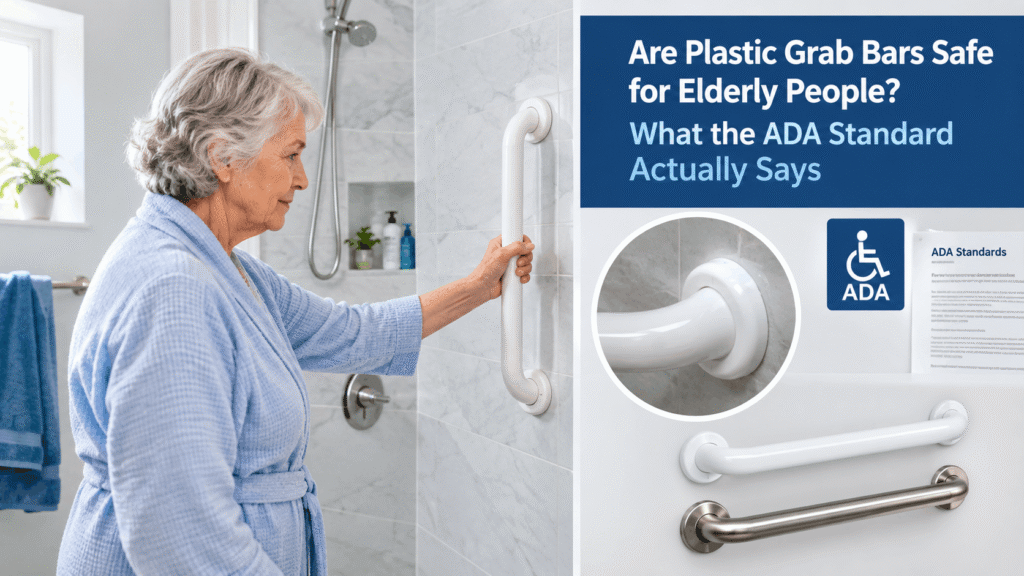
Are plastic grab bars safe for elderly people? A $15 suction bar may look secure, but will it really hold during a slip? The answer depends on more than the word “plastic”. What matters most is how the bar is designed, how much force it can handle, and how securely it is mounted.
Table of Contents
Quick Answer: Plastic grab bars are safe for elderly people only when they’re rigid, load-rated bars anchored into wall studs—not suction-cup bars used as primary support. Under the ADA’s §609.8 standard, a compliant grab bar and its anchoring must hold 250 pounds of force without failing, and a properly mounted composite bar can meet that standard just as reliably as steel.
What You Need to Know
- Plastic grab bar” describes three different products — suction, structural composite, and plastic-coated metal — only one of which is actually risky.
- The ADA requires grab bars to withstand 250 pounds of force without permanent deformation; the standard doesn’t specify material.
- Suction bars can advertise a 200–300 lb capacity but fail under 75–100 lbs of sudden, off-centre force — exactly the force a real slip produces.
- The failure point in most unsafe installs is the wall anchor, not the bar material.
- More than 1 in 4 adults aged 65 and older fall every year, according to the CDC, and most of those falls happen in the bathroom.
What Does “Plastic Grab Bar” Actually Mean?
Most buying guides treat “plastic grab bar” as one category. It isn’t.
| Type | What It Is | Weight-Bearing? | Best Use |
|---|---|---|---|
| Suction-cup plastic bars | Vacuum-seal suction cups, no drilling | No — balance support only | Travel, hotels, rentals |
| Structural composite bars | Solid-core rigid plastic, screw- or stud-mounted | Yes, if rated and anchored | Permanent installs, warmer grip |
| Plastic-coated metal bars | Steel/aluminium core with plastic grip layer | Yes — strength from the metal core | Soft grip without losing steel strength |
The material alone doesn’t determine safety — the mounting method does. A rigid composite bar screwed into solid blocking outperforms a steel bar hanging off drywall anchors every time.
Why the ADA 250-Pound Standard Matters More Than Material
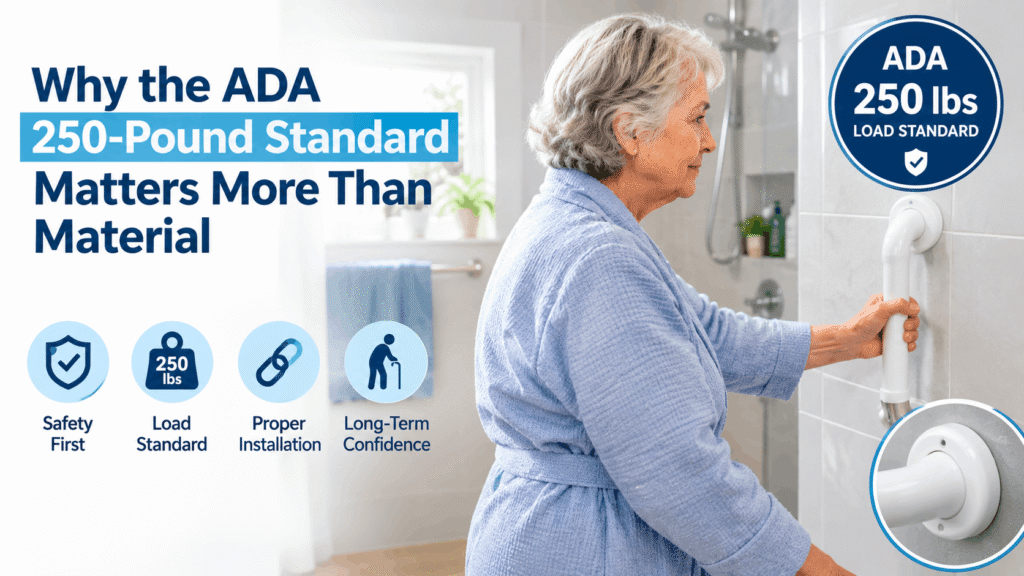
The ADA Standards for Accessible Design (§609.8) require a grab bar, its fasteners, and its wall anchoring—as a system—to withstand 250 pounds of force at any point without failure. The standard says nothing about material.
A well-engineered plastic composite bar can pass this test exactly like a steel bar, provided it’s anchored into studs or rated heavy-duty anchors. What fails almost never is the bar itself—it’s a bar screwed into hollow drywall with standard plastic anchors, regardless of what the bar is made from.
For the exact numbers this standard translates to in your bathroom, see ADA-compliant shower grab bar height and toilet grab bar distance requirements.
Are Suction Grab Bars Actually Dangerous? Yes—when used as primary support instead of a temporary balance aid.
Suction bars often carry a 200–300 lb static capacity, tested under even, steady lab pressure. A real fall applies sudden, uneven force, and documented failures have occurred under as little as 75–100 lbs of that kind of force.
Why suction fails specifically in bathrooms:
Marketing shows the wrong use case—packaging often depicts stepping into a tub, the highest-risk moment, and the moment suction is least reliable.
The vacuum seal degrades silently—a bar can feel firm while already half-released.
Steam and hot water work directly against suction, one of the worst environments for a vacuum seal.
If a suction bar is already in use, treat it as fine print actually intends: a travel or short-term balance aid, tug-tested before every use, never the only support near a tub or toilet.
When Is Plastic Composite a Good Choice — and When Should You Choose Metal?
Composite bars work well for arthritic or weak hands (warmer, better wet grip than steel), rental units with tension-mount or clamp systems, post-surgery recovery, and unheated bathrooms where metal feels unpleasantly cold.
Choose stud-mounted steel or reinforced aluminium instead when the user will regularly place near-full body weight on the bar, the install is meant to be permanent (plastics can degrade faster than metal over many years of UV/moisture exposure), the household needs a bariatric rating above 250 lbs, or no studs are available and only heavy-duty engineered anchors are possible.
The deciding question is never “Is it plastic?” It’s “Is it load-rated, and is it anchored into something solid?”
If you’re unsure whether your wall can take a stud-mounted bar without damaging tile, removing a grab bar without cracking tile covers what solid backing should look like first.
Plastic vs. Metal: Quick Reference
| Suction Plastic | Structural Composite | Steel/Aluminium |
|---|---|---|
| Rated capacity | Not reliable | 250–400 lbs |
| Installation | No drilling | Screws or clamp mount |
| Grip feel | Cold-neutral | Warm, textured |
| Fall-prevention reliability | Low | Moderate–high, if anchored |
Save or screenshot this table — it covers the exact spec to check before buying any bar labelled “plastic”.
Common Mistakes
- Treating a suction bar’s advertised weight rating as a guarantee. That number describes steady lab pressure, not a real slip.
- Skipping the monthly tug test — a seal or anchor can loosen with no visible warning.
- Mounting into drywall without checking for studs first. A bar’s rating means nothing if the wall behind it can’t hold 250 lbs.
- Assuming “plastic” always means weaker — a rated, stud-mounted composite bar can outperform a poorly anchored steel one.
- Ignoring diameter and clearance — target 1.25–2 inches diameter with 1.5 inches of wall clearance, regardless of material.
Safety Checklist
- Suction-only? Use it for light balance support only—never as the user’s sole support.
- Has a tested load rating? Look for an ADA/ANSI rating. If no tested rating is provided, don’t rely on it for full body weight.
- Properly anchored? Use screws into studs or suitable rated hardware rather than adhesive or suction alone.
- Correct diameter and clearance? Choose a bar 1.25–2 inches in diameter with 1.5 inches of wall clearance.
- Correctly positioned? Install it 33–36 inches above the finished floor.
- Recently tug-tested? Check the bar within the last 30 days to make sure it remains secure.
- Inspected for damage? Look for hairline cracks, discolouration, looseness, or other visible signs of wear.
For positioning when space is tight, see grab bar placement in a small bathroom
FAQs
What type of grab bar is safest for older adults?
A securely stud-mounted steel or certified composite grab bar is generally the better choice. Look for a product that meets the ADA’s 250-lb load requirement, has a 1.25–2-inch diameter, and is positioned 33–36 inches above the floor. Suction models should not be relied on for primary support.
Which bathroom grab bar is best for an elderly person?
For regular use and full-body support, choose a stainless-steel or reinforced-composite bar attached securely to studs. A quality suction model may be useful for temporary or travel situations, but it should be checked before every use.
How should bathroom safety rails be arranged for seniors?
Consider providing support in the areas where balance is most challenging: inside the shower or tub, near the entrance, and beside the toilet. For more guidance, see grab bar placement in small bathrooms and corner vs. back-wall placement.
What is the recommended grab bar height for elderly users?
The ADA range is 33–36 inches above the finished floor. The final position should also work comfortably for the individual using the bar. See our ADA shower grab bar height guide for more details.
Can a plastic grab bar support an elderly person’s body weight?
A properly rated structural composite bar can provide body-weight support when it is installed correctly and securely anchored. Basic suction bars and plastic models without a tested load rating should not be treated as full-support grab bars.
Is a metal grab bar always safer than a plastic one?
Not necessarily. A properly engineered and securely mounted composite grab bar can provide strong support. Metal models may offer advantages in durability and higher-weight applications, but secure installation remains essential with either material.
Are grab bars mandatory in every bathroom?
The requirements depend on the type of property and applicable accessibility rules. Private homes and public or commercial facilities can have different requirements. See if grab bars are required in bathrooms for more information.
What to Do Next
- Start with the correct height—Use this ADA shower grab bar height guide to determine the appropriate position before installation.
- Check the wall before drilling—Learn what to look for with this guide on removing a grab bar without cracking tile so you can identify suitable support behind the wall.
- Plan the bathroom as a whole—Use this small bathroom grab bar placement guide to organize support around the shower, bathroom entrance, and toilet.