
Introduction
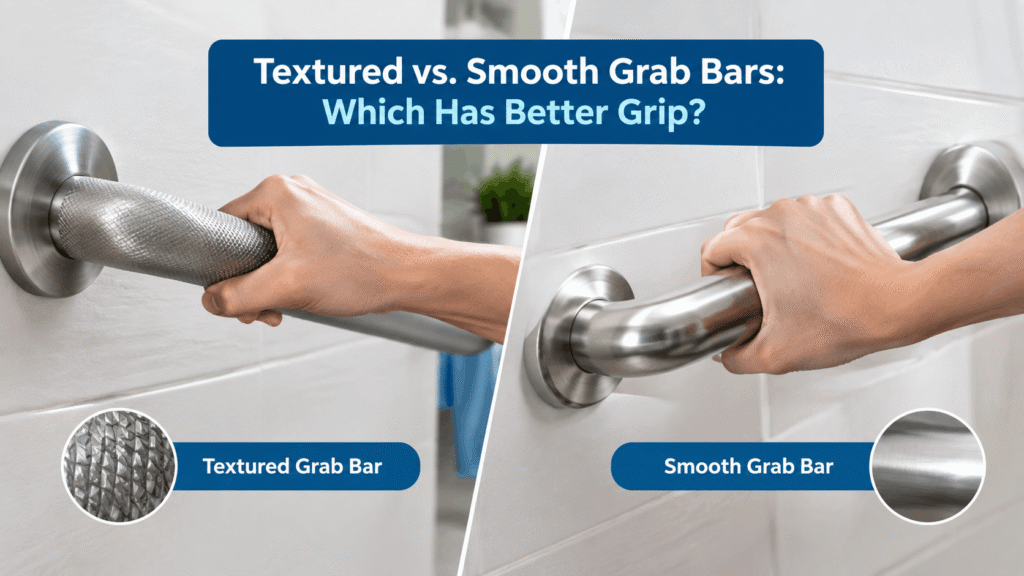
Textured vs. Smooth Grab Bars: Which Has Better Grip? You’re standing in front of a product listing, scrolling past “knurled,” “peened,” and “smooth satin” finish options, and none of it means anything until someone tells you which one actually keeps a wet hand from sliding off. That’s a fair thing to want answered before you spend money on something bolted into your wall studs.
Table of Contents
Quick Answer: Textured finishes—knurled or peened—grip better than smooth finishes, especially on wet or soapy hands, because the surface pattern increases friction. Smooth finishes are more comfortable to hold and easier to clean, but they lose grip fast once water hits them. For most bathrooms, textured wins on safety; smooth wins on comfort.
What You Need to Know
- Textured (knurled/peened) grab bars grip better wet hands—the surface pattern is the whole point.
- Smooth grab bars are more comfortable for sensitive skin, arthritis, or long holding times but slicker when wet.
- Material matters as much as texture—a smooth vinyl bar can out-grip a smooth steel bar.
- ADA doesn’t technically require texture—it requires a surface “free of sharp or abrasive elements,” which is a narrower rule than most sites imply.
- The right choice depends on who’s using the bar, not a universal “best” answer.
Knurled vs. Peened: What “Textured” Actually Means
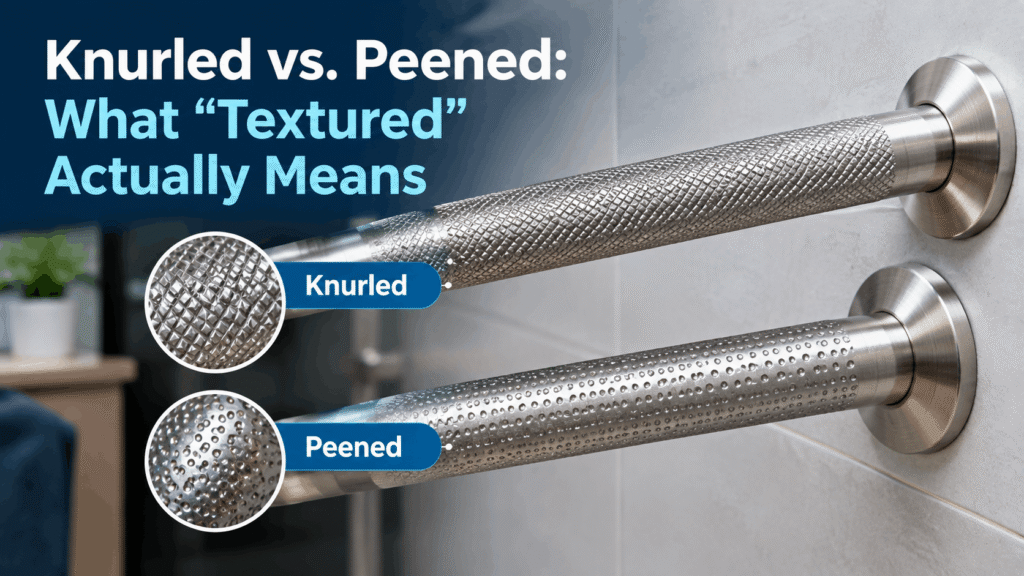
Textured grab bars use a cut or etched surface pattern to increase friction between the bar and your hand. There are two common versions, and they’re not interchangeable.
A knurled finish has a deep, cross-hatched pattern cut directly into stainless steel. It grips aggressively—firmly enough that it “bites” into the hand when gripped firmly, which is precisely what someone with strong grip strength wants in an emergency slip. The trade-off is that the same aggressive pattern can irritate thin or sensitive skin, and the deep grooves trap soap film and skin oils, making knurled bars the hardest of any finish to clean thoroughly.
A peened finish is a lighter version of the same idea—the steel is textured with a subtler, sandblasted-style pattern instead of deep cuts. It still adds real traction over a bare polished surface, but it’s gentler on the hand and noticeably easier to wipe clean. Peened is the finish most manufacturers position as their default “safety” option, precisely because it splits the difference between grip and comfort.
If you’re choosing between the two: knurled for someone who needs maximum bite and has a firm, uninjured grip; peened for almost everyone else, including elderly users and anyone with fragile skin.
Smooth Grab Bars: Where They Actually Win
Smooth grab bars trade some wet-grip performance for comfort, cleanability, and a lower-maintenance surface. That’s not automatically a hazardous trade—it depends on the bathroom and the user.
A polished or satin stainless surface has no grooves to catch dirt or soap scum, so it wipes clean in seconds. It’s also gentler on hands that can’t tolerate texture at all—think arthritis, healing skin, or anyone using the bar for long periods rather than a quick emergency grip. Comfort matters more than people assume: a bar someone avoids using because it feels harsh on their hands isn’t doing its job, no matter how much grip it technically offers.
The catch is unavoidable physics. Once a smooth surface gets wet or soapy, friction drops fast, and a smooth bar can become genuinely slippery at the exact moment someone needs it most—mid-slip, hand already wet, reaching for something to stop the fall.
It’s Not Just Texture—Material Matters Too
Most comparisons stop at “textured vs. smooth” and never mention what the bar is actually made of, which skips half the answer to “What material is best for bathroom grab bars?”
Stainless steel is the standard: durable, available in every finish above, and the least expensive option at scale. Smooth stainless, though, is the coldest and slickest combination on this list—steel plus no texture plus water is the worst-case grip scenario, and it’s also unforgiving on cold hands or during a firm grip in a medical scare.
Vinyl and nylon-coated bars change the equation entirely. The coating is soft and warm to the touch, which matters a lot for people with thin skin, arthritis, or cancer-treatment-related cold sensitivity—a plain steel bar can genuinely be painful to grip for someone in that situation. Vinyl also holds grip reasonably well even without deep texture, because the coating itself has more natural tack than polished steel, wet or dry. Many vinyl grab bars are manufactured with built-in antimicrobial protection, which also simplifies the cleaning trade-off that usually favors smooth steel.
The practical takeaway: a smooth vinyl bar and a smooth steel bar are not the same product for grip purposes, even though both get labelled “smooth” on a spec sheet. If comfort is the priority but you’re worried about giving up grip entirely, vinyl is the finish that lets you have some of both.
Grip Performance Comparison Table
| Finish / Material | Wet-Hand Grip | Dry Comfort | Cleaning Effort | Best For |
|---|---|---|---|---|
| Knurled (steel) | Highest | Lowest—can irritate thin skin | Hardest | Strong grip, high fall-risk situations |
| Peened (steel) | High | Moderate | Moderate | Balanced default for most bathrooms |
| Smooth stainless | Low when wet | Highest for steel, but cold to touch | Easiest | Low-moisture areas, commercial/institutional settings |
| Smooth vinyl/nylon | Moderate-high, even dry | Highest overall | Easy, often antimicrobial | Arthritis, sensitive or thin skin, cold sensitivity |
Save or screenshot this grip comparison table—it covers finish, material, and who each option actually suits, so you don’t have to cross-reference three product pages to answer the same question twice.
Is Smooth Actually Non-Compliant with ADA?
No—and this is where a lot of grab bar guides overstate the rule. The 2010 ADA Standards, Section 609 (Grab Bars), require that grab bars and any adjacent wall surfaces be “free of sharp or abrasive elements” and have rounded edges. That’s a rule about safety hazards, not a rule that mandates a textured surface.
In practice, textured finishes are simply the common, practical way manufacturers satisfy the spirit of that requirement in wet environments—but a smooth bar that meets the diameter, clearance, and load-bearing specs in the same ADA section (1¼” to 2″ circular diameter, 1½” wall clearance, 250-pound load resistance) is not automatically out of compliance just because it lacks texture. If you’re installing in a commercial or code-regulated space, the diameter and clearance numbers are the hard requirements—texture is a best-practice safety choice layered on top, not a separate code line item.
Which Finish Should You Choose?
Match the finish to the person using the bar, not to a generic “best” recommendation. A few common profiles:
- Elderly user with a strong, healthy grip: peened or knurled steel—prioritize wet-hand security.
- Arthritis, thin skin, or cold sensitivity: vinyl or nylon-coated, smooth or lightly textured—comfort has to come first, or the bar won’t get used consistently.
- High fall-risk household (recent fall, unsteady balance): knurled—the deepest grip, cleaning trade-off aside.
- Guest bathroom, low-moisture area, aesthetic priority: smooth polished stainless is a reasonable, lower-risk-context choice.
If you want a structured way to weigh diameter, finish, and placement together before you buy, that’s exactly the kind of checklist worth having on hand rather than re-deriving every time—it’s a natural fit for a short, saved reference rather than something to memorize.
Where to Put It Once You’ve Picked a Finish
Choosing the right grip finish only solves half the problem—placement is what actually determines whether the bar is reachable in the moment someone needs it. If you haven’t nailed down exact positioning yet, our ADA-based height guide walks through the standard 33″–36″ mounting range and why it matters even outside a code-regulated building.
Corner installs and back-wall installs create different grip angles for the same bar, which is worth understanding before you drill: see corner vs. back-wall shower grab bar placement for how that choice interacts with reach and leverage. Near the toilet, spacing follows its own rule set — the distance for toilet grab bars and ADA guidance cover the exact numbers. And if your bathroom is tight on wall space to begin with, placement strategies for small bathrooms address that constraint directly.
Common Mistakes People Make With Grab Bar A few specific versions of that mistake show up repeatedly in buying guides and installer notes:
The most common mistake is picking a finish based on looks or price alone, without accounting for who will actually be gripping it and in what condition. A few specific versions of that mistake show up repeatedly in buying guides and installer notes:
- Choosing smooth steel for a primary shower bar because it matches other bathroom fixtures, then discovering it’s slick exactly when wet hands need it most.
- Installing knurled bars for a user with arthritis or fragile skin, prioritizing maximum grip without checking whether the texture itself will be tolerable to hold.
- Assuming “ADA-compliant” means “textured” and skipping the actual diameter and clearance specs that are the real code requirements.
- Ignoring material entirely and comparing only “textured vs. smooth” as if steel and vinyl behave identically once wet.
FAQs
What material should you choose for bathroom grab bars?
Stainless steel is a popular choice because it offers strength, durability, and good value. However, vinyl- or nylon-covered bars can be more comfortable for users with sensitive or thin skin, especially when the bathroom is cold. The right material ultimately depends on whether the priority is maximum wet grip, hand comfort, or a balance of both.
Are straight or angled grab bars better?
A straight horizontal grab bar is the standard choice for many bathroom applications and supports common movements such as sitting, standing, and transferring. A diagonal bar can provide additional assistance for certain movements, such as rising from a seated position. In most cases, though, an angled bar works best as a supplement rather than a replacement for a correctly positioned horizontal bar.
What installation mistakes should you avoid?
No single grab bar works equally well for every person or bathroom. A peened or knurled steel bar can provide strong traction for someone who needs extra grip in a wet shower. For users who find textured surfaces uncomfortable, a smooth vinyl-coated bar may be easier to hold. The best choice should be based on the user’s grip, comfort, and the location where the bar will be installed.
Can textured grab bars be uncomfortable for people with arthritis?
They can be. Deep knurled patterns may feel rough against sensitive or arthritic hands. Peened finishes offer a compromise by adding texture without the same aggressive feel as deep knurling. For users who prioritize comfort, a smooth vinyl-coated grab bar may be easier to hold while still providing useful traction.
Do textured grab bars require more cleaning?
Usually, yes. Grooves and raised textures can collect soap residue, body oils, and other bathroom buildup. Knurled surfaces generally require more attention than smooth finishes, while peened textures fall somewhere in between. The additional cleaning may be worthwhile when stronger wet-hand traction is an important consideration.
Does a smooth grab bar provide enough safety?
A smooth surface generally produces less friction when wet than a textured one, but that does not automatically make it unsuitable. Proper diameter, secure mounting, appropriate placement, and the user’s grip ability all affect how useful a grab bar will be. In a frequently wet shower, however, users who need additional traction may prefer a textured finish.
What to Do Next
After choosing the material and finish that suit the person using the grab bar, the next step is deciding where to install it. Even a strong, comfortable grab bar won’t provide much help if it is positioned outside the user’s natural reach.
Start by reviewing the ADA height and mounting rules, then compare corner vs. back-wall placement based on your shower layout. If you’re also installing a bar near the toilet, review the toilet-area spacing requirements before drilling.