
Introduction
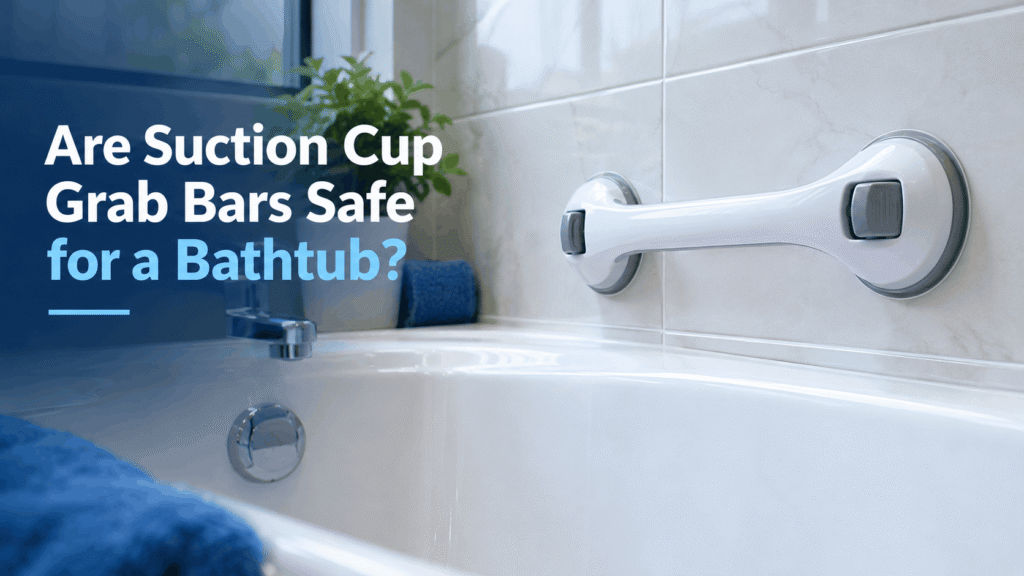
You’re holding a suction cup grab bar still in its box, looking at a wet tub wall, and wondering whether it will actually catch you. It can steady you in the right spot and let you down in the wrong one, and this guide shows you which spot is which. Every claim below traces back to a named study or to published product guidance. Are Suction Cup Grab Bars Safe for a Bathtub?
Table of Contents
Quick Answer: Suction cup grab bars are safe for a bathtub only as a light balance aid on smooth, non-porous, grout-free surfaces, such as one whole tile at least 4 inches square, and only if you reseat and check them before every use. Do not lean full weight on them or rely on them in a fall; use a stud-mounted bar.
What You Need to Know
- A suction cup grab bar steadies you on one smooth, grout-free tile (at least 4 × 4 inches). It does not catch a fall.
- Grout lines, textured walls, and small tiles stop the seal from forming or holding.
- Check the indicator (if your model has one) and tug-test the bar before every bath or shower.
- A stud-mounted grab bar is the safer choice for real support, and suction bars generally do not meet ADA strength.
- If you have fallen before or need the bar to stand up, involve an occupational therapist or professional installer.
Are suction cup grab bars safe for a bathtub? The short answer
They are safe for light, steadying under the right conditions and unsafe as fall protection. A suction cup grab bar is a steadying handle, not a structural anchor.
A suction cup grab bar is a handle with vacuum-sealed cups, used for temporary hand support without drilling.
| Reasonable use | Not safe use |
|---|---|
| A steadying hand while stepping over the tub rim, on a qualifying tile | Supporting your body weight |
| A short-term aid until a fixed bar is installed | Catching a slip or fall |
| A second handhold alongside an existing fixed bar | Hauling yourself up to stand |
| Any mounting on grout, texture, or small tile |
Researchers evaluated two brands of suction cup handholds on six typical bathtub wall surfaces under bathing conditions, and their laboratory study is titled ‘The handholds showed low efficacy.’ The same paper notes that occupational therapists sometimes suggest them when a permanent bar isn’t feasible.
Why do suction cup grab bars fail in a wet tub?
A suction cup holds only while air stays out of the seal, and a bathtub gives air plenty of ways in. Moisture, soap residue, and surface irregularities each weaken the seal.
Grout is the most common culprit. A cup that overlaps a grout line sits over a tiny channel, so the seal never fully forms. Textured walls do the same thing with thousands of small gaps.
Tile size matters too. Cups on tiles smaller than 4 × 4 inches generally cannot activate, because the cup needs a flat face to seal against.
The stakes are real. A PubMed Central paper cites earlier research (Stevens et al.) finding that 70% of bathroom falls happen in the bathtub or shower.
Where should you not use suction cup grab bars?
Skip them anywhere the cup cannot sit flat on a smooth, non-porous face. If the wall fails any one of three tests (smooth, non-porous, fully inside one tile), do not mount the bar there.
| Surface | Verdict | Why |
|---|---|---|
| One large smooth glazed tile, cup fully inside it (at least 4 × 4 in.) | Conditional OK | A flat, non-porous face lets the seal form. |
| Smooth glass-like surface | Conditional OK | Same reason. |
| Cup rim touching a grout line | No | Grout leaves an air channel under the rim. |
| Tile smaller than 4 × 4 in. (mosaic, subway strips) | No | Cups generally cannot activate. |
| Textured or embossed tile or wall | No | Texture blocks a continuous seal |
| Painted drywall or wallpaper | No | Porous, and not recommended for suction bars |
| Natural stone | Avoid | Porous stone breaks the non-porous rule. |
| Smooth acrylic or fiberglass tub surround | Check the manual first. | Manufacturers list approved surfaces; smooth-looking is not the same as approved. |
Save or screenshot this Bathtub Wall Surface Suitability Chart. It covers every surface check you need before pressing a suction cup against a tub wall.
How do you get suction cups to stick to a bathtub?
Clean and dry one qualifying tile, press the bar flat, engage it per the manual, confirm the indicator, then tug-test. The tug test, done before every use, is the step that catches a failing seal.
Follow your product’s manual first. The steps below are a practical routine, not a manufacturer specification.
- Choose whole tiles. Pick smooth, untextured tiles at least 4 × 4 inches. Keep every cup rim clear of grout lines.
- Clean and dry the spot. Remove soap film and body oil with a non-oily cleaner, then dry with a lint-free cloth. Soap residue can weaken suction.
- Press and engage. Hold the bar flat to the wall, press firmly, and engage the lever or pump the way your model requires.
- Read the indicator. If your model has indicator windows, confirm they show attached before you let go. With no indicator, you can only verify with the tug test, so be stricter with it.
- Tug test every time. Pull firmly down and outward, the way you would grab it, for a slow count of five. If it creeps, hisses, or the indicator changes, remove it and start over.
Re-seat on the schedule in your manual. If the manual gives none, treat every bath or shower as a recheck.
What are the most common suction grab bar mistakes?
Most failures trace back to mounting and checking habits, not the bar itself. A bar that has shifted once should be taken out of service until it holds a fresh seal.
- Straddling grout. One cup over a grout line is enough to compromise the grip.
- Mounting on texture or small tile. The cup never seals properly.
- Trusting the weight label over the wall. The rating describes the product, not your tub wall.
- Skipping the pre-use check. Moisture and soap residue can loosen a seal between uses.
- Using it as a lifting handle. Do not treat it like a fixed load-bearing rail.
- Reusing a bar that won’t hold. If the bar moves, stop, clean and dry the surface, and reinstall it per the instructions.
If a screw-mounted bar is the one wobbling, read why a bathtub grab bar gets loose instead, since that is a different problem with a different fix.
How to Install and Check a Suction Grab Bar Safely
A suction grab bar needs the right surface and a secure attachment to work as intended. Before stepping into the shower or bathtub, inspect the mounting area and check that the bar remains firmly attached. Never assume it is secure simply because the suction cups appear to be in place.
Use the instructions provided with your specific product, as attachment methods and safety indicators vary between models.
- Inspect the mounting area. Choose a smooth, nonporous tile surface that meets the manufacturer’s size requirements. Make sure the entire edge of each suction cup sits on the tile without touching grout, seams, or uneven areas.
- Prepare the surface carefully. Wash away soap deposits, dirt, and oily residue using a suitable cleaning product. Wipe the area dry with a clean cloth and allow any remaining moisture to disappear before attaching the bar.
- Attach the suction cups. Position the grab bar where you can reach it comfortably. Press the cups against the tile and activate the locking mechanism according to the product’s instructions. Do not force a lever or pump beyond its intended operation.
- Inspect the safety indicator. Some models feature a visual indicator that helps show whether suction has been maintained. Check that it displays the correct status before use. If the bar has no indicator, follow the manufacturer’s specified inspection procedure instead.
- Recheck the attachment before every use. Examine the cups and locking mechanisms for movement or signs of lost suction. Perform only the stability check recommended by the manufacturer. If the bar shifts, loosens, or shows a warning, remove it and repeat the installation on a suitable surface.
- Replace an unreliable setup. If the cups repeatedly lose their grip, do not keep repositioning the bar and relying on it for support. Consider a permanently mounted grab bar installed with appropriate wall reinforcement.
Important: Suction-mounted grab bars are not substitutes for permanently secured grab bars when substantial body-weight support is needed. They should not be used to catch a fall. Anyone who needs dependable assistance while standing or has a history of falls should seek advice from an occupational therapist or qualified installer.
Suction cup vs. stud-mounted grab bars: which is safer?
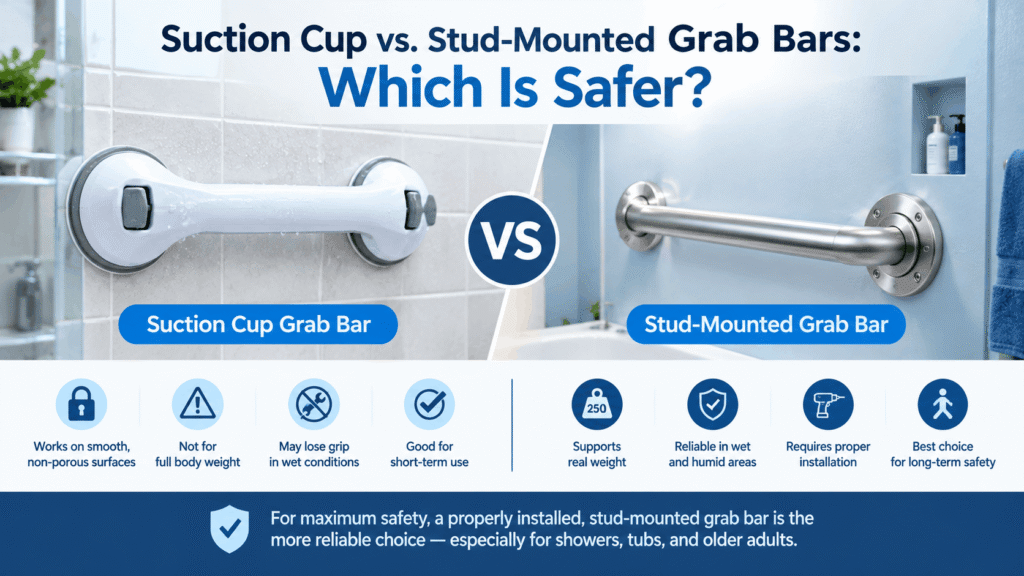
Stud-mounted bars are safer for anything beyond light steadying. A fixed bar’s strength comes from the wall framing, while a suction bar’s strength depends on a seal that can fail without warning.
| Factor | Suction cup grab bar | Stud-mounted grab bar |
|---|---|---|
| Installation | No tools or drilling | Drilling into studs or solid blocking |
| Surface needs | Smooth, non-porous, grout-free, at least 4 × 4 in. | Any finished wall with framing behind it |
| Load | Light steadying only; rating varies by model. | Built to carry body weight when anchored correctly |
| ADA | Generally not compliant | Compliant when ADA-rated and correctly installed |
| Upkeep | Check and re-seat on a routine. | No reseating |
| Best for | Short-term steadying handle | Daily use, transfers, long-term safety |
What is the safest grab bar for a shower or tub?

The safest option is a fixed bar anchored into wall studs or solid blocking. A fixed bar removes the surface-suction problem entirely, so wet walls and grout lines no longer matter.
The evidence for having a reliable bar at all is strong. In a 2023 Human Factors experiment with 63 adults stepping out of a slippery tub, those who had a grab bar available were 75.8% more likely to recover their balance. That study tested grab bars generally, not suction bars specifically.
Start by locating studs with this guide to finding studs for a bathtub grab bar. Then set placement using the ADA bathtub grab bar height rules.
When you’re ready to choose equipment, our roundup of the best grab bars for seniors compares sturdy fixed options for the job.
What if you can’t drill?
Ask your landlord or building manager before ruling out a fixed bar. Until you hear back, treat any temporary aid as a steadying handle only.
Rim-mounted tub rails are another temporary option. A PubMed Central study examined whether older adults could correctly install rim-mounted tub rails and suction handholds in a simulated bathroom.
Who should never rely on a suction cup grab bar?
Anyone who depends on the bar to stand, has poor balance, or has fallen before should skip suction bars. If you need to put real weight on the bar, only a professionally supported fixed installation is appropriate.
- You have difficult transfers in and out of the tub.
- You have had repeated falls.
- Your wall surface fails the three-test rule above.
- You want the bar to double as a lifting aid.
An occupational therapist can assess how you move through your bathroom, and a professional installer can handle tile, fiberglass, and unclear stud locations. This guide is general information, not medical advice.
FAQs
How Safe Are Suction Grab Bars in a Shower?
Suction-mounted grab bars may offer limited balance assistance when attached correctly to a compatible, smooth surface. However, soap residue, moisture, uneven textures, and grout joints can compromise their grip. These products should never be treated as fall-arrest devices or dependable supports for full body weight. For anyone who needs firm assistance while moving in or out of a shower, a properly installed, permanently mounted grab bar is a more suitable option.
How Can You Make Suction Cups Stick to a Bathtub?
Start by checking that the bathtub or surrounding tile is compatible with your grab bar. Clean away dirt, grease, and soap buildup, then dry the surface completely. Position each suction cup on a flat area without crossing grout joints or seams. Activate the locking mechanism according to the manufacturer’s directions and inspect any built-in indicator. Before use, perform the prescribed attachment check. Repeat the inspection every time you plan to use the bar.
Which Type of Grab Bar Is Safest for a Shower?
A permanently mounted grab bar secured to suitable structural backing generally provides more dependable support than a suction-mounted model. Its reliability depends on correct anchoring, appropriate placement, and installation suited to the wall construction. Before drilling into tiled or fiberglass walls, identify the supporting structure and confirm the correct mounting method. If you are unsure how to secure the bar properly, consult a qualified installer.
Which Surfaces Are Unsuitable for Suction Grab Bars?
Avoid installing suction grab bars over grout joints, textured finishes, porous materials, wallpaper, or painted drywall. Small tiles may also be unsuitable if they cannot accommodate the entire suction cup. Always check the product’s surface requirements before installation. Most importantly, do not use a suction-mounted bar as the main support when climbing out of a bathtub, transferring between positions, or recovering from a loss of balance.
Do Suction Cup Grab Bars Meet ADA Requirements?
Suction-mounted grab bars generally do not satisfy the requirements for permanent grab bars under the ADA Standards. Section 609.8 specifies that compliant grab bars must resist a force of 250 pounds applied at any point, subject to the standard’s installation requirements. A product’s suitability cannot be established by appearance alone. For an accessibility project that must comply with the ADA, select an appropriate fixed grab bar and ensure the installation meets the applicable requirements.
Are Suction Grab Bars Suitable for Older Adults?
A suction grab bar may provide limited assistance with balance for an older adult who can use it safely on a compatible surface. However, it is not a dependable primary support for someone with significant balance difficulties, a history of falls, or difficulty getting into or out of the bathtub. A properly installed fixed grab bar is generally the better choice for these situations. An occupational therapist can help identify suitable locations and support options based on the person’s mobility needs.
What Should You Do Next?
If you are choosing a safer grab bar for your bathtub or shower, these guides can help you plan the next step:
- Find suitable mounting support: Read the guide to locating studs for bathtub grab bars.
- Check recommended placement: Use the ADA bathtub grab bar height guide.
- Compare options for older adults: Explore the best grab bars for seniors.
Choose a grab bar based on your wall construction, support needs, and installation requirements rather than suction strength alone.
Short on space? See the best grab bars for small bathrooms. Want the chart and checklist on one page?