
Introduction
Bathtub Entry Grab Bar Placement You just grabbed the shower curtain rod or the soap dish to steady yourself stepping over the tub wall, and your hand found nothing solid. That’s the exact moment an entry grab bar is built for, and getting its placement right is simpler than it looks once you know the two numbers that actually matter.
Table of Contents
Quick Answer: Place the entry grab bar vertically on the wall closest to where you step into the tub—usually the faucet wall—about 4 to 6 inches in from the tub’s outer edge. Use a 24- to 36-inch bar positioned so your hand reaches its bottom while seated and its top while standing, roughly 9 to 42 inches above the tub floor.
What You Need to Know:
- Position the entry grab bar on the wall you use when stepping into and out of the bathtub, rather than on the wall opposite the entry point.
- There is no universal height that works for every bathtub. The bar should be positioned so it remains easy to reach while both sitting and standing.
- The commonly cited 33–36-inch ADA range is intended for side-wall grab bars and should not automatically be applied to an entry bar.
- Even the ideal placement will not provide reliable support if the bar is not securely fastened to suitable structural support, such as a wall stud or properly installed blocking.
- Tub seats and walk-in bathtub designs can require different placement considerations, so the standard approach may need to be adjusted for these setups
Where the Entry Grab Bar Goes
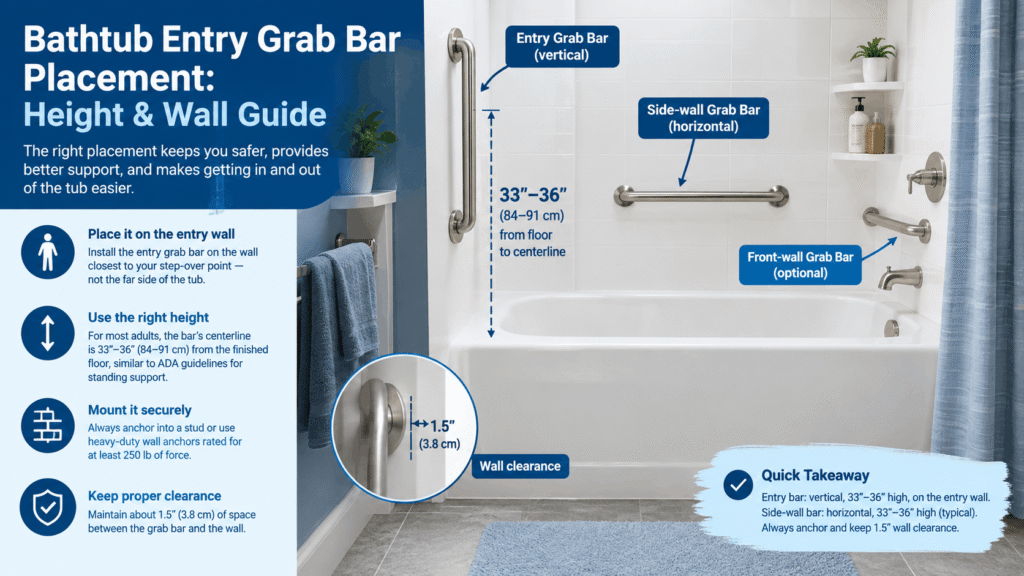
The entry grab bar belongs on the wall nearest your step-over point—the same wall as the faucet and controls in most alcove tubs. That’s the wall your body is closest to during the highest-risk second of the whole bathing routine: the moment one leg is fully weighted while the other crosses the tub wall.
Mount it vertically, not horizontally. A vertical orientation lets your hand travel with your body as you rise from a step to a standing position, which a fixed horizontal bar can’t do.
Entry Grab Bar Placement Cheat Sheet
| Factor | Recommendation | Why? |
|---|---|---|
| Wall | Faucet/valve wall (nearest step-over point) | Matches the moment of highest fall risk |
| Distance from tub’s outer edge | 4–6 inches inward | Keeps the bar reachable without leaning back over the tub lip |
| Orientation | Vertical | Supports the hand through the full stepping motion, not one fixed point |
| Bar length | 24″–36″ | Longer bars reach lower toward the tub floor for seated use. |
| Height range | ~9″–42″ above tub floor (varies by bar length and user height) | The bottom must reach a seated hand; the top must reach a standing hand. |
| Built-in tub seat present | Mirror the bar on both walls. | Entry pattern changes depending on which side the seat sits on. |
Save or screenshot this cheat sheet — it covers the wall, distance, orientation, and height range in one place, which most placement guides split across three separate sections.
Why Entry-Bar Height Isn’t the Same as Side-Wall Height
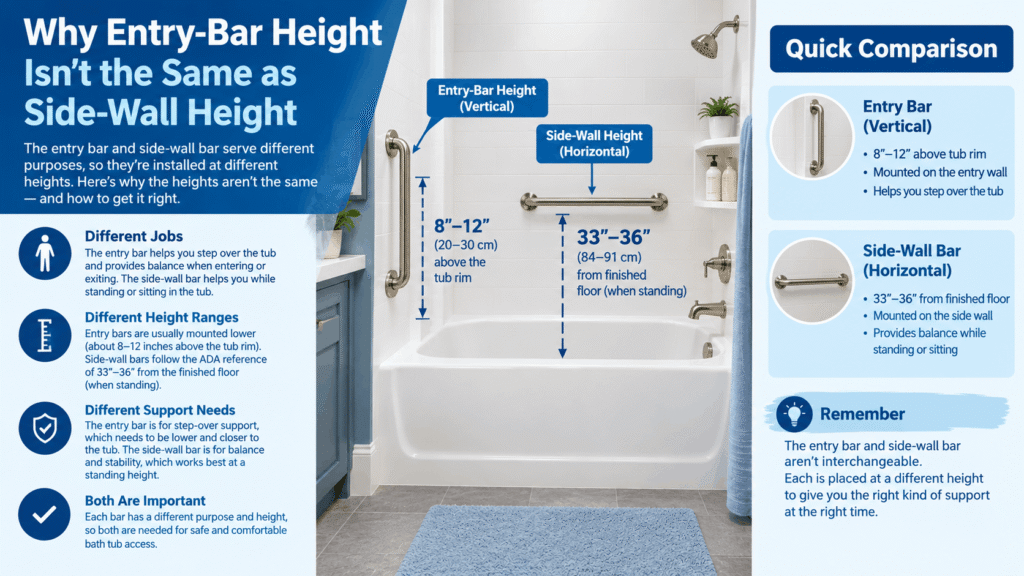
Most placement advice quotes one height number for every bar in the tub, and that number is wrong for the entry bar specifically. The 33″–36″ mounting height that shows up everywhere comes from the U.S. Access Board’s 2010 ADA Standards, Chapter 6 — a spec written for a person standing at a side wall, not a person mid-step with one foot still on the bathroom floor.
An entry bar has to do two jobs at two different heights: give a standing hand something to grip on the way in and give a seated hand something to grip on the way down or up. That’s why the bar spans a wider range — often starting as low as 9 inches above the tub floor — instead of sitting within the tighter ADA band.
How Far From the Tub Edge?
Keep the entry bar 4 to 6 inches in from the tub’s outer edge. Any farther and you’re leaning backward to reach it mid-step; any closer and it interferes with the tub wall’s lip.
Vertical, Horizontal, or Angled for Entry?
Vertical wins for entry specifically. A vertical bar supports the changing hand position as your body moves from standing outside the tub to seated or standing inside it — a horizontal bar only helps at one fixed elevation.
If Your Tub Has a Built-In Seat
Mount an entry bar on both walls flanking the tub opening. A built-in seat changes which side you naturally step toward, and that can flip from one bathing session to the next depending on which way you turn to sit.
Walk-In Tub vs. Standard Alcove Tub
A standard alcove tub has a 14–16 inch wall to step over, which is exactly what makes entry-bar placement urgent. A walk-in tub removes the step-over hazard entirely through its own door, so the “entry bar” question mostly disappears — any grab bar there supports balance during the door-close and fill cycle instead.
Making Sure It’s Actually Anchored There
The measurements above only work if the bar is screwed into something solid. A grab bar mounted into drywall alone can fail under real body weight exactly when you need it.
Before drilling near the location indicated in the cheat sheet, please verify what is in the cheat sheet and confirm what’s actually behind that wall. If you’re not sure how, our guide to finding studs for bathtub grab bars walks you through it. And if the ideal spot lands between studs with no solid backing, installing a bathtub grab bar without a stud covers the hardware that makes that safe.
How to Mark the Spot Before You Drill
- Stand at the tub entrance and mimic your normal step-over motion. Note where your hand naturally reaches for support—that’s your target zone, not a tape-measure number.
- Sit on the tub floor (or have the intended user do so) and reach toward the wall. Mark where the hand lands comfortably. This becomes the bottom of your bar’s range.
- Stand up inside the tub and repeat the reach. Mark that point too. This becomes the top of your range.
- Confirm both marks fall within 4–6 inches of the tub’s outer edge on the entry-side wall.
- Scan for a stud at both marks before finalising anything.
Common Mistakes
Placing the bar on the far wall instead of the entry wall is the single most common error—it protects you once you’re already in the tub, not during the actual step-over.
Other frequent mistakes:
- Using the ADA 33–36″ figure as the only height, ignoring the seated-reach requirement
- Choosing a bar under 18 inches, which limits how far down it can reach for seated use
- Screwing into drywall or tile alone without locating a stud first
- Mounting only one bar total when a tub with a built-in seat needs one on each side
FAQs
Where should grab bars be placed in a bathtub?
For safer tub entry and exit, install a vertical grab bar on the wall closest to where you step over the tub. Position it about 4–6 inches from the outside edge of the tub. For additional support, consider a horizontal bar along the side wall and, if needed, another bar on the front wall near the faucet to provide stability while standing.
What is the recommended height for bathtub grab bars?
For side-wall grab bars, the ADA’s commonly referenced mounting height is 33–36 inches above the finished floor. Entry bars are different because they need to provide support during both standing and seated movements. A vertical entry bar may extend from approximately 9 to 42 inches above the tub floor, depending on the tub design and the user’s reach.
What type of grab bar works well on the side of a bathtub?
A straight horizontal grab bar measuring about 36–48 inches can provide support along much of the tub’s length. Mounting it with the centreline approximately 25 inches above the tub floor can make it easier to reach while sitting, repositioning, or standing.
Where should grab rails be installed in a shower?
Shower grab bars require a slightly different placement approach because shower floors, walls, and thresholds vary. Entry and side-wall bars can both be useful, but their ideal locations depend on the shower layout and the user’s needs. A dedicated guide on shower grab bar placement can provide more specific measurements and recommendations.
Does an entry grab bar need to be a certain length?
For many bathtub entry applications, a 24–36-inch grab bar provides a useful range of support. An 18-inch bar may work in some installations, but its shorter length can limit how far you can reach along the bar, particularly when you need support while lowering yourself or rising from the tub.
Can a bathtub entry grab bar be installed diagonally instead of vertically?
A vertical bar is generally preferred at the tub entry because it provides a consistent handhold as you step over the tub wall. A diagonal bar can be useful on a side wall, particularly when you need support while transitioning between sitting and standing positions.
What to Do Next
Before drilling into the wall, identify the stud locations first. Our guide to finding studs for bathtub grab bars explains how to locate suitable mounting points so you can plan the bar’s position around a secure attachment.
If the ideal mounting position does not line up with a wall stud, read our guide to installing a bathtub grab bar without a stud to learn about appropriate mounting options and hardware.
For a more personalised installation, use our guide to measuring bathtub grab bar height to determine a comfortable mounting height based on your tub, reach, and intended use.