
Introduction
Where to Place Grab Bars in a Bathtub You may have seen someone grab the towel bar to avoid falling in the tub, or you may have seen someone grab the towel bar to prevent themselves from falling in the tub, or you might be the one who reached for it and felt it give way. Towel bars aren’t rated for body weight, and that near-miss is precisely why you’re here. Below is the exact placement, not a vague “somewhere near the tub” answer.
Table of Contents
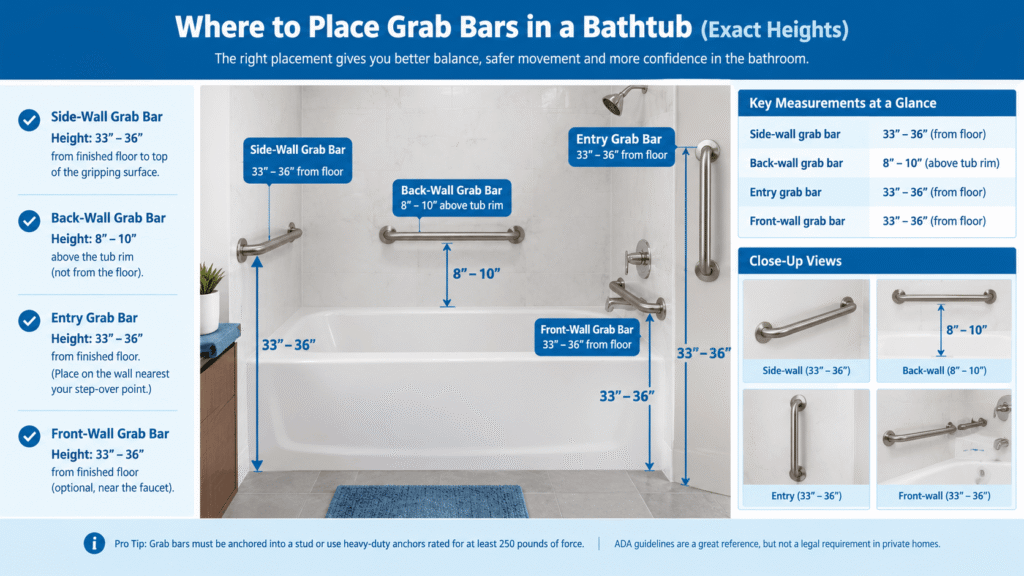
Quick Answer: Most bathtubs need grab bars in three spots: a vertical bar at the entry point for stepping over the tub wall, a horizontal bar on the back wall 8–10 inches above the tub rim, and a horizontal bar near the foot end at 33–36 inches from the floor. Two bars is the minimum; four is the safer standard.
What You Need to Know
- Minimum setup: 1 entry bar + 1 horizontal support bar. Advanced setup: 4 bars total.
- Standard reference height is 33 to 36 inches from the floor, measured to the top of the bar.
- The back-wall bar sits 8 to 10 inches above the tub rim specifically—a different measurement point than the general 33–36 inch rule.
- A bar only works if it’s anchored into a stud or a rated wall anchor—drywall alone will fail under real weight.
- Never mount a horizontal bar at the head end of the tub.
According to a CDC study on nonfatal bathroom injuries, more than 65 per cent of bathroom injuries happen in or near the tub and shower—which is exactly why placement, not just the presence of a bar, matters so much.
Where Do the Bars Actually Go?
The three core locations are the entry wall, the back wall, and the foot-end side wall — each one covers a different moment in the bathing process, not a redundant copy of the others.
Entry wall (vertical or angled bar): This is the bar your hand reaches for the second you step over the tub wall, which is also the single moment most bathroom falls happen. Mount it 4 to 6 inches inside the tub entry, at a length of 24 to 26 inches, positioned so it lines up with a natural grip height rather than a fixed number pulled from a chart.
Back wall (horizontal bar): This bar does the standing-and-sitting work — pushing yourself up, steadying yourself while washing. The correct reference point here is 8 to 10 inches above the tub rim, not the floor, because the rim is where your body weight actually transfers through your arm.
Foot-end side wall (horizontal bar): Near the faucet end, mounted at 33 to 36 inches from the floor, this bar is what you pull against to rise from a seated position. Its length should run 18 to 30 inches, long enough to reposition your grip as you move.
How Many Grab Bars Does a Bathtub Need?
The minimum for basic slip prevention is two bars—one entry bar and one horizontal support bar. Four bars is the advanced setup, and it’s worth the extra installation for anyone bathing daily rather than showering standing up.
Here’s how to decide which setup fits your bathroom:
- Identify who uses the tub and how. Someone who sits to bathe needs different coverage than someone standing to shower inside a tub-shower combo.
- Start with the entry bar—non-negotiable. This is the bar every guide agrees on, and it’s the one that prevents the highest-risk moment.
- Add the back-wall bar next. This covers standing balance and sit-to-stand transfers, the two next most common failure points.
- Add a second, higher side-wall bar only if the person stands in the tub regularly. This fourth bar sits roughly 8 to 11 inches above the lower side bar.
How High Should a Bathtub Grab Bar Be?
The standard reference height is 33 to 36 inches from the finished floor to the top of the gripping surface, and that range is what most manufacturers and installers build to even in homes with no legal requirement to follow it.
That range isn’t one-size-fits-all. A shorter or wheelchair-using person is often better served near 33 inches; a taller person nearer 36. If you want the exact number for the actual person using this tub rather than a generic midpoint, our guide to measuring bathtub grab bar height walks through getting it right the first time, since redrilling into a stud twice is a problem you want to avoid.
Should a Grab Bar Be Horizontal, Vertical, or Angled?
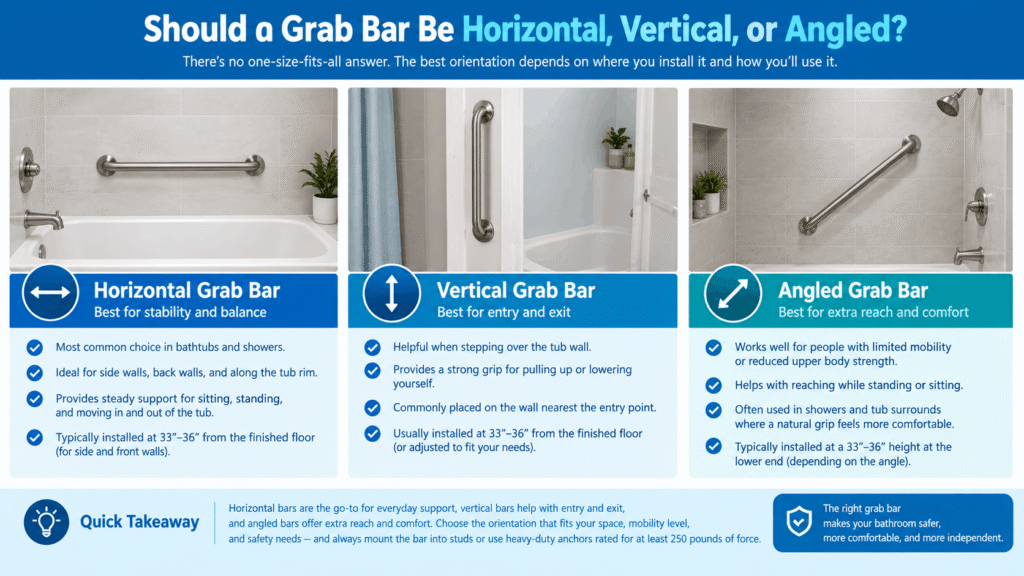
Each orientation serves a distinct motion, and mixing them is normal, not a compromise. A horizontal bar supports standing balance; a vertical bar supports the pulling motion of entry and exit; an angled bar supports the whole arc of standing up or lowering down.
An angled bar is a genuinely underused option. Because your hand slides along the bar’s length as you move, it tracks the sit-to-stand motion instead of forcing your hand to stay at one fixed point—many users find it more natural than a strict horizontal bar once they’ve tried both.
Bathtub Grab Bar Placement Reference Chart
| Wall Location | Orientation | Height (measured from) | Bar Length | Purpose |
|---|---|---|---|---|
| Entry wall | Vertical or angled | 4–6″ inside tub entry | 24″–26″ | Step-in / step-out |
| Back wall | Horizontal | 8″–10″ above the tub rim | 24″–36″ | Standing balance, sit-to-stand |
| Foot-end side wall | Horizontal | 33″–36″ from floor | 18″–30″ | Pull up from the seated position. |
| Side wall (advanced, 2nd bar) | Horizontal | 8″–11″ above the lower bar | 12″–24″ | Standing support while bathing |
Save or screenshot this reference chart — it covers every wall location you’ll need for a standard alcove bathtub, without flipping between five different pages.
Residential Placement vs. ADA/Commercial Rules—What Changes?
In a private home, nothing on this page is legally required—placement is entirely your call, based on the person using the bar. In a commercial setting like a hotel or care facility, the U.S. Access Board’s 2010 ADA Standards make the same 33–36 inch height a legal requirement and add hard minimums: the foot-of-tub bar must run at least 24 inches, and the two back-wall bars must total at least 48 inches combined, positioned within 12 inches of the foot end and 15 inches of the head end.
One rule holds in both settings: no horizontal bar belongs at the head of the tub, because no natural hand motion lands there during entry, standing, or sitting.
Why Placement Depends on Studs, Not Just Height
None of the measurements above matter if the bar isn’t anchored into something solid. A bar mounted into drywall or tile alone can hold a light lean and then fail completely the moment someone puts real weight on it—usually during the exact slip it was installed to prevent.
Before you drill anything, find out how to locate the studs behind your tub wall. If the ideal spot from the chart above doesn’t line up with a stud, you’re not stuck—see what to do when there’s no stud where you need one for safe alternatives that don’t involve guessing.
For the entry bar specifically, where reach and grip angle matter as much as anchoring, our full breakdown of entry-point grab bar height and placement covers the details this page doesn’t have room for.
Freestanding Tubs: A Different Rule Entirely
Everything above assumes at least one adjacent wall to mount into. A freestanding tub often has none. For a freestanding tub, a floor-mounted grab bar or a clamp-style bar that grips the tub edge directly is the safer route, since there’s no wall stud to anchor a standard bar into at all.
Common Mistakes to Avoid
- Anchoring into drywall or tile only—always confirm a stud or use a load-rated anchor system built for wet walls.
- Using a towel bar as a grab bar—towel bars aren’t weight-rated and will pull loose exactly when weight hits them.
- Mounting a bar at the head of the tub—no motion in the bathing process happens there.
- Installing only one bar—an entry bar alone leaves the standing and sitting motions completely uncovered.
- Guessing the height instead of measuring for the actual person who’ll use it.
FAQs
What height should a bathtub grab bar be installed at?
For many bathtub grab bars, 33 to 36 inches above the finished floor is a useful reference range for the gripping surface. A bar installed on the back wall may use a different measurement, often about 8 to 10 inches above the tub rim, because its position needs to work with the user’s movement while sitting down or standing up.
Is a straight or angled grab bar better for a shower?
Either design can provide useful support, depending on how the bar will be used. A horizontal bar provides a consistent handhold, while an angled bar gives the user multiple hand positions along its length. Angled designs can be particularly useful when someone needs support while lowering into or rising from a seated position.
What type of grab bar works well along the side of a bathtub?
A horizontal grab bar around 18 to 30 inches long can work well along the side of a tub. A common reference height is 33 to 36 inches above the finished floor, positioned where the user can comfortably reach it. Whenever possible, the mounting points should be securely fastened to structural framing rather than relying only on the wall surface.
Where should bathtub grab rails be installed?
A basic setup can include a vertical or angled bar near the tub entrance along with a horizontal bar on the side or back wall. Additional bars can provide support at different stages of entering, sitting, standing, and moving inside the tub. The final arrangement should match the user’s reach, movement, and the tub’s layout.
What is the proper distance between a grab bar and the wall?
Leave about 1.5 inches of space between the wall and the inside gripping surface of the grab bar. This clearance allows the hand to wrap around the bar comfortably while providing enough room for the fingers without forcing them against the wall.
Does a bathtub grab bar have to be installed by a professional?
Professional installation is not always necessary. Someone experienced with finding wall framing, drilling into the appropriate material, and following the manufacturer’s mounting instructions may be able to install a standard grab bar. If the mounting location lacks suitable framing, the wall construction is difficult to work with, or the tub requires a specialised support system, professional installation can be a safer option.
What to Do Next
After deciding where the grab bars should go, determine the mounting height based on the person who will actually use the tub. Our bathtub grab bar measuring guide explains how to take the key measurements.
Next, identify the structural support behind the wall using our guide to finding studs for bathtub grab bars. If the preferred mounting position does not line up with a stud, see our guide to installing a bathtub grab bar without a stud before choosing an anchor or installation method.