
Introduction
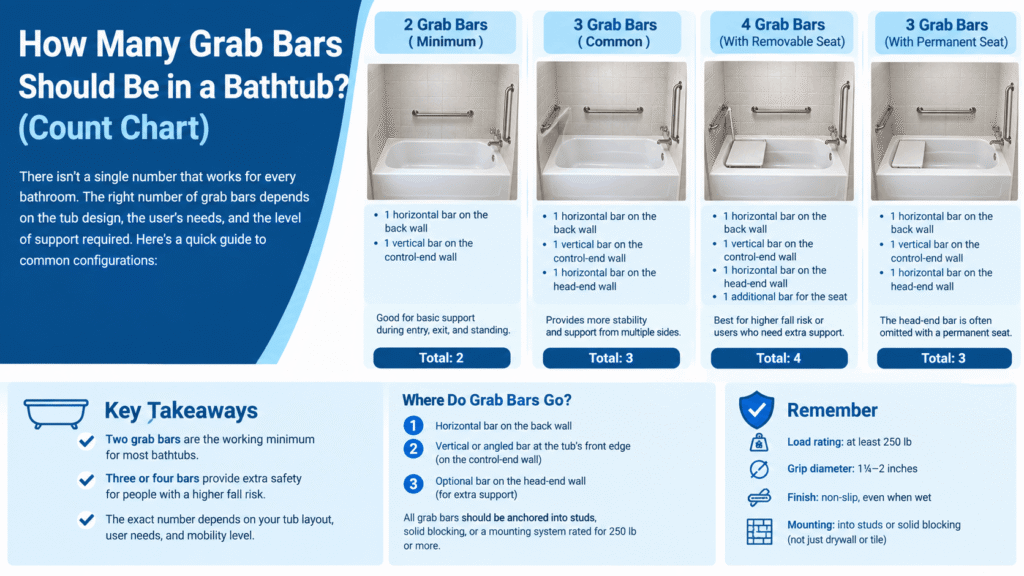
How Many Grab Bars Should Be in a Bathtub? Someone in your home is about to keep using a bathtub, and every product page and forum thread gives you a different number of grab bars. The answer is two at minimum, or three or four when balance or seated bathing is involved, and the chart below shows which wall each bar goes on.
Table of Contents
Quick Answer: A bathtub needs at least 2 grab bars: one horizontal bar on the long back wall and one vertical bar at the tub’s front edge, mounted into studs. Add a third for balance problems and a fourth for seated bathing; the ADA’s own tub layouts call for three to four. Horizontal bars mount 33–36 inches above the floor.
What You Need to Know
- Minimum: 2 bars. One horizontal on the back wall, one vertical where you step over the rim.
- 3 bars suit anyone who feels unsteady getting in or out.
- 4 bars suit seated bathing, transfers, or carer-assisted baths.
- Wall reinforcement matters more than the count. A bar must hold 250 pounds through the bar, fasteners, and wall together.
- Private homes aren’t legally bound to ADA numbers, but the ADA layouts are the best-tested reference.
How Many Grab Bars Should a Bathtub Have?
Two grab bars are a practical minimum for a bathtub, while three or four may provide additional support when a person has a higher risk of falling. Two bars can address the two key stages of bathing: stepping over the tub rim and maintaining stability while standing or moving inside the tub.
The U.S. Access Board’s accessible bathtub layouts show two grab bars on the back wall and one on the control-end wall. When a bathtub has a removable seat, an additional grab bar is shown on the head-end wall, bringing the total to four. For tubs with a permanent seat, the head-end bar is omitted, resulting in three bars. U.S. Access Board
You may see different recommendations online, such as two to three bars or two to four bars. These differences often reflect the bathtub design, the user’s needs, and the level of support required. The table below explains the common configurations more clearly.
Bathtub Grab Bar Count Chart
The right number depends on the tub type and on how the person bathes. Wall names are defined once here, so every bar is unambiguous:
- Back wall: the long wall along the tub.
- Control-end wall: the short wall with the faucet.
- Head-end wall: the short wall opposite the faucet.
- Front edge: the open side where you step over the rim.
| Tub type | Minimum (2 bars) | Recommended (3 bars) | Full support (4 bars) |
|---|---|---|---|
| Alcove tub or tub-shower combo (3 walls) | 1 horizontal on the back wall, 33–36″ above the floor. 1 vertical or angled bar on the control-end wall at the front edge. | Add 1 bar on the head-end wall at the front edge. | Add a second back-wall bar 8–10″ above the tub rim (the ADA’s lower bar), plus the head-end wall bar. |
| Freestanding tub (no adjacent wall) | 1 floor-mounted or tub-clamp bar at the entry side. 1 wall bar within reach of the step-out point, if a wall is nearby. | Add a second floor-mounted bar on the opposite side of the entry. | Consider a different tub type; the wall-mounted layouts above don’t apply. |
| Who it fits | Independent bather, no balance issues. | Older adults bathing alone, or occasional unsteadiness. | Seated bathing, bath seat transfers, post-surgery recovery, carer-assisted baths. |
The alcove rows follow the Access Board tub layouts, adapted for home use. The freestanding row is planning guidance rather than a code figure, because no standard gives a count for tubs without a wall.
Save or screenshot this Bathtub Grab Bar Count Chart. It covers how many bars, which wall, and what height for each tub type.
How to Pick Your Number in 3 Steps
- Ask how the person gets over the rim. If they need a hand free to steady themselves, start at 2 bars and add a third on the head-end wall.
- Ask whether they bathe while seated. A tub bench or bath seat moves you to 4 bars, including the lower back-wall bar 8–10 inches above the rim.
- Ask whether anyone else helps. A carer who stands outside the tub needs the front-edge bars clear and strong, so plan for 4 and add a wall bar outside the tub.
If the answers point to different numbers, use the higher one. An extra bar costs far less than a fall.
If You Can Only Install One Grab Bar, Which One?
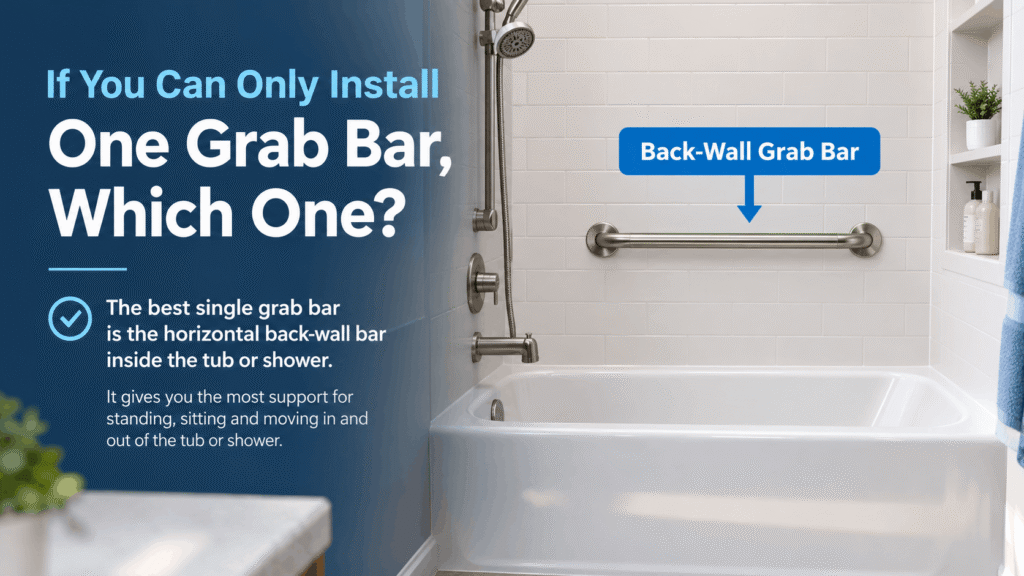
Choose a vertical bar at the point where you step over the tub rim. That’s the moment of highest fall risk, and a vertical bar works at any hand height.
There’s a counterintuitive twist here. The ADA Standards themselves don’t require a vertical bar at bathing fixtures, though the ICC A117.1 standard used in many building codes does, at a minimum length of 18 inches. Research suggests 18 inches is short. U.S. Access Board
A 2025 motion-capture study in JMIR Rehabilitation and Assistive Technologies tracked 28 adults over 65 and 37 adults aged 18–35 leaving a tub. Grasp points on vertical bars ranged from about 75 to 105 centimetres above the tub rim, which is roughly 30 to 41 inches. The researchers concluded that a 1-metre vertical bar in line with the tub rim would support most people. The participants were healthy adults without mobility aids, so treat this as a strong guide, not a rule for every user. JmirJmir
Read the full paper: Levine et al., JMIR Rehabilitation and Assistive Technologies, 2025.
Do I Need Grab Bars Inside and Outside the Tub?
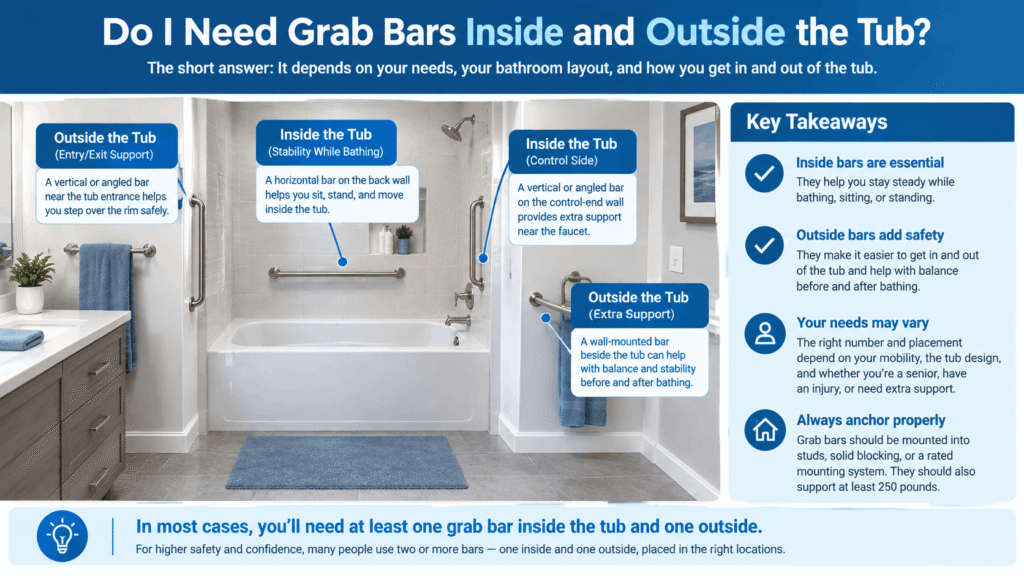
Yes, in most layouts you want support both at the rim and inside the tub. Each position covers a different task.
- At the front edge (outside or on the rim wall): steadies the step over the rim.
- On the back wall (inside): supports standing, turning, and sitting down.
- On the head-end wall: helps when rising from a seat or reaching the tub’s far end.
Where each bar sits on the wall is a placement question. Our bathtub grab bar placement guide walks through exact positions for each of these.
How Many Grab Bars for a Freestanding Tub?
A freestanding tub has no wall to mount to, so it needs floor-mounted or tub-clamp bars instead of wall bars. Wall-mounted counts from the chart don’t transfer directly.
Floor-mounted bars anchor to the floor structure. Tub-clamp bars grip the rim and need a rim that fits the clamp’s width range. Because these bars carry loads differently, follow the manufacturer’s weight rating and mounting limits.
Do Residential Bathtubs Need to Follow ADA Rules?
No. Private homes aren’t required to meet ADA standards, but the standards are the most tested numbers available. In fact, the Access Board notes that in dwelling units, grab bars aren’t required at tubs if walls are reinforced for later installation. Reinforcement is the legal minimum. The bars are up to you. U.S. Access Board
These are the specs professionals build to, from the U.S. Access Board:
| Spec | Requirement |
|---|---|
| Mounting height | 33–36 inches above the floor, measured to the top of the gripping surface |
| Lower tub back-wall bar | 8–10 inches above the tub rim |
| Strength | Must withstand 250 pounds at any point, including fasteners and supporting structure |
| Wall clearance | 1½ inches, an exact dimension meant to prevent entrapment |
For measuring technique, see our guide on how to measure bathtub grab bar height.
Sources: U.S. Access Board, ADA Chapter 6 and the Access Board’s bathing rooms guide.
Common Mistakes When Choosing How Many Grab Bars
The most common mistake is counting bars without checking what they’re bolted to. A bar screwed into drywall alone can fail on the first hard pull.
- Installing only one bar. One bar covers one moment. The rim step and the standing-up each need support.
- Using a towel bar as a grab bar. Towel bars aren’t rated for body weight.
- Mounting every bar at the same height regardless of the user. The 33–36 inch range is a starting point; adjust within it to the person’s height.
- Skipping the studs. Locate them first. Our guide on how to find studs for bathtub grab bars shows how.
- Ignoring a bar that has started to wobble. A loose bar is a warning. See why your bathtub grab bar is loose.
When to Call a Professional
Call a professional when studs aren’t where you need them or when the bather has limited mobility. An occupational therapist can watch how a person actually gets in and out, then recommend positions. A licensed installer can add blocking behind tub surrounds and tile.
This article is general information, not medical advice.
Once you’ve settled on a number, you’ll need bars rated for the load.
Frequently Asked Questions
Where should grab bars be placed in a bathtub?
A common setup includes a horizontal grab bar on the long back wall and a vertical or angled bar near the tub entry on the control-end wall. An additional bar on the head-end wall can provide extra support when needed. Grab bars should be securely attached to wall studs, solid blocking, or an appropriately rated mounting system. See our bathtub grab bar placement guide for a detailed look at each recommended position.
What is the recommended height for grab bars in a bathtub?
For a horizontal grab bar, a commonly referenced range is 33–36 inches above the finished floor, measured to the top of the gripping surface. A lower back-wall bar may be positioned 8–10 inches above the tub rim to provide support for people who bathe while seated. When selecting the final height, consider the needs and reach of the people who will regularly use the tub. U.S. Access Board
What is the best grab bar for a bathtub?
The right grab bar should be designed for bathroom use, have an appropriate load rating, and be compatible with the wall structure where it will be installed. A gripping diameter of approximately 1¼–2 inches is commonly used for accessible grab bars. Look for a product rated to support at least 250 pounds and choose a surface that remains easy to grip when wet.
How many grab bars should be in a bathroom?
There is no single number that works for every bathroom. A tub or shower may need multiple grab bars, while the toilet area can also benefit from bars on the rear and side walls. Additional support may be useful in other locations where a person needs help maintaining balance, such as near an entry point. The exact number should be based on the bathroom layout and the user’s mobility needs.
Do bathtubs legally need grab bars?
In private residential homes, grab bars are generally not automatically required at bathtubs under ADA standards. The U.S. Access Board’s residential guidance allows certain dwelling-unit bathrooms to be designed with reinforced walls so grab bars can be installed later. Public and commercial facilities are subject to different accessibility requirements. Adding proper wall reinforcement during construction can make a future grab-bar installation much easier. U.S. Access Board
Is one grab bar enough for a bathtub?
One properly installed grab bar can provide useful assistance, but it may not support every stage of getting into, using, and exiting the tub. A vertical bar near the tub entry can help with stepping over the rim, while a horizontal bar on the back wall can provide support for repositioning or standing inside the tub. Adding both locations can provide more continuous support.
Can I install grab bars in a tub surround without studs?
Do not rely on ordinary screws installed only into drywall or a thin tub surround. A properly installed grab bar and its mounting system need to withstand the required load. If a stud is not available at the desired location, use solid blocking or a mounting system specifically designed and rated for the installation. The surrounding tile or drywall alone should not be treated as sufficient structural support. Before drilling, learn how to find studs for bathtub grab bars. U.S. Access Board
What to Do Next
Once you know how many grab bars you may need, the next step is determining their exact locations, heights, and mounting points:
- Where should each bar go? Follow our bathtub grab bar placement guide.
- How high should each bar be? Use our guide to measure bathtub grab bar height.
- What should the bars be anchored to? Learn how to find studs for bathtub grab bars.