
Introduction
How an Old Bathtub Safer With Grab Bars Your bathtub was built for the person you were twenty years ago, and the first sign it no longer fits is usually a wobble on the way out. You don’t need a remodel to fix that. This guide shows you how to check your wall, place the bars, and anchor them so they hold.
Table of Contents
Quick Answer: To make an old bathtub safer with grab bars, check what is behind the wall, and mount a vertical bar at the tub entry and a horizontal bar on the long wall, 33–36 inches above the bathroom floor, into studs or solid blocking. If the wall can’t hold a bar, use a rated tub-rim clamp rail or hire a pro.
What You Need to Know
- The wall matters more than the bar. A perfectly placed bar fails if it is screwed into drywall or a thin fiberglass shell.
- Two bars cover most old tubs: a vertical bar at the entry and a horizontal bar on the long wall.
- 33–36 inches is the standard reference height, measured from the bathroom floor to the top of the bar.
- Suction-cup bars and towel bars are not grab bars. Neither is built to take a person’s weight.
- Plaster-and-lath walls, missing studs, and cracked tile are the points where a professional is the safer call.
How Do You Make an Old Bathtub Safer With Grab Bars?
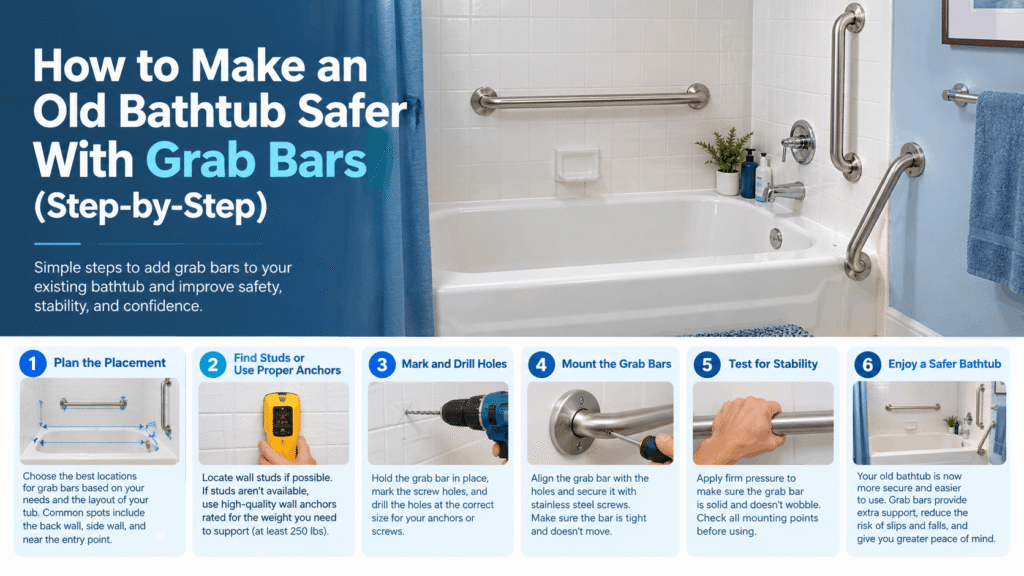
Work in this order: inspect the wall, find the studs, set the height, choose a rated bar, anchor it, and then load-test it. Skipping the first step is the most common reason bars fail.
- Watch where the hands actually go. Have the person step in and out of the tub while you note where they reach for the wall, faucet, or curtain rod. Those are your bar locations.
- Identify the wall type. Use the Old-Tub Wall Inspection Table below. It decides whether you can drill at all.
- Locate and mark the stud centers. Studs in most US homes sit 16 inches apart center to center and 24 inches in some. Mark each center with painter’s tape. Our guide on how to find studs for bathtub grab bars walks through the process.
- Set the height at 33–36 inches. Measure from the bathroom floor, not the tub bottom, to the top of the gripping surface. Adjust for the user: a shorter person may need the low end.
- Pick a bar with a 1¼–2 inch diameter. Choose a bar that is rated by its manufacturer for body weight, not a decorative towel bar.
- Anchor into studs and seal the holes. Use screws that reach the stud, and seal around the flanges with silicone so water can’t enter the wall. Let the sealant cure per the label; many silicones need around 24 hours.
- Load test before first use. Push and pull firmly with your body weight, then recheck after the first week. If it shifts, see why a bathtub grab bar gets loose.
Before You Drill: What Is Your Tub Wall Made Of?
Old tubs rarely have simple walls, so identify yours first. The wall type decides whether a bar can be drilled in, needs added blocking, or should be replaced by a clamp rail.
| Wall type | Main risk | Safest option |
|---|---|---|
| Tile over drywall or cement board, studs reachable | Cracked tile, water in the wall | Anchor into studs; use a tile-rated bit and seal the holes. |
| Fiberglass or acrylic surround | Thin shell flexes and cracks. | Anchor through the shell into a stud or blocking; otherwise, use a tub-rim clamp rail. |
| Tile over plaster and lath (older homes). | Crumbling plaster, studs hard to find | Professional assessment recommended |
| No stud where the bar must go | Anchors pulling out | Add blocking behind the wall, use a rim clamp, or call a pro. |
| Cast-iron or steel tub rim, no usable wall | Wrong clamp fit | Use a clamp rail rated for your rim thickness. |
| Freestanding tub | No adjacent wall | Floor-mounted or clamp-style bar |
Save or screenshot this Old-Tub Wall Check Table — it tells you what your wall can safely hold before you pick up a drill.
Where Is the Best Place to Put a Grab Bar in a Bathtub?
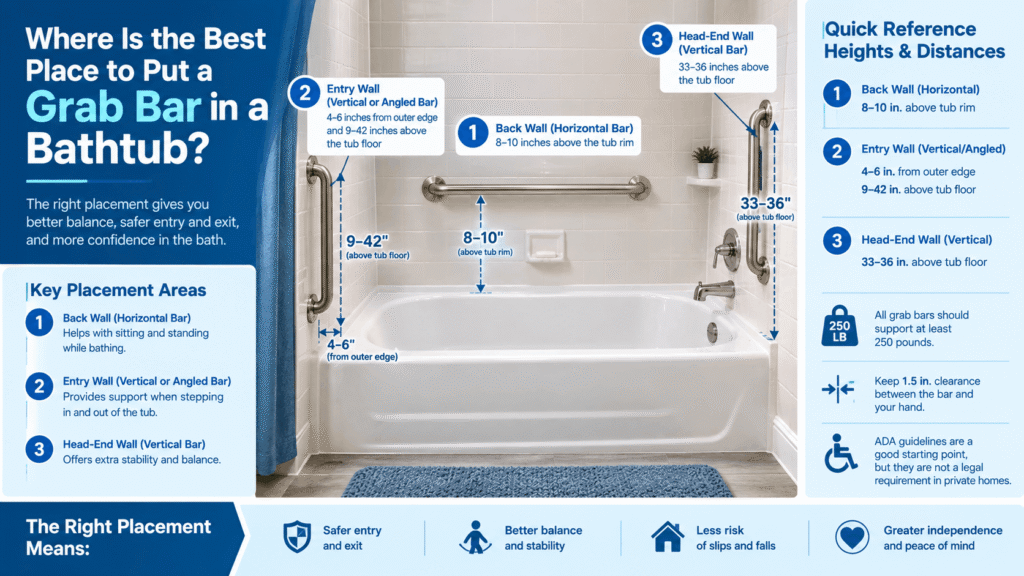
Put a vertical bar at the tub entry and a horizontal bar on the long wall. The entry is where most bathroom falls happen, because it is where a person lifts a leg over the rim.
The vertical bar goes just outside or at the edge of the tub, so a hand can grip it while stepping over. The horizontal bar goes on the long wall for balance while standing and washing.
The ADA standards set the reference heights. The U.S. Access Board’s 2010 ADA Standards, Chapter 6, specify 33–36 inches for the top of the gripping surface. Home bathrooms are not legally required to follow it, so fit the numbers to the person.
For exact positions, see our guide to bathtub grab bar placement. For the entry bar specifically, see bathtub entry grab bar placement and height.
How Many Grab Bars Does an Old Tub Need?
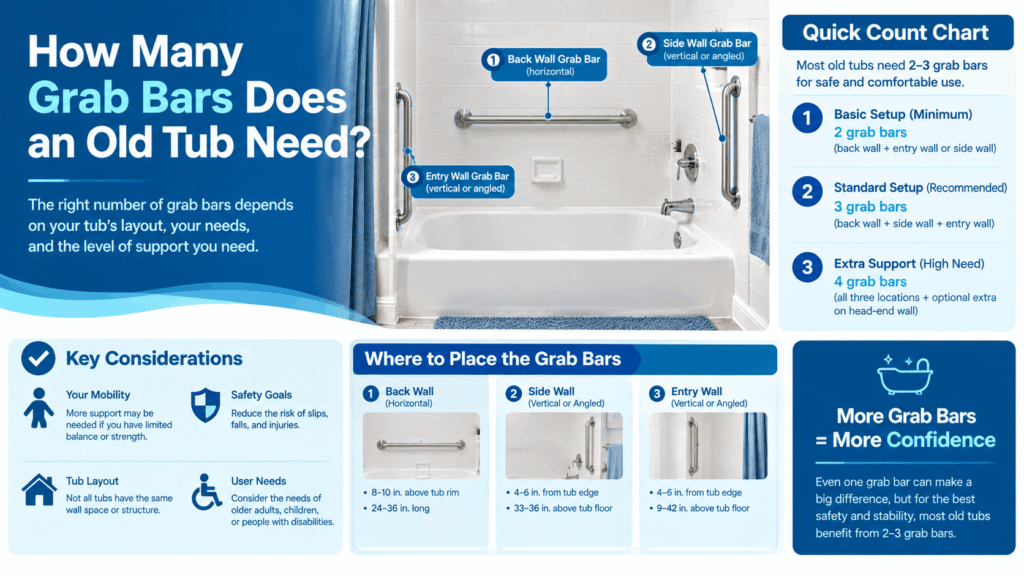
Two is the practical minimum, and a third on the back wall helps if the person turns or sits to wash. One bar alone leaves a gap at either entry or standing.
A single bar gives support at one moment of the bath only. Two bars cover entry and standing. Add a third if the person uses a shower seat or turns around often.
Our full breakdown is in how many grab bars a bathtub needs.
How Do You Anchor a Grab Bar in an Old Wall?
Anchor the bar into studs or solid blocking because anchors in hollow walls can fail under a sudden pull. A grab bar is most important during a slip, when the force placed on it can be highest.
A grab bar that meets ADA standards must resist a force of 250 pounds at any point along its length, according to the U.S. Access Board. Hollow-wall anchors alone rarely provide that level of support in a real-world wall.
Here is the part that catches many people: a stud finder may show you where a stud is, but the bar’s two mounting flanges may not both line up with studs that are 16 inches apart. Check the flange spacing against the marked stud centers before buying the bar.
If only one flange lines up with a stud, don’t improvise by using a toggle anchor for the other. Instead, choose a bar with different flange spacing, add blocking if the wall is open, or consider a properly rated clamp rail.
What Are the Alternatives to Grab Bars in a Tub?
The main alternatives are a clamp-on tub-rim rail, a transfer bench, and non-slip surfaces. None is a full substitute for a wall-mounted bar, but each helps when the wall can’t take one.
A tub-rim clamp rail is a bar that clamps onto the tub edge instead of the wall, used when the wall can’t be drilled. It is one of the few options for tubs with fragile walls. Check the rail’s maximum rim thickness against your tub and its rated load.
This is the one place a product earns a mention: a safety-rated clamp rail, chosen for the exact job of supporting entry when the wall can’t.
Other options:
- Transfer bench: lets a person sit and swing their legs over the rim instead of stepping.
- Non-slip tread or mat: reduces slipping underfoot, not support.
- Handheld showerhead: allows washing while seated.
A walk-in tub or a tub-to-shower conversion removes the step-over entirely, but it is a remodel, not a quick fix.
Are Tub Grab Bars Safe? Common Mistakes to Avoid
Tub grab bars can provide reliable support when they are properly rated, securely attached to strong backing, and positioned within a comfortable reach. Problems usually occur when the bar is installed or used incorrectly.
- Attaching the bar only to drywall: Drywall by itself may not provide enough strength to support a person’s weight during a slip.
- Using a towel bar for support: A towel bar is designed to hold towels, not to support someone’s body.
- Relying on suction-cup grab bars: Suction can weaken or release, especially when the surface is textured, wet, or covered with soap residue.
- Installing the bar at an unsuitable height: The commonly referenced 33–36-inch range should be considered alongside the user’s height, reach, and bathing setup.
- Installing only one support point: A single bar may not provide assistance throughout the different movements required to enter, exit, and use the
A less obvious detail: the standards call for a 1½-inch gap between the bar and the wall. That space is there so a hand can wrap fully around the bar, and mounting it tighter than that makes it harder to hold.
How Can I Make My Bathtub Safe for the Elderly Beyond Grab Bars?
Add Other Safety Features
Improve the tub area with better traction, lighting, and bathing support. A grab bar provides a secure handhold, but other hazards—such as slippery surfaces, limited visibility, and difficult transfers—can also increase the chance of a fall.
Consider adding these safety improvements:
- Non-slip tub protection: Use adhesive anti-slip strips or a suitable non-slip mat inside the bathtub.
- Secure flooring outside the tub: Choose a bath mat with a reliable non-slip backing to reduce movement on wet floors.
- Better nighttime Visibility: Install a night light along the route between the bedroom and bathroom.
- Easier bathing: A handheld showerhead can make bathing more convenient, while a shower seat or transfer bench can provide a stable place to sit.
When to Call a Professional Instead
Some bathtub safety upgrades are better left to a qualified professional. Call a professional if you cannot identify solid wall framing, the existing wall is damaged, plumbing or electrical lines may be behind the mounting area, or the grab bar cannot be securely attached to studs or proper blocking. Professional installation can also be a good choice when the bathtub requires structural changes or the user needs support beyond what a standard grab bar can safely provide
Free Printable Old-Tub Safety Checklist
A one-page checklist keeps you from skipping the steps that matter. The 10 points are:
- Wall type identified (see table)
- Stud centers marked
- Bar heights set (33–36 in)
- Bar diameter 1¼–2 in
- 1½ in wall clearance
- Rated hardware, no suction cups
- Screws reach studs.
- Holes sealed with silicone
- Load test done
- Recheck scheduled
If you want this as a printable one-pager, join the newsletter and we’ll send it with our other bathroom-safety guides. [EMAIL CAPTURE POINT]
FAQs
How can I make a bathtub safer for an older adult?
Start by adding a vertical grab bar near the tub entrance and a horizontal bar along the long wall. Fasten them to studs or properly installed blocking. You can also reduce slip risks with non-slip strips, improve visibility with a night light, and make bathing easier with a handheld showerhead. If the wall cannot provide secure support, consider a properly rated tub rail or transfer bench.
Where should a grab bar be installed in a bathtub?
A vertical grab bar is useful near the point where the user steps over the tub wall, while a horizontal bar along the long wall can provide support during bathing. A commonly referenced mounting range is 33–36 inches above the finished floor, but the final position should also suit the user’s height, reach, and bathing setup.
What can I use instead of grab bars in a tub or shower?
If permanent wall-mounted bars are not practical, options include a properly rated tub rail, transfer bench, shower seat, non-slip flooring products, and a handheld showerhead. For a larger accessibility change, a walk-in tub or tub-to-shower conversion can reduce or eliminate the need to step over a high tub wall.
Are bathtub grab bars safe to use?
A properly rated grab bar can provide reliable support when it is installed according to the manufacturer’s instructions and attached to suitable structural backing. Avoid treating towel bars as grab bars or relying on suction cups for body-weight support. Inspect the mounting hardware regularly and stop using the bar if you notice movement, looseness, or damage.
How many grab bars should a bathtub have?
There is no single number that works for every bathtub or user. Many setups benefit from a vertical bar near the entry and a horizontal bar along the long wall. A third bar may provide additional support on another wall, particularly when the user needs help turning, sitting, or standing. The number and placement should match the user’s movements and bathing needs.
Can a grab bar be installed on a fiberglass tub surround?
Yes, but the fiberglass surround itself should not be treated as the primary structural support. The mounting hardware needs to connect to a suitable stud, blocking, or other structural backing behind the surround. If secure backing cannot be confirmed, consider a properly rated tub rail or have the installation assessed by a qualified professional.
What to Do Next
After installing your bathtub grab bars, verify that each bar is positioned correctly and securely mounted. Then use these guides for more detailed placement information:
- Check our guide to bathtub grab bar placement for general positioning guidance.
- See our guide to bathtub entry grab bar placement and height for the entry area.