
Introduction
You’re standing at the edge of your tub with a drill, a pencil, and a bar, and the box doesn’t say how high it goes. The ADA publishes exact numbers for grab bars, and this page turns them into a chart you can read against your tub rim. bathtub grab bar height
Table of Contents
Quick Answer: Mount a bathtub grab bar 33 to 36 inches above the floor, measured to the top of the bar. If you install two bars on the tub’s back wall, set the second one 8 to 10 inches above the tub rim. These are ADA benchmarks, not home requirements, so adjust for the user’s reach.
What You Need to Know
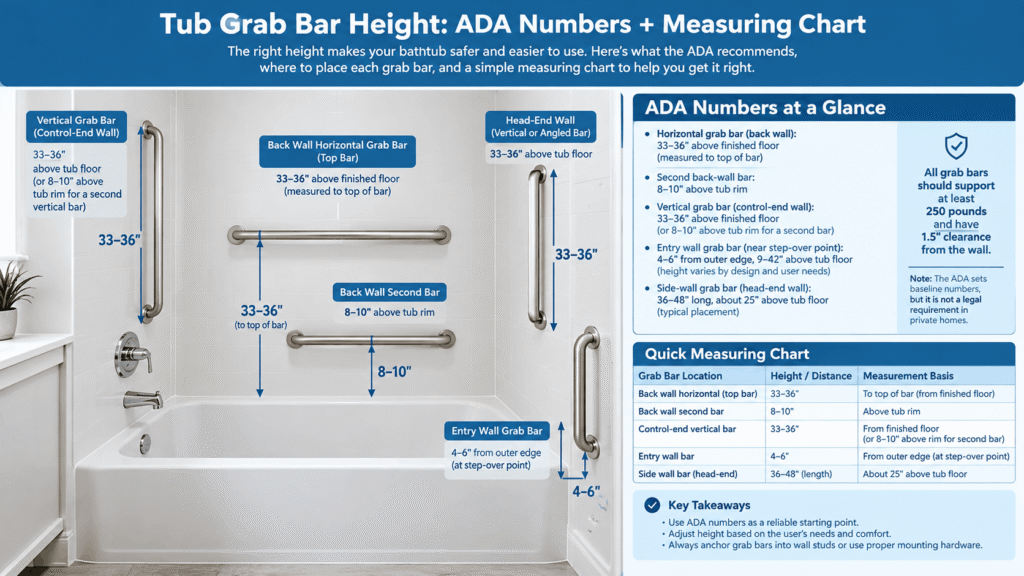
- The upper back-wall bar goes 33–36 inches above the finished floor, measured to the top of the bar.
- The lower back-wall bar goes 8–10 inches above the tub rim, which puts it below the upper bar.
- Each back-wall bar should be at least 24 inches long.
- The ADA does not require a vertical bar at a tub, so it sets no height for one.
- The bar and wall must hold 250 pounds. Screws into drywall alone will not work.
How High Should a Grab Bar Be in a Bathtub?
The standard answer is 33 to 36 inches above the floor for the upper bar, plus a second bar 8 to 10 inches above the rim. The 2010 ADA Standards set the 33–36 inch range, measured from the finished floor to the top of the gripping surface.
The ADA governs public and commercial buildings, so a private home isn’t bound by it. It remains the most tested benchmark available, which is why home guides copy it.
The CDC’s STEADI home checklist recommends grab bars next to and inside the tub for anyone who needs support getting in and out. Pair that advice with the ADA numbers, and you have a defensible starting point.
Do You Measure From the Floor or the Tub Rim?
Measure the upper bar from the floor and the lower bar from the tub rim. Mixing those two reference points is the most common source of a bar mounted at the wrong height.
Use this chart. Measure your rim from the floor outside the tub, then read across. The rim heights are examples, so check your own.
| Your tub rim (floor to top of rim) | Lower bar: rim + 8 to 10 in | Upper bar (from floor) |
|---|---|---|
| 14 in | 22–24 in | 33–36 in |
| 15 in | 23–25 in | 33–36 in |
| 16 in | 24–26 in | 33–36 in |
| 17 in | 25–27 in | 33–36 in |
| 18 in | 26–28 in | 33–36 in |
Save or screenshot this tub rim-to-bar height chart. It covers the one measurement most guides skip.
Worked example: a tub with a 15-inch rim. Aim the lower bar’s top at 24 inches (rim plus 9). Put the upper bar’s top at 34 inches. That leaves 10 inches between the two bars.
Aiming for the middle of the 8–10 inch range (9 inches) keeps you inside the allowed range even if your bar’s diameter shifts the measuring point by an inch.
Where Do the Two Back-Wall Bars Go?
Both bars run horizontally along the long back wall, and each should be at least 24 inches long. The ADA places them close to the ends of the tub so you can reach them from where you step in and where you stand.
For a tub without a permanent seat, which covers most home tubs, the Access Board’s bathing rooms guide puts each back-wall bar within 12 inches of the faucet end and within 24 inches of the head end. Tubs with a permanent seat use 15 inches at the head end instead.
| Bar | Height | Minimum length | Position |
|---|---|---|---|
| Upper back-wall bar | 33–36 in the above floor | 24 in | ≤12 in from the faucet end, ≤24 in from the head end |
| Lower back-wall bar | 8–10 in the above tub rim | 24 in | Same limits as the upper bar |
| Faucet-end wall bar | Per ADA guide | 24 in | Front edge of the tub |
| Head-end wall bar | Per ADA guide | 12 in | Front edge of the tub |
For the full layout, read the guide to bathtub grab bar placement.
The Access Board also states that the ADA Standards do not require a vertical grab bar at bathing fixtures. That means no federal number exists for a vertical bar at the tub entry. Test reach with the actual user instead.
Should Height Change for Tall, Short, or Seated Users?
Yes. The 33–36 inch range is a baseline, and the person using the tub should decide where inside or around it the bar goes. A taller user generally reaches more comfortably toward 36 inches, and a shorter user toward 33.
The lower bar serves the person sitting in the tub, since a bar at 33 inches is out of easy reach from the tub floor. Think of the two bars as covering two postures: standing and stepping, and sitting and rising.
Children and users with limited grip or balance may need custom heights. An occupational therapist can specify them for a specific person.
How Do You Mark the Height Before You Drill?
Mark both heights on the wall first, then test them with the person who will use the bar. A bar that is two inches off can’t be fixed without patching the tile.
- Measure the rim height. Run a tape from the finished floor outside the tub to the top of the rim. Write it down.
- Calculate the lower bar. Add 8 to 10 inches to the rim height. Aim for a rim plus 9 inches.
- Choose the upper bar. Pick a height between 33 and 36 inches, leaning toward 36 for taller users and 33 for shorter ones.
- Draw a level line. Use a level so the bar stays horizontal across the full 24 inches or more.
- Locate the studs. Mark the studs along the line. If you need help, see how to find studs for bathtub grab bars.
- Test the reach. Have the user stand, then sit, with a hand on the line. Adjust before drilling.
- Check clearances. The ADA wants 1½ inches between the wall and the bar, at least 12 inches above projecting objects such as soap dishes, and 1½ inches below and at the ends.
How Strong and How Far From the Wall Should the Bar Be?
The bar, its fasteners, and the wall behind it must withstand 250 pounds. Under ADA Section 609.8, that 250-pound force applies at any point on the bar, fastener, mounting device, or supporting structure.
The structural limit is usually the wall. Drywall alone can’t carry it, so anchor into studs or solid blocking.
A round bar should be 1¼ to 2 inches in diameter and sit 1½ inches off the wall, according to the Access Board. You can read the exact wording in the 2010 ADA Standards.
If no stud lines up with your marks, read about installing a bathtub grab bar without a stud. If an installed bar already moves, see why a bathtub grab bar feels loose.
What Is a Good Grab Bar for the Side of a Bathtub?
For the long wall, choose a wall-mounted horizontal bar rated for 250 pounds. A rating on the box and a stud behind the wall matter more than finish or style.
Some bars clamp onto the tub rim instead of mounting on the wall. They are a different product category, so the wall heights in this article don’t apply to them. Follow the manufacturer’s fit instructions and rated load.
What Mistakes Make a Grab Bar Height Wrong?
Most installation mistakes happen because the measurements are misunderstood, not because the drilling itself is difficult. One common source of confusion is the way the “upper” and “lower” bars are described.
The bar positioned 8 to 10 inches above the tub rim will typically sit about 22 to 28 inches above the finished floor. That places it below the bar installed at approximately 33 to 36 inches. However, some guides use “lower” and “upper” differently, which can make the instructions confusing.
Other mistakes to avoid include:
- Measuring from the bottom of the tub instead of from the finished floor outside the tub.
- Using a towel bar as if it were a grab bar. A towel bar is not designed to provide the same structural support, so understand the difference between a grab bar and a towel bar before relying on one for stability.
- Installing a grab bar without locating suitable studs or properly installing blocking behind the wall.
- Overlooking a soap dish, shelf, or other fixture that interferes with the required clearance around the grab bar.
- Assuming these measurements are automatically legal requirements for every residential bathroom. In a private home, they are generally used as accessibility and safety benchmarks rather than universal legal requirements.
Earlier ADA guidance specified the lower grab bar at 9 inches above the tub rim. Later guidance from the U.S. Access Board allowed a range of 8 to 10 inches, providing installers with some flexibility while maintaining the intended accessibility and usability.
When Should You Call a Professional?
Call one when the wall behind the tub is tile over unknown framing, no stud falls where you need one, or the user has complex mobility needs. A bar installed in the wrong place gives false confidence, which is more dangerous than no bar at all.
A licensed contractor can confirm anchoring. An occupational therapist can set heights for a specific person.
The CDC’s bathroom injury report found that getting out of tubs and showers and on and off toilets are the activities that most often lead to injury. It also says more research is needed on how effective grab bars are.
FAQs
At what height should a bathtub grab bar be mounted?
Under ADA guidance, a horizontal bar is typically placed 33 to 36 inches from the floor, measured to the top of the gripping surface. A second bar can run along the back wall roughly 8 to 10 inches above the edge of the tub. The ADA does not usually apply to private homes, but these figures are a handy accessibility benchmark.
Where should grab bars go in a bathtub?
A common layout uses two horizontal bars along the long back wall, each at least 24 inches long. They should support the bather along the tub while staying within the allowed distances from the tub ends. If the wall can take it, a third bar on the faucet-end wall adds more support. For a full layout, see our guide to bathtub grab bar placement.
Should a bathtub grab bar be straight or angled?
ADA bathtub requirements are based on horizontal bars. In a home, an angled bar can also work if it feels more natural to the person using it. Have the actual user test the grip position before installation. If the user has mobility or joint limitations, an occupational therapist can recommend the best setup.
Which grab bar type suits the side of a tub?
Many people choose a permanent, wall-mounted horizontal bar, anchored to suit the wall construction and the manufacturer’s instructions. Clamp-on bars that attach to the tub rim also exist, but their installation and load ratings differ. Always check the stated weight capacity first.
Does the ADA cover bathrooms in private homes?
In general, the ADA covers public accommodations and similar facilities, not ordinary private residences. Its measurements are therefore not legal requirements for a typical home, but they remain useful guidelines for a safer bathroom.
How long should bathtub grab bars be?
The ADA sets a 24-inch minimum for the bars in a bathtub installation. A longer bar gives more places to grip if the wall has room. Placement matters too: the bars must sit within the specified distances from the faucet end and head end of the tub, which vary with the tub layout and whether it has a built-in seat.
Is a vertical grab bar required at a bathtub?
The ADA does not universally require one. At home, though, a vertical bar near the tub entrance helps when stepping in and out. Choose its position based on the user’s reach, balance, and movement rather than one standard height.
What to do next
- Deciding where the bars should go? Read our guide to bathtub grab bar placement.
- Unsure where to anchor them? See how to find studs for bathtub grab bars.